Boann: Irish Goddess of the River Boyne
There was one well in Ireland nobody was allowed to look at. Boann walked up to it and circled it three times the wrong way.
The water came up out of the ground to answer her. It took an eye, a hand, and a leg, chased her all the way to the sea, and never went back. The river it left behind still runs through County Meath, and it still carries her name.
That is the whole of Boann. She is the goddess who became the Boyne, and the Boyne is the goddess with her body broken open into water.
Overview of Boann
Boann, also written Boand or Bóinn, is one of the Tuatha Dé Danann, the god-race of Irish myth who take their name from Danu. The genealogies make her a daughter of Delbáeth and a sister of Befind. Her husband is a water god named Nechtan, keeper of a secret well; a separate tradition marries her instead to Elcmar, lord of the Brú. Her lover is the Dagda, the chieftain of the gods, and their son is Aengus, the god of youth and love.
Her home is the Boyne Valley, and specifically Brú na Bóinne, “the mansion of the Boyne,” the great bend in the river where the Neolithic mounds of Newgrange, Knowth, and Dowth have stood for more than five thousand years. The myths treat those mounds as the palaces of the gods. Boann’s name is on the whole district.
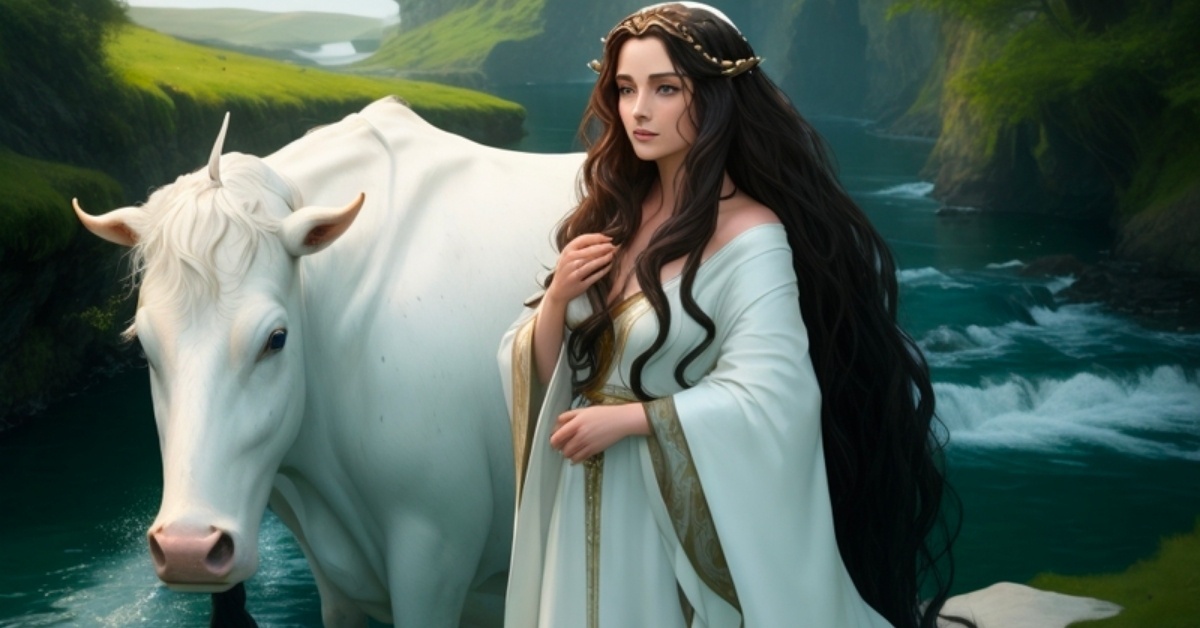
Her name means “white cow.” The Greek geographer Ptolemy recorded the river as Bouvinda in the second century, a name older than any surviving Irish story about her, and the Irish themselves glossed it as bó find, the white or shining cow. The Milky Way, in Irish, is Bealach na Bó Finne, the Way of the White Cow: the river below and the river of stars above share one goddess.
She is a goddess of water first. Through the well she came from, and the salmon and hazels that went with it, she is also a goddess of wisdom, poetry, and the kind of knowledge that costs something to get.
Titles
- Bóinn, Boand, Boand Find (“White Boand”)
- The White Cow
- Segais, her name in the Otherworld, from the well
- Wife of Nechtan
- Mother of the Mac Óc
The Dindshenchas, the medieval Irish “lore of places,” also gives the river itself a string of titles that double as hers: the Arm and Leg of Nuada’s Wife, the Great Silver Yoke, the White Marrow of Fedlimid, the River of the White Hazel.
Characteristics
The old texts describe what happened to Boann far more than they describe her. What we can say:
- A goddess with the whiteness of a cow’s hide or of foam, from her name
- Whole and beautiful before the well, and one-eyed, one-handed, and lame after it
- Bound to a river’s shape: a line of moving water from a spring in Kildare to the Irish Sea
- Attended by a small dog, Dabilla, who followed her to the end
Abilities
- River-making — her body and the Boyne are one thing; she is the river’s source, course, and mouth
- Wisdom by transgression — she sought the well’s knowledge and paid for it, becoming the channel it now flows through
- Fertility of land and cattle — the white cow and the river that waters the richest farmland in Ireland
- Poetic inspiration — the Boyne carries the imbas, the poet’s gift, downstream from the hazels of the well
Symbols
- The River Boyne — her body, her name, and her story in one
- The white cow — the meaning of her name, and the Milky Way’s name too
- The Well of Segais — the sacred spring, ringed by nine hazels, that she disturbed
- The hazelnut and the salmon — the nuts of wisdom dropping into the water and the fish that eats them
- Newgrange and the mounds of Brú na Bóinne — the house of the gods on her river
Traits
- Proud, and set on testing every limit herself before she believes in it
- Fearless in front of the divine, whatever the cost
- Clever, or at least clever enough to hide an affair from a god
- Ashamed of her mutilation, and quick to run from it
- Faithful to her small dog, and he to her
Festivals and Rituals
Boann’s oldest surviving shrine is a place rather than a date. Newgrange was built around 3200 BCE so that on the mornings around the winter solstice, sunlight enters a roof-box above the door and runs the length of the passage to the chamber. The Neolithic builders left no names behind, so the question of who they built it for stays open. The Irish who told Boann’s story two or three thousand years later gave the mound to her son Aengus, and modern readers of the myth often see the Dagda’s “sun standing still” as a memory of that solstice beam.
Today the Boyne Valley marks her in its own way. Boann has a place in the county’s heritage trail and its arts programs, the Milky Way is still photographed above the river under its old name, and the Púca Festival lights up the valley at Samhain each year. Her worship, in the old sense, is the river itself, which people still walk beside and drink from.
Legends associated with Boann
Boann has two great stories, and they are the same story from opposite ends. In one she breaks a rule to get at wisdom and becomes a river for it. In the other she breaks a rule to get at love and becomes a mother for it. Both times she gets exactly what she reached for, and the water takes the rest.
The Well of Segais
Under the hill called Síd Nechtain there was a well, and the well was the most dangerous thing in Ireland.
It belonged to Nechtan, son of Labraid, Boann’s husband. Nine hazel trees leaned over it, and their nuts fell into the water, and the speckled salmon that lived there ate the nuts and grew wise on them. Everything the Irish believed about knowledge came from that pool. The poets’ imbas, the flash of inspired sight, was said to rise from it like bubbles.
Only four people could go near it. Nechtan himself, and his three cup-bearers, Flesc, Lam, and Luam. Anyone else who looked into the well would have both eyes burst in their head. Anyone who moved carelessly around it would not walk away whole.
Boann went anyway.
The poem in the Dindshenchas is clear about why. Pride. She came to the water with no thirst to slake, to test the well’s power against her own, to prove that a rule made for other people had nothing to do with her. She walked around the well three times tuathal, against the sun, the direction that undoes things, and she did it heedlessly.
Three waves came up out of the ground. The first wave broke against her foot and took the leg. The second broke against her face and took her eye. The third shattered a hand. In a moment the most beautiful woman among the Tuatha Dé Danann was one-eyed, one-handed, and lame.
She ran. The poem says she fled so that no one would see her mutilation, and she ran for the sea, the one place big enough to hide in. The water followed her. It poured out of the síd behind her and chased her east across the plain, carving the ground as it went, and it did not stop until it reached the tide at Inber Colptha, where the Boyne meets the sea near Drogheda. There it drowned her. What it left behind was a river, and the river took her name.
Her lapdog Dabilla ran after her the whole way. The flood caught him at the coast and tore him in two, and the two halves became two rocks in the sea. The Irish called them Cnoc Dabilla. Sailors call them Rockabill today.
The Dindshenchas gives the river fifteen names on its journey from the well to the sea: Segais at the source, then the Arm and Leg of Nuada’s Wife, the Great Silver Yoke, the White Marrow of Fedlimid, the River of the White Hazel, and on through names it shares with the Severn, the Tiber, the Jordan, the Tigris, and the Euphrates. The poets were making a point. The river of Ireland was the river of the world.
The Dagda and the long day
The second story comes from Tochmarc Étaíne, “The Wooing of Étaín,” and it opens with a god who wants another god’s wife.
Here Boann’s husband is Elcmar of the Brú, the mound at Newgrange. The Dagda, Eochaid Ollathair, the “good god” and father of them all, wanted her. He is the god of plenty, owner of the cauldron that never empties and the club that kills at one end and revives at the other. He already had a famous liaison with the Morrígan behind him. Subtlety was never his gift. Elcmar’s power was strong enough that Boann could not simply go to him, though, so the Dagda arranged things.
He sent Elcmar on an errand to Bres, far away at Mag nInis. Then he worked spells on the traveler. He kept the darkness of night from falling on him. He kept hunger and thirst from him. And he stretched the day so that nine months passed for the rest of the world while Elcmar felt a single afternoon go by, certain he would be home “between day and night.”
In that long day the Dagda lay with Boann. She conceived, carried, and bore a son, and was up and recovered before her husband walked back through the door. Nobody told him.
She named the boy Aengus, “one desire,” and gave him the title that stuck: the Mac Óc, the Young Son. Her reason, in the tale’s own words: “Young is the son who was begotten at the break of day and born betwixt it and evening.” Conceived at dawn, born by dusk, and the sun never moved.
The child was fostered by Midir of Brí Léith and grew up not knowing whose son he was. When he found out, he went to the Dagda and was acknowledged, and then, with a trick worthy of both parents, he took the Brú itself. He asked Elcmar for the mound for “a day and a night.” In Irish that phrase also means “day and night,” always, and Aengus held him to the second meaning. The house of the Boyne passed from the cuckolded husband to the son of the affair.
Aengus grew into the god of love and youth, the one who dreamed of a girl and searched all Ireland for her, found her as a swan on a lake, and became a swan himself to fly away beside her. Her name was Caer. Boann’s grandchildren, in other words, are Ireland’s great love story.
One version of the well legend ties the two tales together. In it Boann goes to the well after her tryst with the Dagda, hoping its water can wash away what she has done. The well knows better. It rises and drowns her all the same.
Sinann and the other well
Boann has a double. Sinann, granddaughter of the sea god Manannán mac Lir, went to a well of wisdom too, the one called Connla’s Well, where the nine hazels of Crimall dropped their nuts to the salmon and seven streams ran out into the world. She went for the imbas, the poet’s knowledge. She was warned. The well rose, drowned her, and carried her body to the sea, and the river that followed her is the Shannon.
Two goddesses, two wells, two rivers, one plot. Whatever the Irish believed about their rivers, they believed it hard enough to tell it twice.
An older Boann?
The name is older than the story. A Greek geographer in Alexandria wrote down Bouvinda around 150 CE, centuries before any Irish scribe wrote a word about a well. Linguists trace it to Proto-Celtic *Bou-vindā, “white cow,” or “she of the shining cattle.” Cattle were wealth in Ireland, milk was life, and a white cow was the best of the herd. The name says the river was already a goddess, already a cow, already white, when Ptolemy’s informants first heard it.
That fits a pattern that runs right across the Celtic world. Rivers were goddesses. The Seine was Sequana, and at her source in Burgundy the Gauls built a sanctuary where pilgrims left around fifteen hundred votive offerings, many of them carved eyes, limbs, and organs, asking the water to heal what they had lost. A bronze Sequana was dug up there in 1933, standing in a boat shaped like a duck. The Marne was Matrona, “Divine Mother,” whose name survives in the Welsh Modron. The Shannon was Sinann. The Boyne was Boann. In every case the river and the goddess are one word, and the source of the river is the holy place.
The well at the center of her story belongs to a pattern too. Georges Dumézil argued in 1963 that Nechtan’s name is a cousin of the Roman Neptune and the Vedic Apám Napát, “child of the waters,” and that the tale of a forbidden well that lashes out at the one who approaches it is a shared Indo-European myth, older than Ireland. Under that reading the Boyne’s story was ancient before it was Irish. Scholars still argue over the details. The core of it, a spring guarded by a god and dropping wisdom into the water, is among the oldest ideas anyone has had.
Put it together and an earlier goddess comes into view: a white cow-goddess who was the river, whose source was a place of pilgrimage, and whose water carried knowledge. The medieval story of the proud wife and the punishing well is what Christian-era scribes did with her. It is a good story. She was there first.
Boann across cultures
Boann is one of a family of Irish goddesses who overlap at the edges. Brigid, daughter of the Dagda, is the goddess of poetry and the sacred flame, and the imbas that rises from Boann’s well is the same gift Brigid bestows. Ériu, Banba, and Fódla are the land itself; Boann is its water. Together they make an island where the ground and the rivers are all somebody.
Look further out and the drowned river-goddess turns up again and again. The Ganges is Ganga, who came down from heaven so hard that Shiva had to catch her in his hair or she would have shattered the earth. The Yoruba Oshun is the river that bears her name in Nigeria, a goddess of sweetness and fertility whose water is her body. In China the Luo River had its goddess Fufei, drowned in its waters and worshiped after. The story repeats: a woman becomes water, and the water becomes the life of a whole country.
What sets Boann apart is the price. Ganga descends in glory. Boann arrives broken, one-eyed and one-handed, running from what she has become. The Irish looked at their loveliest river and told a story about the cost of wanting to know.
Final thoughts
Every river has a source, and the Boyne’s is a woman who chose a forbidden well over the rule around it.
She was told the rule, she tested it, and the water made her into something larger and stranger than she had been. That is the bargain the Irish saw in their rivers: wisdom is real, it runs downhill to whoever will drink, and somebody paid for it first. Boann’s whole body is the receipt.
Stand on the bank at Newgrange in December, with the sun coming down the passage behind you and the river going past in front, and she is still there, in both directions at once.
Bibliography
- Gwynn, Edward, ed. and trans. “Boand I” and “Boand II,” The Metrical Dindshenchas, vol. 3. CELT: Corpus of Electronic Texts, University College Cork.
- Jones, Mary, trans. “The Wooing of Etain”. Celtic Literature Collective.
- “Boann”, “Wells in the Irish Dindsenchas”, and “Aengus”. Wikipedia.
- “Nechtan (mythology)” and “River Shannon”. Wikipedia.
- “Sequana” and “Dea Matrona”. Wikipedia.
- Dumézil, Georges. “Le puits de Nechtan.” Celtica 6 (1963).
- “Boann, Goddess of the Boyne”. Discover Boyne Valley.
- Murphy, Anthony. “The Milky Way in Irish Mythology and Folklore”. Mythical Ireland.
- Monaghan, Patricia. The Encyclopedia of Celtic Mythology and Folklore. Facts on File.
- MacKillop, James. A Dictionary of Celtic Mythology. Oxford University Press.