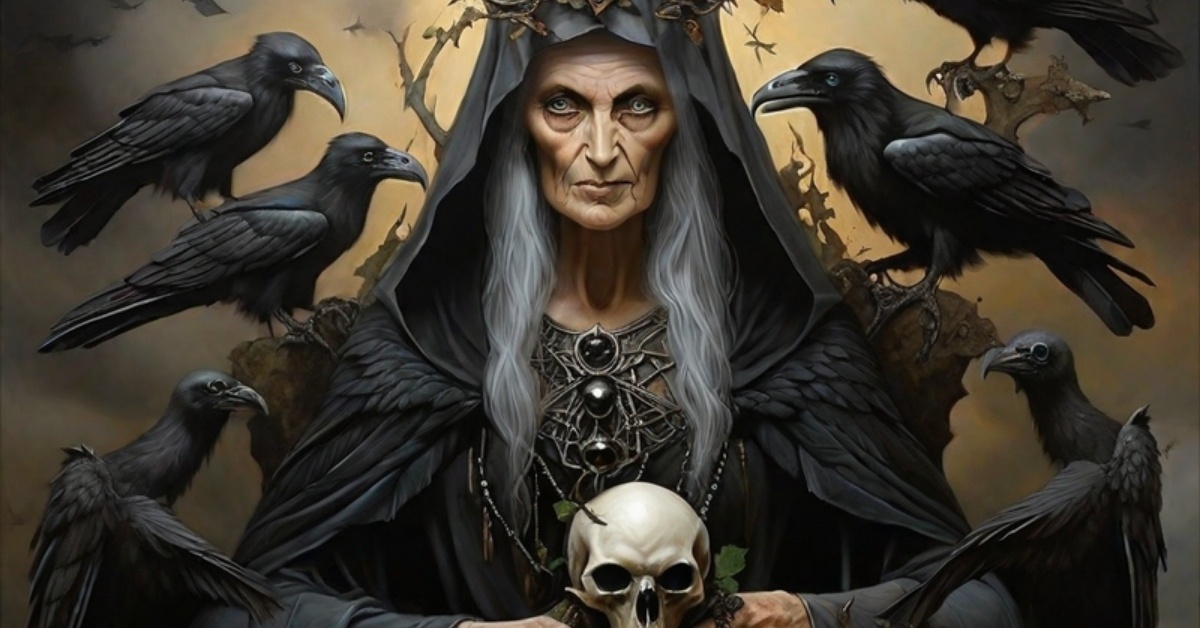
Badb: The Irish Battle-Crow Goddess
A hooded crow drops onto the roof-beam of a hall where a king sits feasting, and every man inside stops chewing.
In Irish story that bird has a name. She is Badb, the battle-crow, and she has come for the dying. Where she screams, warriors lose their nerve, run onto their own spears, and drop dead of fright before an enemy gets near them.
She is the Morrigan’s sister and the shape the war goddess wears once the killing starts. She’s also the voice that, when the field goes quiet, tells you what kind of world is coming next.
Overview of Badb
Badb belongs to the Tuatha Dé Danann, the god-race of Ireland and the people of the goddess Danu. The medieval Book of Invasions makes her a daughter of Ernmas and gives her two sisters in the trade of war, Macha and the Morrigan. Together the three are the Morrígna, and Irish writers could treat them as three sisters or as three names for one goddess without feeling any need to choose. The trinity gets its full telling in the post on the Morrigan. This one stays with the crow.
Her name is the plainest of the three. In Old Irish badb (or bodb) means a hooded crow, the gray-backed scavenger the Irish call the scald-crow, and by extension the war-fury the bird was thought to embody. The word was a common noun before it was a name. A medieval poet could write “a badb” and mean a crow, a battle-spirit, or a screaming woman on a battlefield, and count on his listeners hearing all three at once. When she turns up over an army she gets the epithet that stuck: Badb Catha, “battle-crow.”
The texts also give her a husband. Néit, an obscure war god of the Tuatha Dé, had two wives according to the Book of Invasions, “Badb and Nemain without falsehood,” and the title Bé Néit, “Néit’s wife,” passes between them. Nemain is the spirit of battle-panic, the thing that makes an army break, and later writers fold her into the trio so often that it’s easy to lose track of who is who. The sources keep the two apart, and the difference is useful. Nemain is the panic. Badb is the bird that brings it, and the voice that speaks afterward.
Her festival calendar is empty. Her stories are full.
Titles
- Badb Catha, “battle-crow,” her epithet on the field
- Bé Néit, “wife of Néit,” a title shared with Nemain
- Daughter of Ernmas
- One of the Morrígna, the three war-sisters of the Tuatha Dé Danann
- “A badb,” the common noun for a war-fury, used of her and of the beings like her
- The Badhbh, later “the Bow” or “the Bibe,” her name in the mouths of Leinster and Waterford farmers, where it came to mean the banshee
Characteristics
How the texts show her:
- A hooded crow, gray-backed and black-hooded, perched over a battle or on a roof-beam
- A tall woman whose shins are as long as a weaver’s beam, “as dark as the back of a stag-beetle,” with her mouth on one side of her head
- A red-mouthed woman with one eye closed and one foot raised, the posture of an Irish curse
- A lean, gray hag hopping and shrieking over a warrior’s head
- Three naked figures on the roof-tree of a doomed hall, blood jetting through them, “the ropes of their slaughter on their necks”
Abilities
- Battle-terror — her scream alone empties a camp of courage; men die of fright with no wound on them
- Prophecy — she foretells the peace after a war and the ruin at the end of the age, in the same hour
- The death-omen — she appears to a king or hero before the day he dies, and names it
- Weather-magic — with her sisters she pours mist, fire, and a rain of blood onto an enemy army
- The crow-shape — the form she is most often seen in, and the one that outlived the others
Symbols
- The hooded crow — her body, her name, and the bird that feeds on the field when she is finished
- The shriek — the sound of a battle turning, heard over the heads of the losing side
- The doorway at sunset — where she stands to be admitted, and where a king’s taboo breaks
- The rain of blood — her weather, sent down on the heads of the Fir Bolg
- The roof-beam — the perch from which she watches a feast that has already become a wake
Traits
- Impartial about the dying; her own side wins, and she still names its end
- Honest to the last line; her prophecies come true, the good and the unbearable alike
- Drawn to hostels, halls, and any room where a doomed man sits down to eat
- Loud where the Morrigan is cunning; she wins by fear where her sister wins by seduction
- Patient; she can wait a thousand years on a farmhouse roof
Festivals and Rituals
The monks who wrote her down kept the stories and dropped the rites, so no feast of Badb survives from pagan Ireland. What survives instead is the bird.
Her greatest scenes fall at Samhain, the feast of the dead at the turn of the Irish year, and modern devotees of the Morrígna keep that night for all three sisters. For the rest of the year the old Irish honored her the way you honor a thing you’d rather avoid: by watching the sky. A hooded crow calling over a house, or settling on its roof, was read as her, and the reading lasted. In Munster and south Leinster the word badhbh stopped meaning a goddess and became a local name for the banshee, the death-messenger who keens outside a family’s window on the night one of them is going to die. In Waterford she is “the Bibe,” in Wexford and Wicklow “the Bow,” and an Irish dictionary of 1819 defines her flatly as “a female fairy, phantom, or spectre.” Her worship, if that is the word for it, was the act of hearing a crow and going quiet.
Legends associated with Badb
Badb’s stories share one shape. A battle or a feast is about to happen, she arrives, and everyone present learns how it ends. The interest is in what she does with that knowledge, because she tells the truth every time and the truth is different every time.
Fire and blood over the Fir Bolg
Before the Tuatha Dé Danann fought the Fomorians, they had to take Ireland from the people who already held it, the Fir Bolg. That war was the First Battle of Moytura, and Badb opened it.
While the two armies were still gathering, “Badb and Macha and Morrigan went to the Knoll of the Taking of the Hostages, and to the Hill of Summoning of Hosts at Tara,” and from those two heights they sent their weather down onto the Fir Bolg camp: magic showers of sorcery, thick banks of mist, a furious rain of fire, and “a downpour of red blood from the air on the warriors’ heads.” The Fir Bolg got no rest and no sleep for three days and three nights. Then their own druids found an answer to it and the storm lifted, and the two sides met on the plain of Moytura with the Fir Bolg already worn thin.
The passage is short, and Badb’s name comes first in it. That order tells you what the storyteller thought she was for. Macha and the Morrigan have other business elsewhere in the cycle. Badb is the one you call when you want an army frightened before a sword is drawn.
The two prophecies at Moytura
The Second Battle of Moytura is the Morrigan’s great story, told in full in her post: the meeting with the Dagda at Samhain, the Fomorian king’s courage taken from him, the chant that broke the enemy and drove them into the sea. Badb steps forward after all that, when the corpses have been cleared, and the text gives her the last word.
The scribe handles the two sisters loosely here. The victory is proclaimed by “the Morrigan, daughter of Ernmas,” to the royal heights of Ireland and to the mouths of its rivers. Then the text adds, in Whitley Stokes’s translation, “And hence it is that Badb also describes high deeds. ‘Hast thou any tale?’ saith everyone to her then.” Two names, one mouth, and the medieval writer felt no need to sort them out.
What she says first is a blessing on the land the gods have just won:
Peace up to heaven,
Heaven down to earth,
Earth under heaven,
Strength in everyone,
A cup very full,
A fullness of honey,
Honour enough,
Summer in winter.
Read it out loud. It’s the sound of a country exhaling. Peace and plenty, mead in abundance, a cup full to the brim.
Then everyone asks whether she has any other tale, and she does:
I shall not see a world that will be dear to me.
Summer without flowers,
Kine will be without milk,
Women without modesty,
Men without valour,
Captures without a king.
Woods without mast,
Sea without produce.
Wrong judgments of old men,
False precedents of brehons,
Every man a betrayer,
Every boy a reaver.
Son will enter his father’s bed,
Father will enter his son’s bed.
An evil time!
Son will deceive his father,
Daughter will deceive her mother.
That is the end of the age. The land will fail, the law will fail, and the family will fail last and worst. It comes out of the same mouth as the blessing, in the same hour, and the text moves on from it without comment. This is Badb’s whole character in two poems: she was on the winning side, she blessed the victory, and she still told the winners exactly what their descendants would become. A goddess of war who only prophesied victories would be a flatterer, and nobody has ever accused a crow of flattery.
The woman at the door of Da Derga’s hostel
Conaire Mór was the best king Ireland ever had, and the story of his death is a long list of the rules he broke on the way to it.
His reign came with taboos, and one of them was that he must never let a lone woman into the house where he lodged after sunset. On the night he came to the hostel of Da Derga, with his enemies already gathering outside, a woman came to the door alone, after the sun had gone down. Her shins were as long as a weaver’s beam and as dark as a stag-beetle’s back. She wore a gray woolen mantle, her hair hung to her knees, and her mouth was on one side of her head. She leaned against the doorpost and cast an evil eye on the king and his young men.
Conaire asked her name. She gave him more than thirty, in a single breath, standing on one foot to recite them: Samain, Sinand, Seiscleand, and on and on, down through Níth and Némain, Badb, Blosc, and Bloár, to Mache, Méde, and Mod. Badb, Nemain, and Macha are all in the list. The Morrígna had come to the door as one woman.
He asked what she wanted. She wanted in. He reminded her of his taboo and offered to send food and a gift out to her. She answered that if the king of Ireland had no room in his house for one woman’s meal and bed, then someone with more generosity would provide them, and the shame of it did the rest. He let her in. She had already told him what she saw for him: that “neither fell nor flesh” of his would escape the place he had come to, “save what birds will bear away in their claws.” The hostel burned that night with Conaire inside it, and the birds were the same birds they always are.
The tale keeps one more image of her. Among the rooms of the hostel is one the text calls the Room of the Badbs, where three figures sit naked on the roof-tree, blood jetting through them and the ropes of their slaughter around their necks. The outlaws spying on the hall recognize them: they are present at every destruction, and any house they sit over is already lost. A related tale, the destruction of Da Choca’s hostel, sends its doomed prince past a red woman washing his harness at a ford and then has the poets warn that “the red-mouthed Badbs will cry around the house.” Wherever an Irish hall is about to burn, Badb is on the roof.
The Badb over the hosts
Her plainest work is on the battlefield, and the Irish kept describing it for six hundred years.
In the Táin, on the night Medb’s army camps at Mag Trego, a poet named Dubthach rants a prophecy of the slaughter Cú Chulainn is about to make of them. “Thereupon the Nemain, that is, the war-goddess, attacked them,” and it was, the text says dryly, “not the quietest of nights.” In the fuller version of the scene a hundred of Medb’s warriors die of terror where they lie, with no enemy in sight. And when Cú Chulainn himself dies, strapped to his standing stone, the crow that settles on his shoulder to tell his enemies it’s safe to approach is the Morrigan “and her sisters in the form of scald-crows.” Badb is one of the sisters, and the scald-crow is her bird.
The Battle of Magh Rath, a saga built around a real battle fought in the year 637, gives her a body: over a warrior’s head there hovers “a lean hag, quickly hopping,” shrieking as she goes. And the War of the Irish with the Foreigners, the twelfth-century account of Brian Boru’s last battle at Clontarf in 1014, four centuries into Christian Ireland, still puts a “wild, impetuous, precipitate, mad” badb over the armies, shrieking and fluttering above their heads while the Vikings and the Irish cut each other down. The monks who copied that text believed in one God. They also believed that a crow screamed over Clontarf, and they knew her name.
An older Badb?
Ireland gave Badb her stories. Her name was carved in stone on the Continent before any of them were written down.
In 1860 a broken altar came out of a field near Mieussy, in Haute-Savoie in the French Alps, in what had been the country of the Allobroges. Its left side is damaged, and the surviving text reads ATHVBODVAE AVG(VSTAE) SERVILIA TERENTIA V(OTVM) S(OLVIT) L(IBENS) M(ERITO): “To the august Athubodua, Servilia Terentia paid her vow willingly and deservedly.” The stone is cataloged as CIL XII 2571. A Roman citizen, a woman with a good Latin name, had paid for an altar to a goddess with a Gaulish one. Most scholars since Adolphe Pictet in 1868 have read the first letter as lost and restored the name as Cathubodua, from Gaulish catu-, “battle,” and bodua, “crow.” Battle-crow. Badb Catha, in the language the Irish word came from, on a stone seven hundred years older than the Irish manuscripts. W. M. Hennessy built his 1870 study of the Irish war goddess on that equation, and it is still the standard one.
The reading has its critics, and they deserve a hearing. Auguste Allmer, Jules Toutain, and Bernard Rémy have argued that nothing is missing, that Athubodua is the whole name, and that she was a local water goddess of the lake nearby. Noémie Beck, whose 2009 study of Celtic goddesses is the fullest recent treatment, thinks the stone is too damaged to rule the lost letter out, and she points to a second inscription that makes the crow harder to dismiss: an altar from Herbitzheim in Alsace, CIL XIII 4525, dedicated “to Victoria Cassibodua.” That name is cassi-, probably “strong” or “sacred,” plus the same bodua. A strong crow or a holy crow paired with the Roman goddess of victory looks like a war-crow by another name.
Under both names sits a root, Proto-Celtic bodwā, and philologists have argued for a century over which came first, the bird or the fight. Julius Pokorny and others link it to Old Norse böð and Old English beadu, both meaning “battle,” which would make Badb’s name a cousin of the word the Anglo-Saxons used for war. Hennessy thought the root meant rage or fury first and that the crow was a later picture of it. Pierre-Yves Lambert has proposed a different derivation, from a root meaning “to warn,” which would make her name mean “presage” and put the prophecies rather than the bird at her center. Xavier Delamarre adds a Germanic cousin: Baduhenna, a goddess with a sacred grove in Frisia, in whose name Tacitus records nine hundred Roman soldiers dying in the year 28.
Beck’s conclusion is measured, and it is the one to carry away. Three goddesses, in three Celtic-speaking regions, share the element “crow” and an association with battle, and that, she writes, “strongly suggests that the tradition of a war-goddess in the shape of a crow was extant in Celtic times.” The archaeology backs her. Greek and Roman writers, Pausanias, Aelian, and Silius Italicus among them, reported that Celtic warriors left their battle-dead for the carrion birds, and a third-century BC iron helmet from Ciumești in Romania is crowned with a bronze bird, read as a crow or raven, whose hinged wings flapped when its wearer ran. Whoever wore it wanted to look like the thing that comes after a battle. On this reading the Badb of the Irish texts is the last and best-recorded member of a family that once flew over battlefields from the Alps to the Atlantic, and the scribes of medieval Ireland were writing down a goddess the Gauls had been praying to for centuries.
Badb across cultures
A crow who screams over a battle and knows who will die in it turns out to be an idea a great many people had.
Her nearest relations are named above, on stones in France. Beyond them, the Norse imagined the valkyries, the “choosers of the slain,” riding over the field to pick who fell, and gave Odin two ravens who flew out each morning to see everything and tell him. The Greeks had the Keres, dark-winged spirits who swarmed a battle to drink the blood of the dying, and Homer puts one on the shield of Achilles, dragging a corpse by the feet through the fighting.
Within Ireland her other line runs through the death-messengers. The banshee who keens outside a house is the badhbh under a Christian name, and Clíodhna, the fairy queen of Munster, was remembered as the chief of them. And in the very text that gives Badb her prophecies, a different goddess invents the sound the banshee makes. When the Dagda’s daughter Brig, the Brigid of later tradition, loses her son Ruadán at Moytura, she comes to the field and keens for him, and the text says it was the first time keening was ever heard in Ireland. Badb screams to announce the killing. Brigid wails when it’s done. Between the two of them, the Irish had a goddess for every sound a battlefield makes.
Final thoughts
Every other goddess of war gets a weapon. Badb gets a voice, and she uses it twice.
The first time she tells you that you’re going to die, and she is right. The second time, after you have won, she tells you what your victory will turn into, and she is right about that too. She delivers both the same way, with neither mercy nor malice, because she is a crow and a crow reports what is on the ground. That is a stranger and more honest thing to worship than a goddess who promises victory, and it may be why the Irish kept her longer than any of her sisters, on farmhouse roofs and in the word for the banshee, a thousand years after they stopped praying to her.
Which leaves the question the text hangs over Moytura. The winners asked her for a tale and got the end of the world. Would you have asked?
Bibliography
- Stokes, Whitley, trans. “The Second Battle of Moytura”. Revue Celtique 12, 1891; via CELT, University College Cork.
- Gray, Elizabeth A., trans. Cath Maige Tuired: The Second Battle of Mag Tuired. Irish Texts Society, 1982; via CELT.
- Fraser, J., trans. “The First Battle of Moytura”. Ériu 8, 1916; via the Celtic Literature Collective.
- Stokes, Whitley, trans. The Destruction of Dá Derga’s Hostel. 1910; via Wikisource.
- “Bruiden Da Choca”. CODECS: Online Database and e-Resources for Celtic Studies.
- O’Rahilly, Cecile, trans. Táin Bó Cúailnge, Recension I. Dublin Institute for Advanced Studies, 1976; via CELT.
- “The Death of Cu Chulainn”. Celtic Literature Collective.
- Hennessy, W. M. The Ancient Irish Goddess of War. Revue Celtique 1, 1870.
- Beck, Noémie. Goddesses in Celtic Religion: Cult and Mythology, ch. “Divine Crows of War: Badb, Cathubodua and Cassibodua.” PhD thesis, Université Lumière Lyon 2, 2009.
- Todd, James Henthorn, ed. and trans. Cogadh Gaedhel re Gallaibh: The War of the Gaedhil with the Gaill. Rolls Series, 1867.
- Lysaght, Patricia. The Banshee: The Irish Death-Messenger. Roberts Rinehart, 1986.
- Wright, Gregory. “Badb”. Mythopedia.
- Jones, Mary. “Badb”. Jones’s Celtic Encyclopedia.
- “Badb”, “Cathubodua”, “Neit”, and “Baduhenna”. Wikipedia.