Proserpina: Roman Goddess of the Underworld and Spring
In 70 BC a lawyer asked a Roman jury to picture a lake.
Cicero was prosecuting Verres, the governor who had stripped Sicily bare, and in the middle of the charge sheet he stopped to describe a place near the town of Henna: deep still water, flowers in every direction, and a cave that went straight down into the dark. There, he told the court, the king of the dead drove up out of the ground and took her. The whole island belonged to her and her mother, and every Roman in the room had known the story since childhood.
Her name was Proserpina. She rules the underworld beside Dis Pater, comes back up to the fields each spring, and at Rome she was honored at an altar the city kept buried in the earth.
Overview of Proserpina
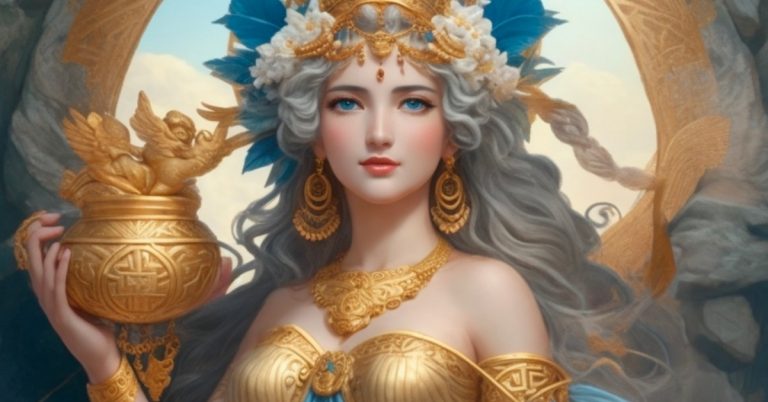
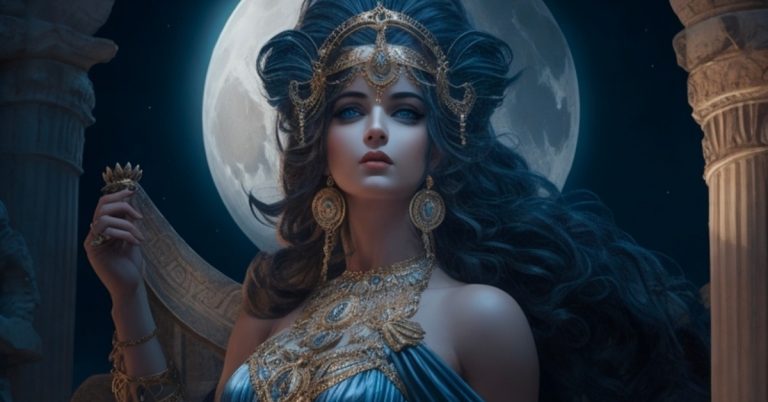
Proserpina is the daughter of Ceres, the Roman goddess of grain, and Jupiter, king of the gods. Her husband is Dis Pater, whom the poets also call Pluto and Orcus, the lord of the dead. Half the year she reigns beside him as queen of the underworld. The other half she walks in her mother’s fields, and the crops come up with her.
Greek readers will recognize Persephone, and the Romans made no secret of the borrowing. Their poets set the story in Greek-speaking Sicily and took its bones from Greek sources. But Proserpina had a Roman life of her own. She was matched with an old Italic goddess called Libera, honored on the Aventine Hill since the early Republic. She and her husband received the darkest sacrifices in the Roman calendar, black victims by night in the Campus Martius. And she turns up on the lead curse tablets that ordinary Romans buried in the ground, the goddess you addressed when you wanted an enemy handed over to the dead.
Her name puzzled the Romans themselves. The scholar Varro tied it to serpere, “to creep,” and proserpere, “to creep forward,” and explained that Proserpina was a name for the moon, which creeps across the sky now to the right, now to the left. Cicero preferred a farmer’s reading: Proserpina, he wrote, stands for the seed of the crops, hidden in the earth and sought by her mother. Modern scholars mostly treat the name as a Latin reshaping of Persephone, which probably arrived by way of the Etruscans, who painted her on their tomb walls as Phersipnai. The Romans heard the sprouting grain in it anyway.
Titles
- Queen of the Underworld
- Libera (“the Free One,” her old Italic name at Rome)
- Juno of the Underworld (Virgil’s Iuno inferna)
- Consort of Dis Pater
- Cruel Proserpina (Horace’s saeva Proserpina, whom no head escapes)
- Goddess of Spring and the sprouting grain
Characteristics
How Proserpina tends to appear in Roman art and poetry:
- A young woman, most often caught at the moment of the abduction, reaching back toward her companions
- Enthroned beside Dis Pater, crowned, in the dark
- Holding a torch, or two, the sign of the search and of her own light below
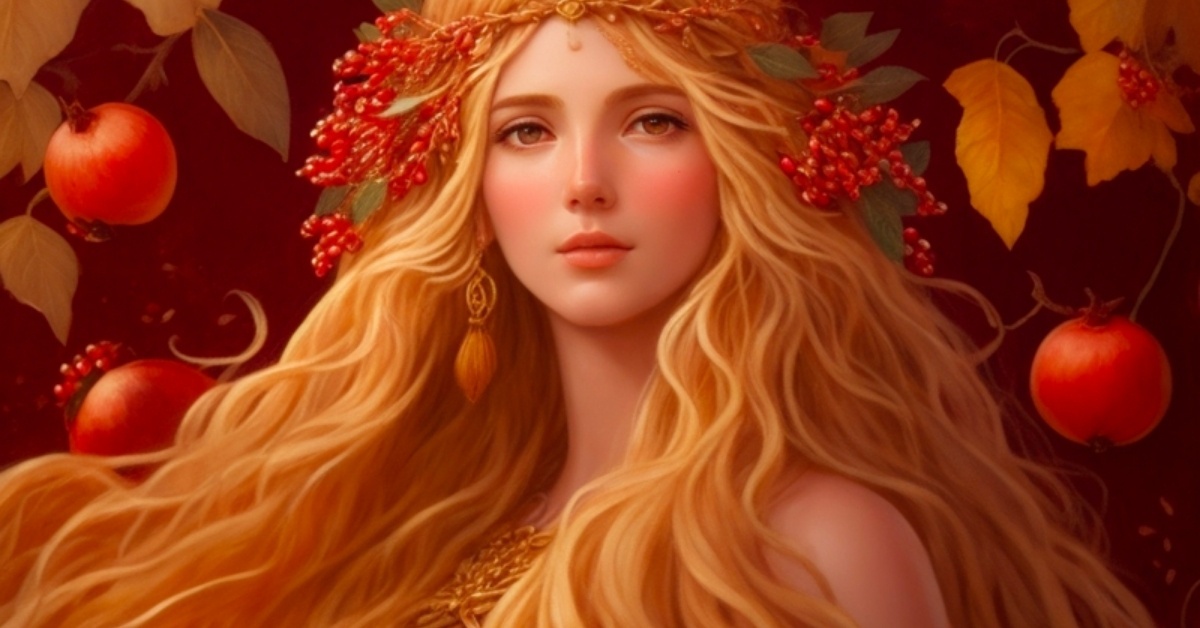
- Carrying a pomegranate, and sometimes a sheaf of wheat or a basket of the flowers she was picking
- In the Etruscan version, with snakes twisting in her hair
Abilities
- Rule of the dead — every soul below is her subject, and she decides who leaves
- The seasons — her going down empties the fields; her return fills them
- The sprouting grain — as Libera, the growth in the seed and the fruitfulness of women
- Claiming the dying — in Virgil it is Proserpina who cuts the lock of hair that frees a soul from its body
- Hearing curses — with Dis Pater, the power Romans called on to bind an enemy
Symbols
- The pomegranate — the seeds that made her queen of the dead
- The torch — Ceres’s search, lit at the fires of Etna
- Wheat and the seed — her mother’s grain, and the meaning Cicero found in her name
- The golden bough — the branch the living must bring her to enter her kingdom
- The flowers of Henna — violets, lilies, and poppies, the meadow she was taken from
- Black victims — the offerings made to her and Dis by night
Traits
- Changeable, as Ovid says: gloomy on the way down, radiant on the way up
- Formidable in her own kingdom, the queen the dead obey
- Reachable, on her terms, by music and by courtesy
- Territorial about what is hers, from seven seeds to Eurydice
- A daughter first; the story keeps her mother in every scene
Festivals and Rituals
Two calendars honored Proserpina at Rome, one bright and one dark.
The bright one belonged to her mother. The Cerealia ran from April 12 to 19, and Ovid tells us how to dress for it: white, and only white, on Ceres’s day. It closed with a strange rite in the Circus Maximus, foxes let loose with burning torches tied to their backs, which Ovid traces to a farm boy who once set the crops alight by burning a fox he had caught. There was also the Liberalia on March 17 for Liber, and Libera was probably honored alongside him. And from the late third century BC, Roman matrons kept a Greek-style rite for Ceres and Proserpina, the sacrum anniversarium Cereris, led by priestesses brought up from the Greek towns of Naples and Velia and given Roman citizenship for the job. Cicero says the whole ceremony ran in Greek. The women fasted and reenacted the mother’s search for the daughter.
The dark one belonged to her husband. In the Campus Martius, at a place called the Tarentum, stood an altar to Dis Pater and Proserpina that the Romans kept underground and uncovered only for the occasion. In 249 BC, with the First Punic War going badly and the omens worse, the Senate consulted the Sibylline Books and was told to hold games there: three nights of sacrifice, a black bull for him and a black cow for her, for the two rulers of the dead. Those were the Ludi Tarentini, held again in 146 BC, and they grew into the Secular Games that marked the turning of an age.
And there was Henna itself. After the murder of Tiberius Gracchus in 133 BC, the Sibylline Books demanded that “the most ancient Ceres” be appeased, and Rome sent its priests to Sicily, to the lake and the cave, to go, as Cicero put it, into the presence of the goddess herself. Rome’s grain goddess still lived where she had lost her daughter.
Legends associated with Proserpina
Proserpina has one great story, and the Romans told it three ways: in Ovid’s Metamorphoses, in his Fasti, and four centuries later in Claudian’s unfinished epic, The Rape of Proserpina. Each poet moved the furniture. Together they are the Roman version.
Venus reaches into the dark
Ovid begins in heaven, and with a grudge.
Venus was sitting on Mount Eryx in Sicily when she saw Dis, lord of the dead, driving his chariot across the island. An earthquake had shaken the giant Typhoeus buried under Sicily, and the king below had come up to check that the ground still held and kept the daylight out of his kingdom. Venus turned to her son. Heaven was hers, she told Cupid, and the sea was hers. The third kingdom alone still stood outside the reach of his arrows. Worse, a fashion for virginity was spreading among the goddesses: Pallas and Diana had escaped her, and now Ceres’s daughter looked set to do the same. So Cupid picked his sharpest arrow, bent the bow against his knee, and shot the king of the dead through the heart.
That is the Roman motive. In the Greek hymn, Zeus arranges the match with his brother. In Ovid, the god of the dead falls in love because the goddess of love wanted a bigger empire.
The meadow at Henna
Near the walls of Henna, in the middle of Sicily, lies a lake called Pergusa. Ovid describes woods all around it, a canopy that kept off the sun, cool damp ground, and flowers in every color. He says it was spring there all year.
Proserpina was playing in that meadow with her friends, filling her lap and her basket with violets and white lilies, trying to gather more than any of the other girls. In the Fasti Ovid gives the whole bouquet: marigolds, violets, poppies, hyacinth, amaranth, thyme, cornflowers, clover, roses, crocus, and lilies. She had wandered a little way from the others, the way you do when the best flowers are always one step further on.
Dis saw her, loved her, and took her in nearly the same instant. Ovid says so almost in those words, and adds: “so swift is love.” She screamed for her mother and her friends, the flowers spilled out of the torn edge of her dress, and she wept for the flowers too, which is the detail everyone remembers. Then the black horses were running, the chariot flying over the deep pools and sulfur springs of Sicily, heading for the bay of Syracuse.
There a nymph tried to stop him. Cyane rose waist-deep from her pool and stretched her arms across the way. “She should have been asked,” she said. Cyane’s own husband, the river Anapis, had won her by asking. Dis answered with his scepter. He hurled his royal scepter into the bottom of her pool, the earth opened, and the chariot plunged down the road it made. Cyane wept for the girl and for her own violated waters until she dissolved into them, bones softening, limbs thinning to nothing, and became the pool she had guarded.
Cicero told the jury that the Sicilians could still show you the spot where the ground closed, and that the people held a festival there every year.
Ceres with two torches
Ceres searched the world. Ovid says there was no land and no sea she left out. At Etna she lit two pine trunks in the crater and carried them through the nights, one in each hand, and kept them burning through the days.
Small stories cling to the search. Worn out and thirsty, she knocked at a cottage door, and an old woman brought her a sweet barley drink. While she drank it, a rude boy laughed at her and called her greedy. She threw the rest of the drink in his face, and he shrank into a spotted lizard, the stellio, which still hides from people, ashamed. In the Fasti the search takes her to Eleusis in Greece, where an old farmer named Celeus takes her in, and she tries to make his sickly son Triptolemus immortal by laying him in the embers. The boy’s mother screams, the spell breaks, and Ceres settles for a different gift. Triptolemus, she says, will be the first man to plow, and sow, and reap.
Back in Sicily she found Cyane’s pool, but Cyane was water now. What the nymph could still do was float up the girl’s sash, which had fallen in the water. Ceres knew it at once. She tore her hair, and she turned on the island that had let this happen. She broke the plows, struck down the oxen and the farmers, ordered the fields to fail, and spoiled the seed. The island she had loved above every other land became a desert.
Then another nymph spoke. Arethusa, who had fled under the earth all the way from Greece to rise again in Sicily, told Ceres what she had seen on her passage through the underworld: her daughter, still frightened, “but a queen, the greatest in that world of darkness, the powerful consort of the king of hell.”
In the Greek telling it is Hecate who hears the girl’s cry and Helios who names the culprit. Ovid gives those jobs to Arethusa and, in the Fasti, to the Sun. Rome’s Ceres learns the truth from water.
Seven seeds, or three
Ceres went straight to Jupiter, and Ovid lets her argue like a mother. If the word “mother” means nothing to you, she says, remember at least that she is your daughter too. Jupiter’s answer is a shrug. The girl has come to no harm, he says; a king of the dead is no bad son-in-law, and he is Jupiter’s own brother besides. Still, if Ceres insists, Proserpina may come home, on one condition: she must have eaten nothing in the underworld. So the Fates decreed.
She had eaten. Wandering in the gardens below, she had picked a pomegranate from a bending branch, peeled back the pale rind, and swallowed seven seeds. Only one creature saw her, Ascalaphus, son of a nymph of the underworld river, and he told. Proserpina’s answer was her first act as a queen. She flung water from the Phlegethon in his face and turned him into a screech owl, the bird of ill omen, so that every mortal who hears one is hearing her verdict.
Jupiter split the difference. He divided the year in two, and Proserpina became a goddess of two kingdoms, spending “so many months with her mother, so many months with her husband.” Her whole manner changed with the crossing, Ovid says. A face that had been sad even to Dis brightened at the surface like the sun coming out from behind rain clouds.
The Fasti counts differently. There Proserpina ate three seeds, Jupiter ruled that she would spend six months in heaven and six below, and Ceres at last put her face and her heart back on. Seven seeds and three are both Ovid. Even one poet, telling the story twice, gave two answers.
Claudian’s Proserpina
Four hundred years after Ovid, when Rome’s poets were writing for a Christian court, an Alexandrian-born Latin poet named Claudian went back to the story and made it enormous. De raptu Proserpinae, written around AD 395 to 397, runs to three books and stops mid-scene. What survives is the most vivid Roman telling of all.
Claudian starts in hell, with a grievance. Every other god has a wife and children; Pluto rules a kingdom of shadows alone. He threatens war on heaven, and he means it: the Furies, the monsters, the Titans in their chains, all of it loosed on the upper world unless Jupiter gives him a bride. Lachesis, the Fate, begs him to send an embassy first, and Mercury carries his demand to Olympus. Jupiter agrees, and picks the bride himself: Ceres’s only daughter.
Ceres, meanwhile, has done everything a mother could. She turned down Mars and Apollo as suitors and hid the girl in a house in Sicily under the guard of Etna itself. Proserpina passes the time weaving a tapestry for her mother, and the tapestry is the whole cosmos: the elements settling into their places, the stars, the sun and moon, the sea. She is working on the ocean when the doors open and three goddesses walk in. Venus, Pallas, and Diana, sent by Jupiter to lure her out. She leaves the sea unfinished.
Venus, whose part in this is the cruelest, talks her into a walk. In a meadow beneath Etna the girls compete for flowers, Proserpina in the lead, and then the earth splits. Pluto’s chariot comes up out of it. Pallas raises her Gorgon shield and Diana strings her bow, and for a moment two goddesses fight the lord of the dead, until Jupiter thunders and they lower their weapons. Proserpina cries for her mother as the horses go down, and Claudian gives Pluto a long, strange speech of comfort in reply. The light is still hers, he tells her, only different. He has stars of his own below, and a purer sun. Every king on earth will end up her subject. The golden apples are hers. Then the underworld throws a wedding. The Furies wear garlands, Cerberus goes quiet, the wheel of Ixion stops, and the dead are told, for one night, to rejoice.
The third book belongs to Ceres. Jupiter forbids the gods to tell her anything. She dreams her daughter is in chains. She flies home to Sicily and finds the loom, the unfinished web, the door standing open, and the old nurse Electra, who tells her everything. Then she climbs Etna, tears up two cypresses by the roots, lights them in the crater, and sets out.
That is where the manuscript ends. Claudian’s Ceres is still walking with her torches. Whether he stopped writing or the rest was lost stays an open question.
Queen of the dead at Rome
Outside the abduction, Proserpina appears in Roman poetry as a fixed point: the queen you must satisfy before you enter or leave her kingdom.
Virgil’s Aeneas may go down only once he finds the golden bough, which grows in a dark grove sacred to “the underworld’s Juno,” and which “lovely Proserpine has commanded to be brought to her as a gift.” The Sibyl who guides him serves Trivia, the Roman Hecate, at the grove of Avernus. Aeneas sets the bough on Proserpina’s threshold before he may pass. Earlier in the same poem Dido lies on her pyre, caught between living and dying, because Proserpina has yet to take the golden lock from her head, and Juno has to send Iris down to cut it in her place. In Virgil’s Rome, a soul leaves its body only when the queen of the dead takes her token.
She can be persuaded. In the Georgics Orpheus sings his way down, and it is under a law Proserpina “had ordained” that Eurydice follows him up, on the condition he then breaks. In Apuleius, Venus sends the girl Psyche into the underworld with a jar to beg one day’s worth of Proserpina’s beauty. The queen receives her courteously and fills the jar, and what she puts in it is Stygian sleep. Horace is blunter. In one ode the poet lists the ways the young and the old die together and ends with the line the Romans remembered: no head escapes cruel Proserpina.
And below the poetry there are the lead tablets. Romans who wanted an enemy destroyed wrote the curse on a thin sheet of lead, rolled it up, and buried it in a grave or a well, addressed to the powers below. Dis Pater and Proserpina head the list on many of them. The girl from the meadow had become the goddess you sent your worst wishes to.
An older Proserpina?
The name Proserpina was laid over an older Italic goddess who had nothing to do with any kidnapping.
On the Aventine Hill, since 493 BC, stood a temple dedicated to three gods together: Ceres, Liber, and Libera. The story goes that a dictator vowed it during a famine, and it was dedicated in the year the common people of Rome, the plebs, won their first political rights by threatening to walk out of the city. The Aventine temple became their temple. Its gods, an Italic trio of grain, wine, and growth, were the patrons of the plebs, and the Senate’s decrees were kept there under their protection. Libera in this triad was an Italic goddess of fertility and increase, the feminine half of Liber Pater, and Cicero notes that Romans still spoke of the pair as Ceres’s children, liberi.
That is the goddess Proserpina was fitted onto. Toward the end of the Second Punic War, around 205 BC, Rome adopted a Greek-style rite for Ceres and her daughter, brought its priestesses up from Naples and Velia, and from then on Libera and Proserpina were treated as one goddess in official cult. Cicero, sixty years later, uses both names in one breath: “Libera, whom they also call Proserpina.” Whether Libera had always been a maiden-daughter, or was an independent goddess of growth who acquired a Greek biography, is a question the sources leave open. Some scholars read the Aventine Libera as a genuine Italic figure, older than any story about a kidnapping. Others think the triad was Greek-inspired from the start, modeled on Demeter, Dionysus, and Kore in the Greek cities of southern Italy, where the sanctuary of Persephone at Locri was already the most famous in Italy. Both readings are live.
The dark Proserpina arrived by a separate road. The altar of Dis Pater and Proserpina in the Campus Martius came with its own foundation story, which Valerius Maximus tells. A Sabine named Valesius, whose three children were sick with fever, was told by a voice to carry them to the Tarentum on the Tiber. Warm water from the river cured them, and in their sleep the children were told to sacrifice black victims to Dis Pater and Proserpina. When Valesius dug to build the altar, he struck one already in the ground, twenty feet down, inscribed to the two of them. He held three nights of games for his three children. The historical record starts in 249 BC, when the Sibylline Books, Rome’s Greek oracle, ordered games at that same altar. This was a cult imported by decree, in wartime, from Greek sources, and it stayed Greek in feel: black victims, night sacrifices, an altar kept underground. When Augustus revived the Secular Games in 17 BC, he took Dis and Proserpina off the program and gave their nights to the Fates, the goddesses of childbirth, and Mother Earth. By then the Republic the underworld couple had been called in to save was gone, and so were they.
The name is the last thread. The Romans heard proserpere in it, the creeping-forward of a shoot out of the soil, and Varro and Cicero both wrote as if that were the whole story. Modern scholarship takes the name as a Latin reworking of Persephone, most likely by way of the Etruscans, who called her Phersipnai and painted her enthroned beside her husband Aita, snakes in her hair, in the Tomb of Orcus at Tarquinia. So underneath the Roman Proserpina there are at least three things: an Italic Libera of the growing seed, a Greek queen of the dead brought up from the south, and an Etruscan name in between. The Romans folded them into one goddess and left the seams showing.
Proserpina across cultures
The Roman goddess sits at the center of a family of underworld queens, and the resemblances run in every direction.
Her Greek twin is Persephone, whose story the Romans took over wholesale and whose mysteries at Eleusis they traveled to join; Hadrian and Marcus Aurelius were both initiated there. The Etruscan Phersipnai, enthroned beside Aita at Tarquinia and Orvieto, is the same goddess seen through Etruscan eyes, and probably the channel through which her name reached Latin. Farther off, Sumer’s Ereshkigal ruled the dead as an absolute queen long before either of them, and the Norse Hel, half living flesh and half corpse, kept a cold hall of her own. What is distinctly Roman about Proserpina is the paperwork: a temple date, a Senate decree, a citizenship grant for her priestesses, and a jury told exactly where on the map she was taken.
Final thoughts
In Rome’s Galleria Borghese there is a marble Proserpina whose thigh dents under Pluto’s fingers. Bernini carved it in 1621, and people still stand in front of it and wince, because he made the stone give like skin.
That is the Roman way with this goddess. The Greeks kept her mystery; the Romans kept her place, her date, and her detail. They knew which lake, which cave, and how many seeds, and they were happy to give two different answers to the last one. They dressed in white for her mother’s festival and sacrificed black bulls in the dark for her husband, and they wrote her name on the curse tablets and on the sprouting grain in the same breath.
She is the goddess of the thing that goes under and comes back. Every Roman farmer watched her do it once a year.
Which Proserpina do you find yourself believing in: Ovid’s homesick girl, Claudian’s queen who is promised the dead, or Cicero’s local goddess with a lake you can still visit?
Bibliography
- Ovid. Metamorphoses, Book V (the rape of Proserpina, Cyane, Arethusa, Ascalaphus). Trans. A. S. Kline, Poetry in Translation.
- Ovid. Fasti, Book IV (the Cerealia and the abduction). Trans. A. S. Kline, Poetry in Translation.
- Claudian. The Rape of Proserpine. Trans. Maurice Platnauer, Loeb ed., Theoi Classical Texts Library; also on Project Gutenberg.
- Virgil. Aeneid, Book IV (Dido’s lock) and Book VI (the golden bough). Trans. A. S. Kline, Poetry in Translation.
- Virgil. Georgics, Book IV (Orpheus and Eurydice). Trans. A. S. Kline, Poetry in Translation.
- Apuleius. The Golden Ass, Book VI (Psyche’s errand to Proserpina). Trans. A. S. Kline, Poetry in Translation.
- Horace. Odes, Book I, 28. Trans. A. S. Kline, Poetry in Translation.
- Cicero. Against Verres 2.4, 106-111 (Henna, Ceres, and Libera). Trans. L. H. G. Greenwood, Loeb ed., Attalus.
- Cicero. On the Nature of the Gods, Book II, 62-66 (Liber, Libera, and the seed). Loeb ed., LacusCurtius.
- Cicero. For Balbus, 55 (the Greek priestesses of Ceres). Attalus.
- Varro. On the Latin Language, Book V, 68 (Proserpina and proserpere). ToposText.
- Valerius Maximus. Memorable Deeds and Sayings, Book II, 4.5 (Valesius and the Tarentum). ToposText.
- Platner, Samuel Ball, and Thomas Ashby. “Ditis Patris et Proserpinae Ara”. A Topographical Dictionary of Ancient Rome, via LacusCurtius.
- Spaeth, Barbette Stanley. The Roman Goddess Ceres. University of Texas Press.
- “Sanctuary of Persephone” (Locri). Encyclopaedia Britannica.
- “Proserpina”, “Libera (mythology)”, and “Aventine Triad”. Wikipedia.
- “Secular Games”, “Persipnei”, and “Tomb of Orcus”. Wikipedia.