Vesta: Roman Goddess of the Hearth and the Sacred Fire
Rome kept one fire that was never allowed to go out. For close to a thousand years, six women tended it in shifts, day and night, inside a round house in the middle of the Forum.
There was no statue in that house. Ask a Roman where Vesta was, and he would point at the flame.
Overview of Vesta
Vesta is the Roman goddess of the hearth, the household fire, and the fire that stood for the city itself. She is a daughter of Saturn and Ops, which makes her a sister of Jupiter, Neptune, Pluto, Juno, and Ceres, and she sits among the Dii Consentes, the twelve most honored gods of Rome.
Her home is Rome, and the Romans traced her cult back further than the city. They said her fire had burned first at Lavinium, the settlement Aeneas founded when he landed from Troy, then at Alba Longa, and finally in the Forum, where King Numa built her a house and gave her priestesses.
For a goddess this central, she has almost no stories. The Greeks handled Hestia the same way, and Roman writers eventually treated the two as one. Vesta never fights, never schemes, never takes a lover, and rarely leaves the fire. Her real story is her cult, one of the oldest and strictest in Rome, and that is where this post will spend most of its time.
Her name is old enough that scholars still argue over it. Cicero thought it came straight from the Greek Hestia. Modern linguists have proposed Indo-European roots meaning “to dwell” and “to burn,” and one leading authority on Greek thinks Hestia may be a pre-Greek word with no relation to Vesta at all.
Her great festival was the Vestalia, held every June.
Titles
- Vesta Mater (“Mother”)
- Vesta Publica Populi Romani Quiritium (“the public Vesta of the Roman people”)
- Vesta Iliaca (“Vesta of Troy”)
- Vesta Aeterna (“Eternal Vesta,” a title stamped on imperial coins)
Characteristics
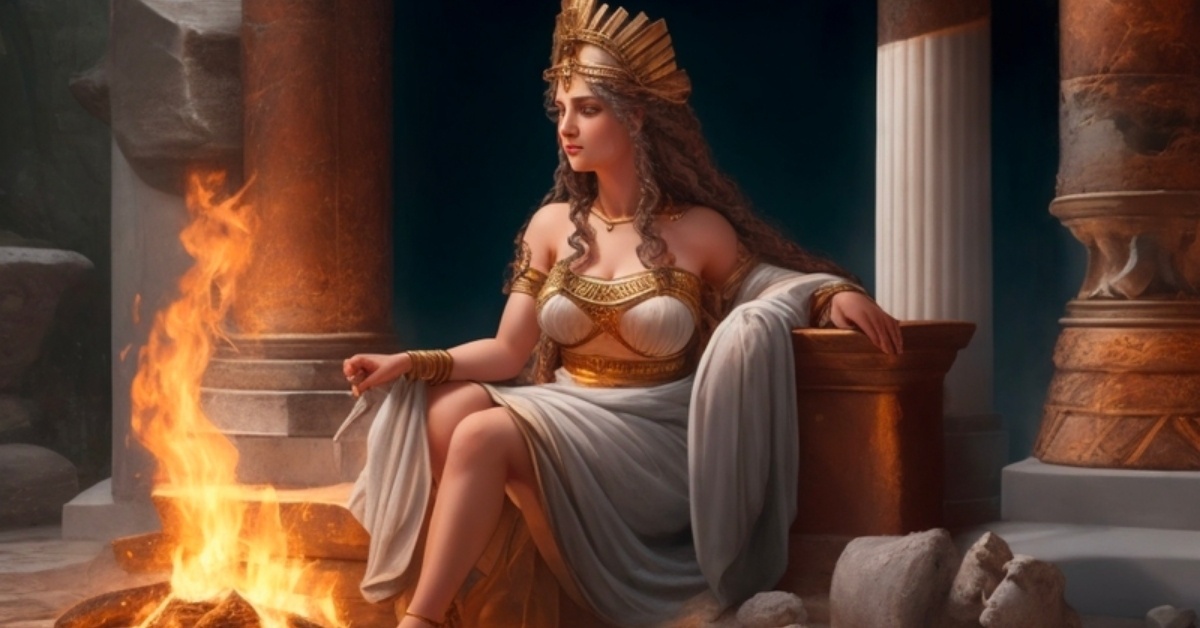
How Vesta tends to be shown in art:
- A grown woman, calm and composed, rarely young
- Veiled, with a long stola and a mantle drawn over her head
- Often seated, in the pose of a matron at home
- Holding a patera for pouring offerings, a scepter, or a lit torch
- Sometimes shown beside a small round temple, or holding the Palladium
- Occasionally with a donkey at her side
Abilities
- Keeper of the fire — the hearth of every household and the one hearth of the state
- Guardian of Rome’s continuity — as long as her fire burned, the city stood
- Custodian of the sacred objects — the Palladium and the Penates of the Roman people were kept in her house
- Purification — her priestesses made the mola salsa, the salted flour sprinkled on every public sacrifice
- The fertility of the hearth — in the oldest stories, a spark from her fire could father a king
Symbols
- The undying flame — the goddess herself, since she had no image
- The round temple — the shape of an early Latin hut, kept even in marble
- The donkey — the animal that saved her, garlanded at her festival
- The veil — the mark of the Roman matron, worn by goddess and priestess alike
- The Palladium — the image of Athena carried out of burning Troy
- Bread and salted flour — the daily work of the hearth, raised to ritual
Traits
- Constant, the one goddess who stays put
- Private, with no appetite for the quarrels of Olympus
- Unmarried by her own choice, and firm about it
- Severe on questions of purity, in herself and in those who served her
- Generous to the household that kept her fire and fed her
Festivals and Rituals
The heart of Vesta’s worship was the Vestalia, from June 7 to June 15.
On the first day, the penus Vestae, the curtained inner sanctum of her temple, was opened for the only time in the year. Married women walked to it barefoot and with their hair loose, carrying plain offerings on simple dishes. No man could enter. On June 9, the millers and bakers of Rome took the day off, and their donkeys were led out wearing garlands of flowers and strings of small loaves around their necks. On June 15, the temple was swept clean and the sweepings carried to the Tiber, a rite the calendars marked with the letters Q.St.D.F., “when the dung has been carried out, business may lawfully proceed.”
Every year on March 1, the old Roman New Year, the fire was renewed and fresh laurel hung in the temple. In April, at the Fordicidia, the chief Vestal burned the unborn calves from a sacrifice to Earth, and the ashes went into the purifying smoke of the Parilia, the birthday of Rome.
Legends associated with Vesta
Vesta’s myths are few and short, and nearly all of them come from one book: Ovid’s Fasti, his poem on the Roman calendar. Everything else comes from what the Romans did for her. Read together, the poems and the rituals tell one story, about a fire that could not be allowed to die and the women who kept it alive.
The goddess who chose the fire
Ovid tells it briefly. Saturn and Ops had three daughters. The first two, Juno and Ceres, married. The third, Vesta, could never stand the idea.
Both Apollo and Neptune courted her. She refused them both and asked her brother Jupiter for one favor: that she be allowed to stay a virgin forever. He granted it. In return she took the hearth as her seat, and Cicero says every Roman prayer and sacrifice closed with her name.
Ovid pushes the thought further. Vesta, he says, is nothing but living flame, and nothing is born of flame. Then he confesses something. For years he had assumed there were statues of the goddess in her temple, and only later learned there were none. The Roman poet had to be told that the fire was the goddess.
The donkey that saved her
This is the one story where anything happens to Vesta, and it explains the strangest sight of her festival.
The gods were feasting at a party thrown by Cybele, the Great Mother. Vesta grew tired and lay down on the grass to sleep. Priapus, the crude garden god, saw her and crept closer, meaning to force himself on her while she slept.
Beside them stood the old satyr Silenus’s donkey. At the worst possible moment for Priapus, it brayed. Vesta woke, the gods came running, and Priapus fled with the whole company laughing at him.
That, Ovid says, is why the bakers hang loaves around their donkeys’ necks every June. The animal had earned its garland.
The six who kept the fire
The Vestal Virgins were the only full-time female priesthood in Rome, and everything about them was designed around one job: the fire must never go out.
A Vestal was chosen as a child, between six and ten years old. Her parents both had to be living, her body without defect, and in the early centuries her family patrician. The Pontifex Maximus, Rome’s chief priest, took her by the hand and led her away with the words te, Amata, capio, “I take you, beloved.” From that moment she belonged to no father and no husband. She was one of the only women in Rome who owned her own property and could write her own will.
Her term was thirty years. Ten to learn, ten to serve, ten to teach. She fed the fire, fetched water from a sacred spring in a vessel built so it could not be set down, ground and salted the mola salsa for the state sacrifices, and guarded whatever Rome held most precious, from the Palladium to the wills of emperors.
In exchange, Rome gave her honors no other woman had. A lictor walked ahead of her in the street, and magistrates gave way. She had the best seats at the games. A condemned man who met her by chance on his way to execution was spared. Her word in court needed no oath. And when she died, she could be buried inside the sacred boundary of the city, a right reserved for almost no one.
After thirty years she was free to leave and marry. Most stayed.
The price of the vow
The honors had a shadow, and the Romans never pretended otherwise.
If the fire went out on a Vestal’s watch, the city read it as a sign that the goddess had withdrawn her protection. The Pontifex Maximus scourged the priestess responsible, in a dark room and through a curtain, so that no man’s eye fell on her. Then the fire was rekindled the old way, by rubbing wood against wood, or, in later centuries, by focusing the sun through a bronze mirror.
If a Vestal broke her vow of chastity, the punishment was death, and the form of it followed from who she was. A Vestal was sacred. Her blood could not be shed. So she was carried in a closed litter through the silent city to a spot near the Colline Gate called the Campus Sceleratus, the Field of Wrongdoing. There a small chamber had been dug into the earth and furnished with a couch, a lamp, and a little bread, water, milk, and oil. She climbed down the ladder herself. The ladder was drawn up, the entrance sealed, and the ground leveled over it. Her lover was flogged to death in the Forum.
It was rare, and it was remembered every time. Plutarch describes the whole city following the litter in silence, and calls it the most dreadful sight Rome had to offer. The historians record a handful of cases across the centuries, often in years of crisis, when a lost battle or a plague sent Rome looking for a broken vow to explain it. The best known is Cornelia, the chief Vestal under the emperor Domitian, whom later writers believed innocent. Set against her stands Tuccia, accused and vindicated: she carried water from the Tiber to the temple in a sieve, and not a drop fell.
The house with no statue
Vesta’s temple stood in the Forum next to the Regia, the old house of the kings, and beside the large courtyard house where the Vestals lived. Every other temple in Rome was rectangular. Hers was round, with a hole in the roof to let the smoke out, and the Romans knew why: it kept the shape of the thatched huts their ancestors had lived in. Ovid adds that it was round because the earth is round, and Vesta is the earth.
Behind the curtain of the penus lay the things Rome could not afford to lose. Chief among them was the Palladium, the small wooden image of Minerva that Aeneas was said to have carried out of burning Troy. As long as it stayed in Vesta’s keeping, Rome could not fall.
Twice the story was tested. In 390 BCE, when the Gauls were about to sack the city, the Vestals gathered the sacred objects and fled on foot. A plebeian named Albinius, carting his own family to safety, saw them on the road, set his wife and children down, and drove the priestesses and their gods to shelter at Caere. In 241 BCE the temple itself caught fire. Lucius Caecilius Metellus, the Pontifex Maximus, ran into the burning shrine where no man was allowed and carried the Palladium out. Later writers said he lost his sight for it. Ovid says the goddess approved of what he did.
The temple burned again under Nero and again in 191 CE, and each time Rome rebuilt it round. The three columns standing in the Forum today belong to the last version, paid for by the empress Julia Domna.
Fire that made kings
Rome’s oldest stories give Vesta’s fire the power to make kings.
The mother of Romulus and Remus was Rhea Silvia, a Vestal of Alba Longa, forced into the priesthood by a usurping uncle so that she could never bear an heir. She bore twins anyway, and Rome was the result. A generation of kings later, the servant girl Ocresia was tending the hearth in the palace of King Tarquin when a phallus rose out of the flames. The child she conceived was Servius Tullius, who grew up to be one of Rome’s best-loved kings, and a ring of fire was seen to play around his head as he slept.
The hearth, in these tellings, is where the city’s founders come from. Vesta’s virginity and Vesta’s fertility turn out to be the same idea: a fire kept pure so that a whole people can be born from it.
The last flame
The cult outlived the Republic, the Caesars, and the arrival of Christianity, and it ended with paperwork. In 382 CE the emperor Gratian cut off the Vestals’ public funding and confiscated their house. In 391 Theodosius I banned pagan worship altogether, and the fire in the Forum was put out. In 394 the last chief Vestal, Coelia Concordia, stepped down.
Rome had promised itself it could not fall while the flame burned. In 410, less than twenty years after it went dark, the Goths came through the gates.
An older Vesta?
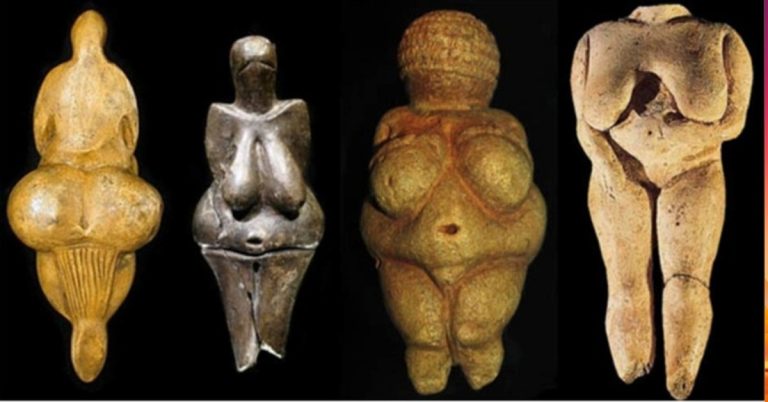
Strip away the poetry and the Greek comparisons, and what is left is a fire in a round hut, tended by unmarried women, at the center of a settlement. That arrangement is older than the Romans’ own memory of it.
The round temple is the plainest clue. Archaeologists working in Latium have dug up the cremation urns of the people who lived there in the tenth through eighth centuries BCE, and many of them are shaped like small houses: oval huts with pitched, thatched roofs and a smoke hole. Vesta’s shrine kept that shape for a thousand years while every other temple in Rome went square. The Romans themselves said the building copied the huts of their ancestors, and the archaeology agrees with them. Her house looks like a village’s common hearth that was never allowed to change.
Comparative scholars push the trail further back. Georges Dumézil, who spent his career setting Roman religion beside its Indo-European cousins, noticed that the ancient Vedic ritual of India kept two fires, a round householder’s fire at the center and an offering fire to the east, and that Rome appears to preserve the same layout at the scale of a city: Vesta’s round house as the hearth of the whole community, with the other temples as its offering fires. In the Rigveda that central fire is the god Agni, “the householder,” and he too was never to go out. More recently, Marcello De Martino has argued that Hestia, Vesta, and their cousins descend from an Indo-European goddess of the hearth who stood at the center of a deified cosmos.
The linguistics are less settled than the ritual. Dumézil derived Vesta from a root meaning “to burn”; others prefer a root meaning “to dwell” or “to pass the night,” which would make her name simply “the one of the house.” And the great Greek etymologist Robert Beekes judged that Hestia is probably a pre-Greek word, with no link to Vesta at all. If he is right, the two hearth goddesses are cousins by function alone, which would make the shared pattern more striking: two peoples arriving at the same virgin-tended fire in the same round room without borrowing the word for it.
All of this leaves the Vesta of Ovid and the Forum in place and sets her on a longer timeline. Before she was a Roman state goddess with priestesses and a place on the calendar, she seems to have been the fire itself, kept alive in a hut at the heart of a Latin village, with the women of the house watching it because a cold hearth meant the end of the household.
Vesta across cultures
The fire that must not go out is an idea that keeps turning up wherever people have gathered around one.
The Greeks had Hestia, and in every Greek city the prytaneion, the town hall, kept a public hearth in her name. When colonists set out to found a new city, they carried fire from the mother city’s hearth to light the new one, so that the flame was, in a literal sense, the same. Rome’s own story of a fire passed from Troy to Lavinium to Alba to the Forum belongs to that same habit of mind.
In Vedic India the householder’s fire was lit at marriage and kept burning for the life of the household, and Zoroastrian Persia built temples whose entire purpose was to shelter a fire that had never gone out, some of which are said to have burned for many centuries. In Ireland, the Christian nuns of Kildare tended a perpetual fire in Saint Brigid’s name inside an enclosure no man could enter, a custom the medieval writer Gerald of Wales described and that scholars widely read as inherited from an older cult of the goddess Brigid. And across the Atlantic, the Cherokee kept a sacred fire in the council house, put it out and rekindled it at the Green Corn ceremony each year, and carried its coals to light the hearths of every home.
Different peoples, different words, and the same arrangement: one fire at the center, kept by a chosen few, standing for the life of everyone else. Vesta is the Roman form of something people have wanted since the first hearth was built.
Final thoughts
Picture the Forum on an ordinary night in the second century. The shops are shuttered, the law courts dark, the great temples locked. One small round building shows a glow through the smoke hole in its roof, and inside it a woman in a white veil is feeding sticks to a fire, the same fire her teachers fed, and their teachers before them, back further than anyone could count.
That is the whole of Vesta. She needed no myth because she was always there. Every Roman child grew up watching her flame on the family hearth, and every Roman citizen knew the state kept one too. She is the goddess of the thing that has to be done every single day or the household dies, which is as unglamorous and as necessary as divinity gets.
The Romans thought their city would last as long as her fire did. What in your own life stays alive only because someone, every single day, chooses to keep it burning?
Bibliography
- Ovid. Fasti, Book VI (June 9, the Vestalia). Trans. A. S. Kline, Poetry in Translation.
- Plutarch. Life of Numa. Trans. Bernadotte Perrin, Loeb Classical Library, via LacusCurtius.
- Mark, Joshua J. “Vesta”. World History Encyclopedia.
- Apel, Thomas. “Vesta”. Mythopedia.
- Dumézil, Georges. Archaic Roman Religion. Trans. Philip Krapp. University of Chicago Press.
- De Martino, Marcello. “Hestia: The Indo-European Goddess of the Cosmic Central Fire”. Culture and Cosmos 23, no. 1 (2019): 3–19.
- Beekes, Robert. Etymological Dictionary of Greek. Brill.
- Serith, Ceisiwr. “The Proto-Indo-European Hearth”. Ár nDraíocht Féin.
- “Vesta (mythology)”, “Vestal Virgin”, “Temple of Vesta”, “Vestalia”, and “Sacred fire of Vesta”. Wikipedia.
- “Latial culture” and “Hut urn”. Wikipedia.