Benzaiten: The Japanese Goddess of Flowing Water, Music, and Words
In a cave in the hills behind Kamakura, people kneel at a spring and wash their money. They set coins and folded bills in small bamboo baskets, dip them in the water, dry them, and spend them, because what the spring touches is supposed to come back multiplied. The shrine was founded, its sign says, in 1185, on the day of the snake in the month of the snake, after the first shogun of Japan dreamed of a god with the body of a serpent and the head of an old man.
The goddess the shrine belongs to began her life in India, as a river in the oldest Sanskrit hymns, more than two thousand years before the shogun’s dream. In Japan she is Benzaiten, and she has gathered more to herself than almost any other deity in the country: water, snakes, dragons, islands, music, speech, luck, and wealth. Her name once meant eloquence. Somewhere in the Middle Ages a single written character changed, and it came to mean money.
Overview of Benzaiten
Benzaiten (pronounced ben-ZAI-ten), also Benten for short, is the Japanese form of the Indian goddess Saraswati, the Hindu patron of learning, speech, and music whose name began as the name of a river. She reached Japan inside a Buddhist scripture in the seventh or eighth century and became, over the next thousand years, a goddess of everything that flows. Water first: her shrines stand on islands, beside lakes and ponds, and at springs. Then the things the Japanese tradition heard as flowing like water: music, words, eloquence, knowledge, and finally fortune.
Her name tells the story of that drift. The characters she arrived with, 弁才天, mean roughly “heavenly one of eloquence and talent.” During the Muromachi period, from the late fourteenth century on, writers began substituting a different zai, 財, the character for wealth, so that 弁財天 means “heavenly one of eloquence and riches.” Both spellings are still in use. The second is the one on the signs at shrines where people wash their money.
Benzaiten is a Buddhist deity by origin, one of the ten, the devas adopted from India as protectors of the teaching. For most of her history in Japan that distinction mattered little. She was worshipped at temples and at shrines, paired with native kami, and given a snake god to wear on her head. The one moment when the distinction mattered enormously, the government order of 1868 that split Buddhism from Shinto, is a story in its own right below.
She is the only woman among the Seven Lucky Gods, the Shichifukujin, who sail into Japanese harbors on their treasure ship at the New Year. Her three great island sanctuaries are Chikubushima in Lake Biwa, Itsukushima in the Inland Sea, and Enoshima in Sagami Bay, with the mountain shrine of Tenkawa in Nara sometimes named as a fourth or in place of one of them.
Titles
- Benzaiten, “heavenly one of eloquence and talent,” or in the later spelling “of eloquence and wealth”
- Benten, the short everyday name
- Daibenzaitennyo, “great heavenly woman of eloquence,” her name in the Golden Light Sutra
- Myoonten, “heavenly one of wonderful sound,” the name attached to her music
- Uga Benzaiten, her composite form with the snake kami Ugajin
- Itsukushima Daimyojin, her medieval title at Miyajima, shared with the kami Ichikishimahime
- Sarasvati, her Sanskrit name
Characteristics
How the sutra, the island legends, and the sculptors describe her:
- A woman of great beauty, courtly in dress, usually seated
- A persuader, who talks a dragon out of a thousand years of violence
- Armed, in her oldest Japanese form, with eight weapons at once
- A musician, in her best-loved form, with a lute across her lap
- A guardian of islands, caves, and the water around them
- A bringer of luck, whose character for talent was traded for the character for wealth
Symbols
- The biwa — the short-necked Japanese lute, her instrument in the two-armed form
- Water — the lake, the bay, the pond, and the spring; her sanctuaries sit in or beside it
- The white snake — her messenger, and in Uga Benzaiten the god on her head
- The dragon — the five-headed suitor of Enoshima and the dragon god of Lake Biwa
- The torii — the shrine gate worn in her headdress as Uga Benzaiten
- The wish-granting jewel — held in one of the eight hands
- The treasure ship — the takarabune of the Seven Lucky Gods
Legends associated with Benzaiten
Benzaiten’s stories were written in Japan by monks, chroniclers, and playwrights between the eleventh and the fifteenth centuries, and each one explains how a goddess from a sutra came to own a particular piece of Japanese ground. The sutra gives her a voice. The island legends give her an address.
The vow in the Golden Light Sutra
Benzaiten came to Japan in the Suvarnaprabhasa, the Golden Light Sutra, a Mahayana scripture that promises protection to any ruler who honors it. The Nara court adopted it as a charm for the safety of the state. In the Chinese translation made by the pilgrim-monk Yijing in 703, the one that became standard in East Asia, the fifteenth chapter belongs to Sarasvati. She steps forward before the Buddha and vows to protect anyone who recites, copies, or keeps faith with the text, and she promises them eloquence, memory, and understanding.
The chapter has a second half, and it is the strangest part of her Japanese inheritance. A brahmin named Kaundinya stands up and praises the goddess, and the goddess he describes carries a bow, an arrow, a sword, a spear, an axe, a vajra, an iron wheel, and a noose in eight hands. The scholar Catherine Ludvik has shown that this hymn is a reworked praise of the Indian battle goddess Durga, carried over into the sutra under Sarasvati’s name. Japan took the chapter whole. Its oldest surviving image of Benzaiten, a clay statue in the Hokkedo hall of Todaiji in Nara from the middle of the eighth century, has eight arms.
The same sutra carried a second goddess to Japan, Sri-mahadevi, the Buddhist form of Lakshmi, who became Kichijoten. Her chapter follows Sarasvati’s. In the medieval period the two were often confused, and Kichijoten’s portfolio as goddess of fortune drifted across to Benzaiten, which is one reason the character for talent could become the character for wealth.
The island that rose from the sea
The Enoshima Engi was written in Chinese in 1047 by the Tendai monk Kokei, and it explains how the island of Enoshima, off the coast south of Kamakura, came to belong to Benzaiten.
Before the island existed, the text says, the people of the shore were tormented for more than a thousand years by a five-headed dragon who lived in a lake inland. The dragon ate the children of the villages, and the storytellers read the name of the nearest village, Koshigoe, as “where the children were lost.” Then in the summer of 552, in the reign of Emperor Kinmei, the sky and the sea went into convulsions. Clouds gathered, the earth shook, and when it was over an island had risen from the bay. A heavenly woman descended onto it. The dragon saw her and fell in love, and he came to the island and asked her to be his wife.
In Kokei’s telling, she refused him. She reminded him of what he had done, and she argued with him until he was ashamed. The dragon vowed to stop, turned himself toward the shore, and became a hill, the one called Ryuko, Dragon’s Mouth, which still faces the island across the water. The year carries its own message. 552 is also the date the Nihon Shoki gives for the arrival of Buddhism in Japan, and Kokei was tying his goddess’s island to the first year of the faith.
The scales of the dragon
The Taiheiki, the fourteenth-century war chronicle, adds a story that the rulers of Kamakura told about themselves. Hojo Tokimasa, father-in-law of the shogun Yoritomo and founder of the family that would govern Japan for more than a century, went to the cave at Enoshima and prayed to Benzaiten for twenty-one days for the prosperity of his descendants. On the last night a beautiful woman appeared, promised him that his line would rule, and warned him that it would fall if it ruled badly. Then she went back into the sea as a great serpent, leaving three scales on the sand. Tokimasa picked them up and made them his crest.
The three triangles are still the emblem of the Hojo and one of the most recognizable crests in Japan. In the story the goddess, the snake, and the sea are already one thing.
The dream on the day of the snake
The shrine in the cave at Kamakura, Zeniarai Benzaiten, has its own founding legend, and it names the moment the snake god and the goddess were formally joined. In 1185, according to the account at the shrine, Minamoto no Yoritomo dreamed on the day of the snake in the month of the snake of the kami Ugafukujin, a being with a serpent’s body and a human head, who told him that a miraculous spring rose from the rocks in a valley to the northwest. Yoritomo found the spring and built a shrine to Benzaiten and the snake god together.
Washing coins in the spring came later. In 1257 the regent Hojo Tokiyori is said to have told the faithful to wash their money there so that the kami would multiply it. The practice has outlived the Kamakura shogunate by seven and a half centuries, and the shrine is still the second most visited in the city.
The fisherman on Lake Biwa
The Noh play Chikubushima, anonymous and probably from the fifteenth century, takes the goddess to her island in Lake Biwa. A courtier of Emperor Daigo travels north from the capital to worship Benzaiten on Chikubushima. At the lakeshore he meets an old fisherman and a young woman putting out in a boat, and they take him across. When they land, the courtier is startled to see the woman walk toward the shrine, and he asks whether the island is forbidden to women. The fisherman and the woman answer together that Benzaiten is a woman herself and welcomes women to her island.
Then the pair reveal themselves. The woman enters the shrine and comes out as Benzaiten, who dances. The fisherman leaps into the lake and rises again as the dragon god of the waters, who offers the courtier treasures and promises to protect the country. The play ends with goddess and dragon side by side, which is how the island’s worshippers understood them: the lady of the shrine on the rock, and the dragon in the water around it.
Eight arms or a lute?
Two different Benzaitens stand in Japanese temples, and the question of which came first, or whether they are the same goddess at all, has occupied scholars for a century.
The first is the warrior of the Golden Light Sutra. She has eight arms, and in each hand a weapon or an emblem of power. This is the form of the eighth-century Todaiji statue, the form carried into the esoteric Buddhist mandalas of the ninth century, and the form that became Uga Benzaiten in the Middle Ages, with the weapons gradually traded for a key, a jewel, and other signs of wealth. Ludvik reads this figure as Durga wearing Sarasvati’s name, a goddess of battle who entered Japan under the banner of a goddess of speech.
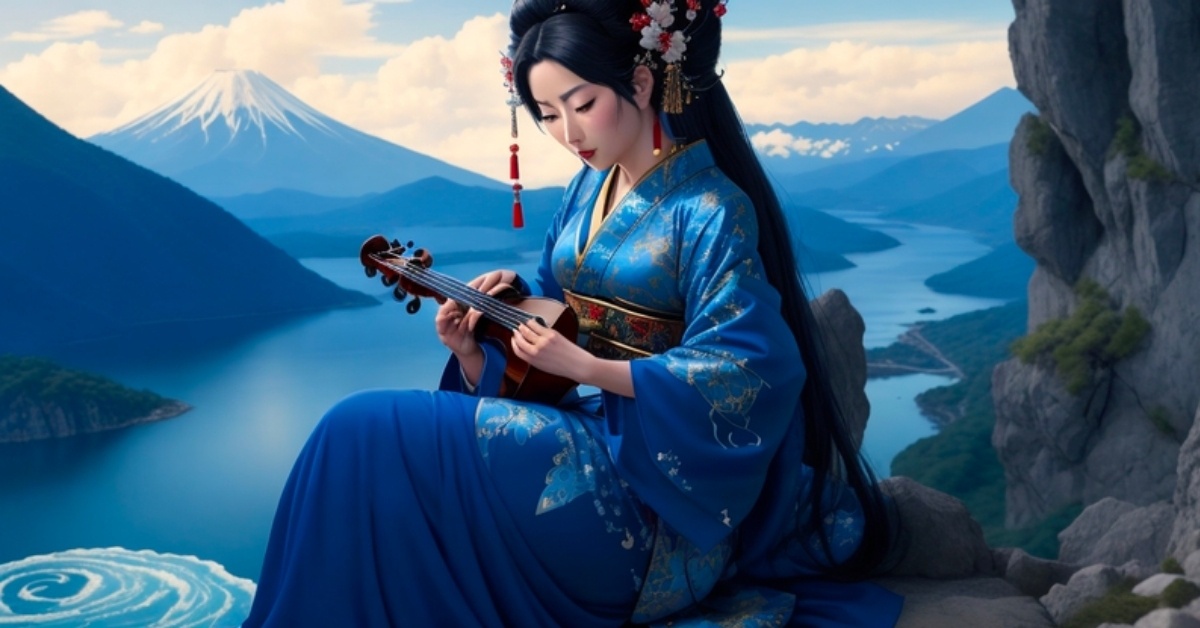
The second has two arms and a biwa. This is the Benzaiten most people picture: a court beauty with a lute across her knees, often seated on a rock above water or on the back of a white dragon. She owes her instrument to Saraswati’s vina, and in Japan she was linked with Myoon Bosatsu, the bodhisattva of wonderful sound from the Lotus Sutra, whose cult court musicians brought back from Tang China in the ninth century. Biwa players prayed to her, and a tradition held that a professional biwa player who married would lose his skill, because the goddess was jealous.
One reading, common in the older handbooks, takes the lute player as the real Sarasvati and the eight-armed figure as a later Japanese elaboration. Another, which Ludvik’s work on the sutra supports, puts the armed figure first in Japan and the musician second. A third, which Bernard Faure develops across his two volumes on the gods of medieval Japan, declines to rank them. In his account, Benzaiten in the Middle Ages was a node in a network, identified in turn with dragons, snakes, the fox goddess Dakiniten, and the kami of several islands, and each identification left a form behind. The two statues at Enoshima make the point. The shrine’s octagonal treasure hall keeps a Kamakura-period eight-armed Benzaiten and, a few feet away, a Kamakura-period Benzaiten who is nude and playing the biwa. Pilgrims have been bowing to both for seven hundred years.
The snake on her head
Between the eleventh and the thirteenth centuries Benzaiten acquired a companion who changed her. His name is Ugajin, or Uga no Kami, and he is a snake with the head of a human being, usually an old man and sometimes a woman. For all his archaic look, scholars trace him to medieval esoteric Buddhism. A set of three sutras composed in Japan in the thirteenth century, attributed to the Buddha but written by Tendai monks, present him as the true essence of Benzaiten and describe the composite goddess who resulted.
Uga Benzaiten is the eight-armed goddess with a torii gate in her headdress and the coiled, white, human-headed snake sitting on top of it. She is surrounded by fifteen or sixteen child attendants, each in charge of a different kind of good fortune: the granary, the stable, the silkworms, the treasury. The weapons of the Golden Light Sutra have mostly become a key and a jewel. Catherine Ludvik’s study of the figure traces how a goddess of eloquence became, under the snake, a goddess of wealth, and Faure gives the transformation a chapter title: from dragon to snake.
Snakes had been near her all along. The Indian Sarasvati was linked with the nagas, the serpent beings of the waters, and in China and Japan the nagas became dragons. The white snake is Benzaiten’s messenger at most of her shrines, and seeing one is still read as a sign of coming luck. Her holy day is the day of the snake, mi no hi, which comes around once in every sixty-day cycle, and the busiest crowds at Zeniarai Benzaiten gather then.
Who is she after 1868?
For a thousand years the question of whether Benzaiten was a Buddhist deity or a Shinto kami had an easy answer: she was both, and nobody minded. Then in 1868 the new Meiji government ordered the separation of the two religions, shinbutsu bunri, and every sanctuary in Japan had to decide what it was. Her three islands answered in three different ways.
The medieval identification that made the decision possible was with Ichikishimahime, one of the three Munakata goddesses of the sea. In the Kojiki and the Nihon Shoki, the three sisters are born when the sun goddess Amaterasu takes her brother Susanoo’s sword, breaks it, chews the pieces, and breathes them out as mist, and from the mist come three daughters. They are goddesses of the sea lanes between Japan and Korea, and Itsukushima at Miyajima is one of their oldest homes. At some point in the Middle Ages Ichikishimahime, a beautiful goddess of water and the sea, was identified with Benzaiten, a beautiful goddess of water who had just arrived, and the combined deity was worshipped as Itsukushima Daimyojin.
At Itsukushima the Meiji order split them back apart. Ichikishimahime stayed in the great shrine over the water, and Benzaiten’s image was carried a few hundred yards to the Buddhist temple of Daiganji, where it remains. At Enoshima the sanctuary declared itself a shrine, enshrined the three Munakata goddesses in its three halls, and moved its Benzaiten statues to the treasure hall. At Chikubushima the government forced the main Benten hall to be renamed for a kami, Tsukubusuma, a name taken from a tenth-century register, and in 1874 the island’s Buddhist temple and the new shrine were formally divided, with a different goddess installed in the hall Benzaiten had held since the eighth century.
So the same figure now has three legal identities. Ask at Daiganji and she is a Buddhist deva. Ask at Enoshima Shrine and she is Ichikishimahime, with Benzaiten as a title the kami bears. Ask the people washing money in the cave at Kamakura and they are talking to Benzaiten and the snake god together, as if the order of 1868 had passed them by. Scholars treat the three as readings of a single history. Faure’s phrase for the medieval system is a fluid pantheon, in which identity ran like water from one god to another, and the Meiji separation was an attempt to freeze it. The ice held at some shrines and not at others.
Benzaiten and the goddesses of flowing things
The nearest relative is her own source. Saraswati sits by a river in white with a vina, a book, and a rosary, and the children of India write their first letter in front of her every spring. Benzaiten kept the lute and the water and let go of the book; in Japan, musicians and merchants prayed to her far more often than students did. She picked up what her new country wanted from a beautiful woman beside the sea: luck, protection, music, and a dragon.
The pattern of a river goddess who becomes a goddess of speech and wealth has company. In West Africa, Oshun is the river Osun in Nigeria and also the orisha of sweetness, fertility, and money, and her devotees bring her honey and coins. In India, Saraswati’s own name, as her post explains, meant “she who has pools” before it meant anything about knowledge. Water that moves seems to invite the same metaphor in different places: whatever else flows, speech, music, fortune, ends up in the care of the same woman.
Within Japan, her closest neighbor is Inari, the kami of rice and commerce whose red gates and fox messengers are everywhere. Inari is native, and Benzaiten is imported, and both became gods of money for the merchants of Edo. Faure notes that the two were drawn into each other’s orbit through the fox goddess Dakiniten, so that the snake on Benzaiten’s head and the fox at Inari’s gate were, for medieval ritualists, part of one system of animal messengers who could be asked for wealth. The other great imported woman of Japanese Buddhism, Kannon, the bodhisattva of compassion, shares temple halls with her, and the resemblance stops at the door. Kannon hears cries. Benzaiten answers with a tune, an argument, or a full purse.
Final thoughts
The coin baskets at Kamakura are a small thing to end on, and they hold the whole history. A Sanskrit river became a goddess of speech. A sutra about protecting the state carried her to Japan with another goddess’s weapons in her hands. Monks gave her an island, a dragon, and a snake; the court gave her a lute; the merchants changed one character in her name and asked her for money. A government tried to decide once and for all which religion she belonged to, and the people kneeling at the spring went on talking to both.
The oldest claim made about her in Japan is the one in the sutra, that she gives eloquence, and that one has survived every change of costume. The dragon of Enoshima was talked down. A goddess of persuasion ended up as a goddess of wealth, and the two powers still share the same shrines. Which one would you walk up the island steps to ask for?
Bibliography
- Faure, Bernard. Protectors and Predators: Gods of Medieval Japan, Volume 2. University of Hawai’i Press, 2016. Chapter 5, “From Dragon to Snake: Uga Benzaiten,” and chapter 7, “The Face of the Snake: Ugajin”; Benzaiten’s martial inheritance; her links to Dakiniten and Inari.
- Faure, Bernard. The Fluid Pantheon: Gods of Medieval Japan, Volume 1. University of Hawai’i Press, 2016. The model of medieval deities as a network of shifting identifications rather than fixed figures.
- Ludvik, Catherine. Sarasvatī: Riverine Goddess of Knowledge. From the Manuscript-carrying Vīṇā-player to the Weapon-wielding Defender of the Dharma. Brill, 2007. The eight-armed goddess of the Golden Light Sutra as a reworked praise of Durga; the transmission from India to Japan.
- Ludvik, Catherine. “Uga-Benzaiten: The Goddess and the Snake.” Impressions 33 (2012): 95–110. The composite iconography of Uga Benzaiten, the torii headdress, the fifteen attendants, and the shift from eloquence to wealth.
- Ludvik, Catherine. “Re-contextualizing the Praises of a Goddess: From the Harivaṃśa to Yijing’s Chinese Translation of the Sūtra of Golden Light.” In Sources and Time, ed. Giovanni Verardi and Silvio Vita. Italian School of East Asian Studies, 2006. Kaundinya’s hymn and its Durga source.
- “Benzaiten”. Wikipedia. Yijing’s chapter 15, the eight weapons, the Tendai identification with Ugajin, the three great shrines and the Tenkawa variant, the conflation with Kichijoten.
- “Enoshima Engi”. Wikipedia. Kokei’s 1047 text; the five-headed dragon, the island rising in 552, the goddess’s refusal, and the dragon becoming Ryuko hill.
- “Enoshima Shrine”. Wikipedia. The three Munakata halls, the treasure hall with the eight-armed and biwa-playing statues, and the Hojo Tokimasa scale legend.
- “Zeniarai Benzaiten Ugafuku Shrine”. Wikipedia. Yoritomo’s dream on the day of the snake in 1185, Ugafukujin, and Hojo Tokiyori’s coin-washing instruction of 1257.
- “Hōgon-ji” and “Chikubushima”. Wikipedia. The island’s founding legend, the Meiji renaming of the Benten hall as Tsukubusuma Shrine, and the 1874 division.
- “Chikubu-shima: Synopsis and Highlight”. The Noh.com Plays Database. The courtier, the fisherman and the woman, the question of a prohibition on women, and the manifestation of Benzaiten and the dragon god.
- “Ichikishima-hime”. Yokai.jp Encyclopedia. The medieval syncretism as Itsukushima Daimyojin and the 1868 separation, with Benzaiten moved to Daiganji.
- Schumacher, Mark. “Benzaiten” and “Benzaiten’s Main Sanctuaries in Japan”. A-to-Z Photo Dictionary of Japanese Buddhist Statuary. The Todaiji clay statue, the Myoon Bosatsu connection, the three thirteenth-century Benzaiten sutras, the 才/財 character change, mi no hi, and the shrines’ Meiji choices.
- Aoigaoka Keisei. “Benzaiten (Goddess of Music and Good Fortune) Seated on a White Dragon”. The Metropolitan Museum of Art. The biwa-playing goddess on the dragon in Edo-period painting.