Harmonia: Greek Goddess of Harmony and Concord
Every god on Olympus came to her wedding. The Muses sang. Apollo played. It was the first marriage feast the gods ever laid for a mortal, and it was the last good day her family had for five generations.
Harmonia is the goddess of things fitting together: war and love, a husband and a wife, a city and its people. She was also handed, at that same wedding, the most dangerous piece of jewelry in Greek myth.
Overview of Harmonia
Harmonia is a minor goddess by rank and a major one by consequence. In the version most Greeks knew, she is the daughter of Ares, god of war, and Aphrodite, goddess of love, born of an affair that Aphrodite’s husband Hephaestus never forgave. Her name is the ordinary Greek word harmonia, which meant a joint or a fastening before it ever meant music: the place where two planks meet and hold.
Her one story is a marriage. Zeus gave her to Cadmus, the Phoenician prince who founded Thebes, and through that marriage she became the grandmother of Dionysus, the ancestor of Oedipus, and the source of the curse that ran through the whole Theban royal house. Her home is Thebes, in Boeotia, and the Thebans could still point to her bridal chamber in the marketplace when the traveler Pausanias visited in the second century AD.
The Romans knew her as Concordia, and gave her a temple in the Forum.
Titles
- Harmonia (“the fitting-together”)
- Daughter of Ares and Aphrodite
- Queen of Thebes, wife of Cadmus
- Concordia, her Roman name
- The Allmother, in one late poet’s cosmic version of her
Characteristics
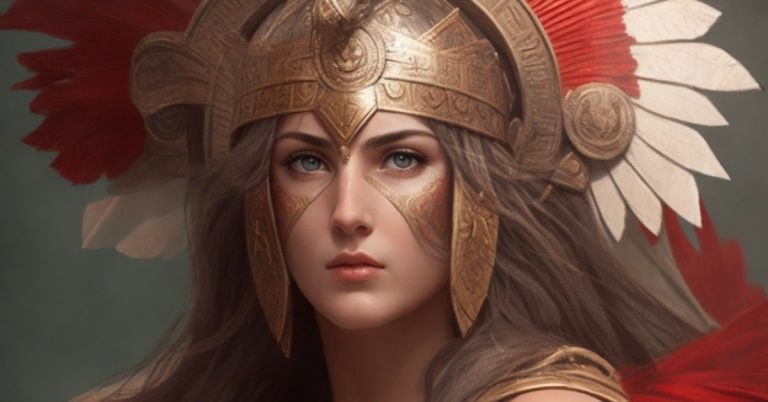
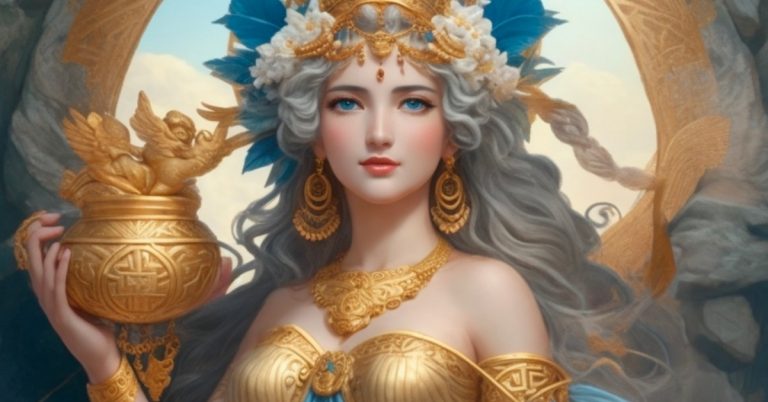
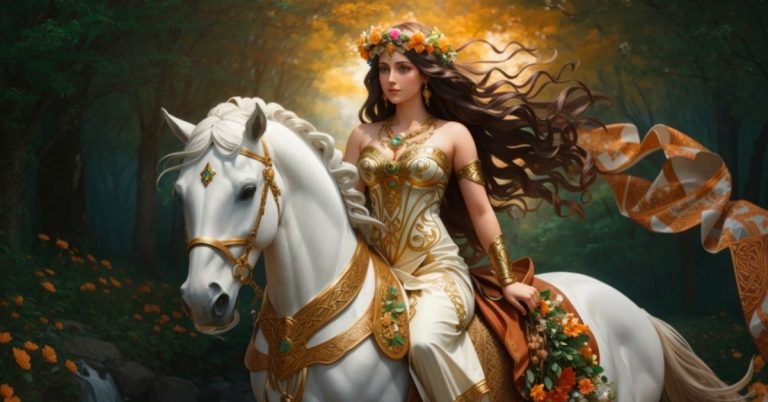
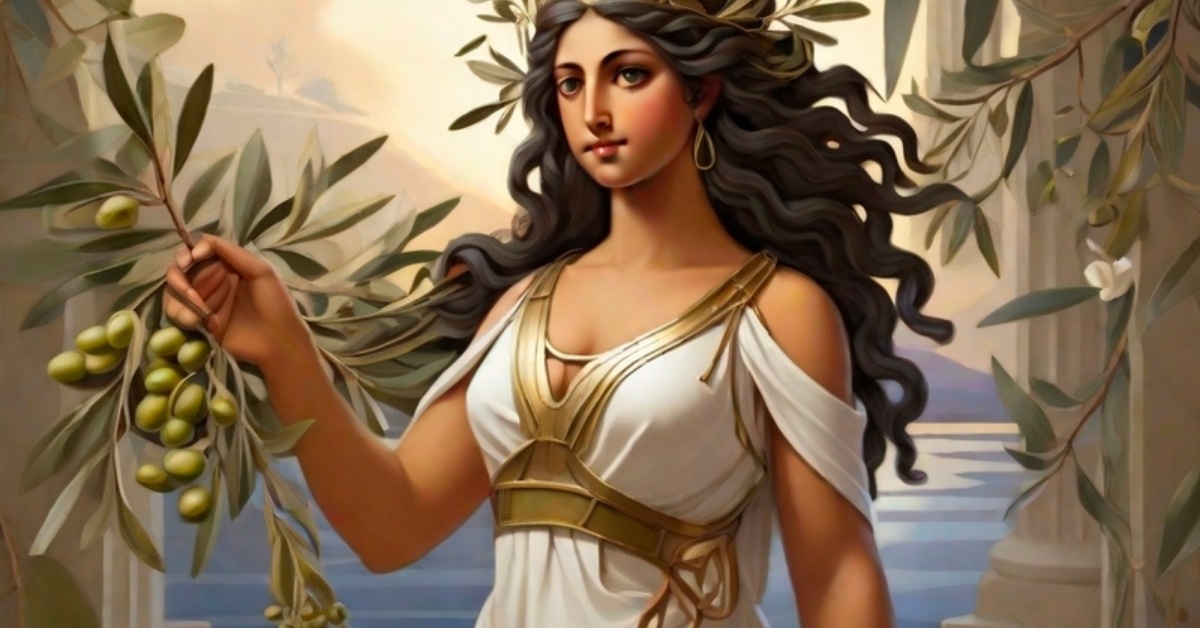
How Harmonia tends to be shown in art:
- A young bride, veiled or crowned, at the side of Cadmus
- Wearing a golden necklace, sometimes shaped as two serpents
- Serene where her parents are anything but
- In her last form, a snake coiled beside a second snake
- On Roman coins as Concordia: seated, holding a bowl and a horn of plenty
Abilities
- Reconciling opposites — the daughter of war and love, and the proof they can share a house
- Blessing marriage — hers was the model divine wedding, and hers was the name couples invoked
- Binding a city — the founding queen of Thebes, the mother of its first royal line
- Civic concord — as Concordia, the goddess Rome prayed to when its factions were at each other’s throats
- Endurance — she outlasted the curse, the exile, and the serpent’s skin, and reached the Isles of the Blessed
Symbols
- The necklace — Hephaestus’s wedding gift, and the doom of everyone who wore it after her
- The serpent — the shape she and Cadmus took at the end of their lives
- The lyre — Hermes’s wedding gift, the instrument that made “harmony” a musical word
- The peplos — the robe given alongside the necklace, cursed in some tellings
- Clasped hands and the cornucopia — Concordia’s emblems on Roman coins
Traits
- Composed and steady, the quiet center of a loud family
- Loyal past the point of reason: she asked to share her husband’s fate rather than outlive it
- Generous, dedicating the first images of Aphrodite at Thebes
- Blameless and unlucky, the one person in the necklace’s story who did nothing to earn it
- Long-suffering, a queen who watched four daughters destroyed and kept her seat
Festivals and Rituals
Harmonia’s worship rode on other people’s occasions: on weddings, on the civic pride of Thebes, and on a mystery cult on the island of Samothrace.
At Thebes, Pausanias saw the ruins of Cadmus’s house in the marketplace, the room the Thebans called Harmonia’s bridal chamber, and the spot where the Muses were said to have sung at her wedding. Elsewhere in the city stood three ancient wooden images of Aphrodite, said to be carved from the figureheads of Cadmus’s ships and dedicated by Harmonia herself. She named them Ourania, Pandemos, and Apostrophia: heavenly love, common love, and the love that turns away from wrongdoing. A goddess of harmony, sorting her mother’s power into its proper parts.
On Samothrace, home of the Mysteries of the Great Gods, she was remembered in a different way. The historian Ephorus reported that the islanders still “searched for Harmonia” during their festivals, acting out the moment Cadmus carried her off. Scholars think the annual rite included a sacred wedding, with Cadmus and Harmonia played out on the sanctuary ground.
In Rome, Concordia’s temple stood at the foot of the Capitoline, vowed by Camillus in 367 BC to mark peace between the patricians and the plebs. The Senate met there in a crisis. Cicero delivered speeches against Catiline under her roof.
Legends associated with Harmonia
Harmonia’s myth is really one long story, the story of Thebes, and she stands at the head of it. It runs from a divine wedding to a cursed heirloom to two old serpents in the hills of Illyria.
The daughter of war and love
Ares and Aphrodite had no business being together. She was married to Hephaestus, the lame smith of the gods, and Ares was exactly the kind of man a goddess of love would ruin herself over. The two of them carried on in Hephaestus’s own bed until the Sun, who sees everything, told the husband.
Hephaestus’s revenge is one of the funniest scenes in Homer. He forged a net of chains too fine to see, strung it over the bed, and pretended to leave for Lemnos. The lovers took the bait. The net dropped. Hephaestus called every god on Olympus in to look, and they stood around the trapped pair laughing until Poseidon talked the smith into letting them go.
Harmonia was the child of that affair. So were Phobos and Deimos, Fear and Terror, who ride with their father into battle. Hesiod lists all three together, and the contrast is the whole point. Out of the same bed came the two spirits that make soldiers run, and the one goddess who makes enemies stop.
The smith did not laugh long. In the later telling, Hephaestus swore he would have his revenge on any child that came of the affair. He waited years. He waited for her wedding.
The wedding at the Cadmea
Cadmus had earned a bride. He had crossed the sea from Phoenicia hunting for his sister Europa, whom Zeus had stolen in the shape of a bull. He never found her. Following a cow, as the oracle at Delphi told him to, he came to the site of Thebes, killed the serpent of Ares that guarded its spring, and on Athena’s instruction sowed its teeth in the ground. Armed men sprang up. He set them fighting each other, and the five who survived became the first noble families of the city.
For killing the serpent, Cadmus served Ares for an “everlasting year,” eight years by the reckoning of the gods. When his time was up, Athena gave him the kingship, and Zeus gave him Harmonia.
Every god came down to the Cadmea, the citadel of Thebes, for the wedding. The Muses sang. Apollo played the lyre. Pindar called it one of the two happiest moments any mortal ever had, and he put the other one at the wedding of Peleus and Thetis, the parents of Achilles. The gods sat down to a mortal’s table and brought gifts. Demeter gave grain. Hermes gave a lyre. Electra, in the Samothracian telling, gave the sacred rites of the Great Mother, with cymbals and drums.
And someone gave the necklace.
The Necklace of Harmonia
The ancient sources cannot agree on who handed it over, which tells you how the story grew. Apollodorus says Cadmus gave it to his bride, having received it from Hephaestus, or from Europa, who had it from Zeus. Others said Aphrodite gave it. Diodorus says Athena did. But the version that stuck is the one where the smith god made it with his own hands, gold worked into two serpents with jeweled eyes, and forged into it every misfortune he could think of.
It was beautiful. It made any woman who wore it irresistibly lovely, and it kept her young. It also destroyed, one by one, every woman who owned it.
Harmonia’s own daughters went first. Semele, pregnant by Zeus, was tricked by Hera into demanding to see him in his full glory, and burned to ash. Ino was driven mad by Hera and leapt into the sea with her son in her arms. Agave, in a Bacchic frenzy, tore her own son Pentheus apart on the mountainside and carried his head home thinking it was a lion’s. Autonoë’s son Actaeon was turned into a stag and eaten by his own hounds. Four daughters, four ruins, and the necklace still in the family.
It came down the generations to Jocasta, queen of Thebes, who owned it when she married the young stranger who had killed her husband. The stranger was her son Oedipus. When she learned it, she hanged herself.
Her son Polynices took the necklace into exile. When he needed the seer Amphiaraus to join the Seven Against Thebes, an expedition Amphiaraus knew would kill him, Polynices bribed the seer’s wife Eriphyle with the necklace. She sent her husband to his death for it. Before he went, Amphiaraus made his son Alcmaeon swear to avenge him, and Alcmaeon did. He killed his mother, and then the necklace was his, and the Furies were on him.
Alcmaeon gave it to one wife, then took it back by lying to her father, to give it to a second wife. Her family ambushed him on the road. His sons hunted them down in turn. Finally somebody in that family had the sense to dedicate the thing to Athena at Delphi and walk away.
The dedication bought a few centuries. Then, during the Third Sacred War, a Phocian general named Phayllus looted Delphi and gave the necklace to his mistress. Her son went mad and burned the house down with her in it. The Greeks told that story as history, with a date.
Read the whole chain end to end and one thing stands out. Harmonia wore the necklace first and longest, and the curse never landed on her. It passed through her and struck the people around her. That is either the cruelest version of the story or the truest thing it says about her.
Cadmus, Harmonia, and the serpents
Cadmus and Harmonia grew old. They watched Thebes fall apart around their grandchildren, and in the end they left the city they had founded and went north, to the Encheleans of Illyria, on the far side of the Greek world.
The Encheleans were at war and had been promised victory if Cadmus led them. He led them to victory and became their king. But the killing of Ares’s serpent had never been paid for. In Euripides’s Bacchae, Dionysus tells his own grandfather what is coming: Cadmus will become a serpent, and Harmonia, “Ares’ daughter,” will be turned into a beast and take a serpent’s form. They will lead barbarians against Greek cities and plunder the oracle of Apollo. Only then will Ares carry them to the land of the blessed.
Ovid tells the transformation itself. Worn out by grief, Cadmus asks aloud whether the serpent he killed was sacred, and if so, let him become one. His skin hardens into scales. His legs fuse. Harmonia watches it happen, and she calls out to the gods to let her share it. She strokes the snake that was her husband. It winds around her neck, the neck that wore the necklace, and then there are two of them, gliding away together into the woods.
Some said they went on to Elysium in that shape. Others said they were carried there in a chariot drawn by serpents. Either way, Harmonia got what she asked for. Whatever happened to Cadmus happened to her too.
An older Harmonia?
Before Harmonia was the bride of Thebes, she may have been something else, and the Greeks themselves left the evidence.
The clearest sign is that they told two incompatible stories about who her parents were. The mainland version, from Hesiod down, makes her the daughter of Ares and Aphrodite. But on Samothrace, in the northern Aegean, the islanders insisted she was born there, to Zeus and the Pleiad Electra, and that her brothers were Dardanus, ancestor of Troy, and Iasion, who founded the island’s mysteries. The historian Diodorus records the Samothracian version and notes flatly that it contradicts what “the Greeks recount in their mythologies.” In this telling Cadmus came to Samothrace on his search for Europa, was initiated into the mysteries of the Great Gods, saw Harmonia during the rite, and carried her off. The island turned that abduction into a festival. Ephorus, in the fourth century BC, reported that the Samothracians still searched for Harmonia every year, and the classicist Sandra Blakely reads the annual rite as a sacred wedding played out on the sanctuary ground. The Great Gods of Samothrace are usually identified with the Kabeiroi, the secretive underworld powers whose cult was also celebrated at Thebes. If so, Harmonia’s link to Thebes may have come south with the cult.
The second sign is her name. Harmonia was a word before it was a goddess, and the philosophers used it for the deepest thing they could think of. Philolaus, the Pythagorean, made harmonia one of his three first principles: the “fitting together” of limit and the unlimited that lets a cosmos exist at all, with the musical scale as its clearest example. Empedocles went further and made Harmonia a divine name for Love itself, the force that glues bones together and holds the whole sphere of the world “fast in the close obscurity of harmonia.” When the late poet Nonnus sent Aphrodite to consult “the hall of Allmother Harmonia,” a primeval goddess who keeps the oracular tablets of the universe, he was writing that philosophical Harmonia back into myth as a power on the order of Gaia, older than any wedding.
None of this replaces the Theban story. Hesiod’s Harmonia, Ares’s daughter, is the one the poets sang. But the Samothracian cult and the philosophers’ cosmic principle point at a goddess who was, for some Greeks, much bigger than a single marriage: the thing that holds the world’s opposites together, whichever opposites you have in mind.
Harmonia across cultures
The Romans took her over wholesale as Concordia, and they took her seriously. Where Harmonia in Greece was a bride, Concordia in Rome was a policy. Camillus vowed her temple in 367 BC when the patricians and plebs finally agreed to share the consulship, and for the rest of Roman history, whenever a civil quarrel was patched over, someone rebuilt her temple or struck her image on a coin. The emperor Tiberius restored it. Under Augustus and Livia, Concordia became a virtue of the imperial household, the harmony of the emperor’s own marriage standing in for the harmony of the state.
That move, from a goddess of marriage to a goddess of civil peace, is one other cultures made too. The Greek word for it was homonoia, “same-mindedness,” and Concordia is closer to that than to Harmonia’s own name. In Egypt, Ma’at held the same job at a cosmic scale: the right ordering of the world that the pharaoh had to maintain and that every soul was weighed against after death. In China, he, harmony, sat at the center of Confucian thought, the state of a household and a kingdom when everyone plays their proper part.
Harmonia’s necklace has cousins as well. The cursed heirloom that ruins each owner in turn is one of the oldest story shapes there is: the Ring of the Nibelung in the Norse and German sagas, the gold that Fafnir guards and Sigurd wins and dies for. The Greeks got there first and gave the curse a woman’s neck to hang from.
Final thoughts
The strange thing about Harmonia is how little she does and how much happens around her.
Count her deeds and every one of them is a form of staying. She marries, bears children, dedicates three statues of her mother, follows her husband into exile, and asks to be turned into a snake beside him. Around that stillness the whole tragic history of Thebes revolves: Dionysus, Pentheus, Oedipus, Antigone, the Seven at the gates. Every one of them descends from her wedding day.
The Greeks called that quality harmonia, and they meant it precisely. A joint’s whole job is to hold. She is the goddess who holds, and the fact that the thing she held together was cursed from the first night says more about the family she married into than about her.
Which raises the question the myth never answers: was the necklace the curse, or was it the price of being the one person in that family who could bear to wear it?
Bibliography
- Apollodorus. The Library, 3.4.2 (the wedding and the necklace); 3.5.4 (the serpents); 3.6-3.7 (Eriphyle and Alcmaeon). Trans. J. G. Frazer, via Theoi.
- Atsma, Aaron J. “Harmonia”. Theoi Greek Mythology.
- Blakely, Sandra. “Kadmos, Jason, and the Great Gods of Samothrace: Initiation as Mediation in a Northern Aegean Context.” Electronic Antiquity 11.1 (2007).
- Diodorus Siculus. Library of History, 5.48-49 (the Samothracian Harmonia and the wedding gifts). Trans. C. H. Oldfather, via LacusCurtius.
- Euripides. Bacchae, 1330-1343 (the serpent prophecy). Trans. T. A. Buckley, via Perseus.
- Hesiod. Theogony, 933-937 and 975-978. Trans. H. G. Evelyn-White, via Theoi.
- Homer. Odyssey, Book 8 (Ares and Aphrodite in the net). Trans. A. T. Murray, via Perseus.
- Huffman, Carl. “Philolaus”. Stanford Encyclopedia of Philosophy.
- Nonnus. Dionysiaca, Book 41 (the hall of Allmother Harmonia). Trans. W. H. D. Rouse, via Theoi.
- Ovid. Metamorphoses, 4.563-603 (Cadmus and Harmonia become serpents). Trans. Brookes More, via Perseus.
- Pausanias. Description of Greece, 9.12.3 (the bridal chamber at Thebes) and 9.16.3 (the three Aphrodites). Trans. W. H. S. Jones, via Perseus.
- Pindar. Pythian 3.86-96 (the weddings of Cadmus and Peleus). Trans. Diane Arnson Svarlien, via Perseus.
- Smith, William, ed. “Harmonia”. A Dictionary of Greek and Roman Biography and Mythology.
- “Harmonia”, “Necklace of Harmonia”, and “Concordia (mythology)”. Wikipedia.