Brigid: Triple Goddess of Healing, Poetry, and Smithing
Meet the goddess who refused to be retired.
When Christianity swept through Ireland, most of the old gods faded into footnotes.
Brigid didn’t.
The people loved her so fiercely that the church simply made her a saint and kept right on celebrating her.
Goddess of fire, healing, poetry, and the blacksmith’s forge, she’s worshipped under two names and one feast day, and she still gets her candles lit every February.
Overview of Brigid
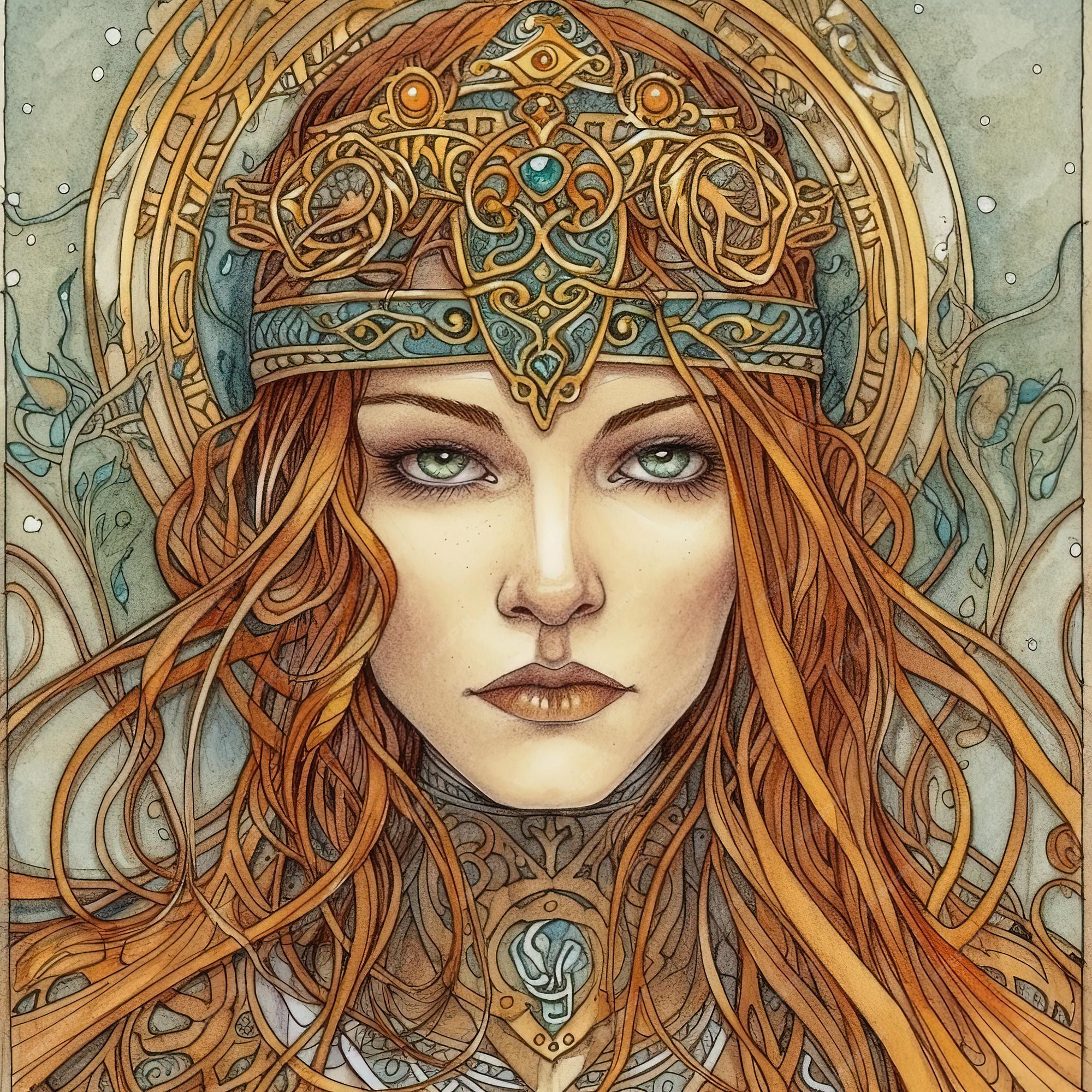
Source: FreePik
Brigid belongs to the Tuatha Dé Danann, the otherworldly people of Irish myth said to have ruled the island long before the Gaels arrived.
She’s a triple goddess, which means she holds three aspects at once: healer, poet, and smith. Some traditions treat those as one goddess wearing three hats. Others say there were genuinely three sisters all named Brigid, each with her own craft. Accounts differ, and honestly, the ambiguity suits her.
What everyone agrees on is the fire. Brigid is a goddess of flame in every sense: the hearth fire, the forge fire, and the spark of inspiration that makes a poet reach for the right word.
Poets adored her above all the other gods. She’s still invoked today by anyone looking for healing, creativity, or a little warmth in the dark. Her great feast, Imbolc, falls on the first of February, right when winter starts loosening its grip.
Titles
- The Exalted One (the literal meaning of her name)
- Bride
- The Fiery Arrow
- The Great Mother
- Brigid of the Tuatha Dé Danann
Characteristics
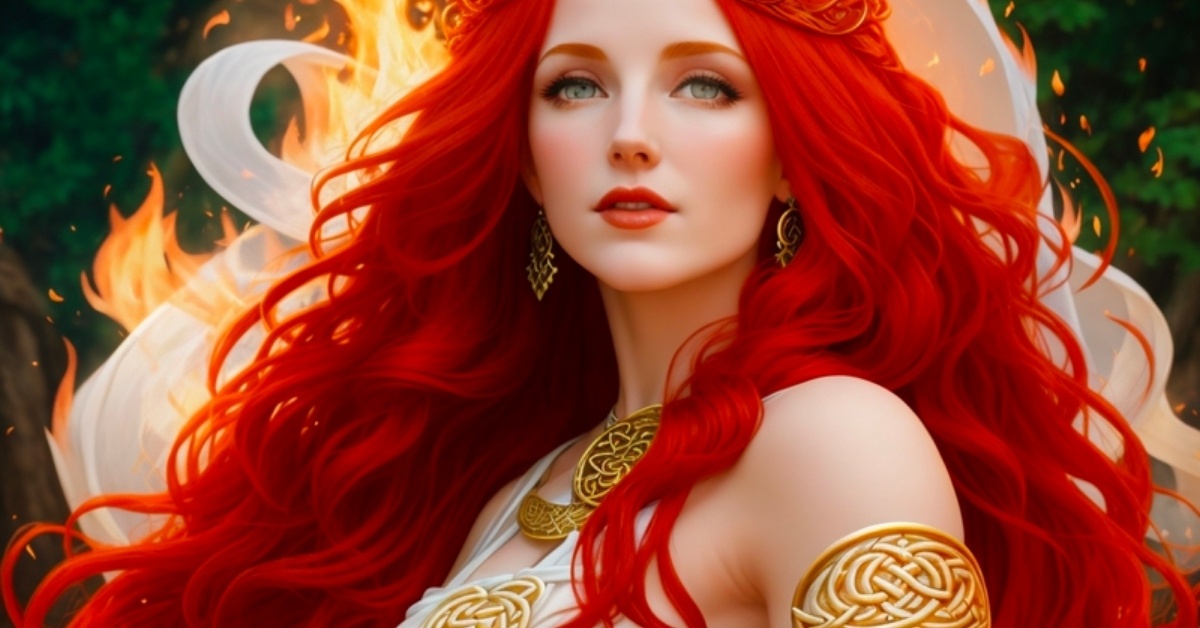
How Brigid tends to appear in art and legend:
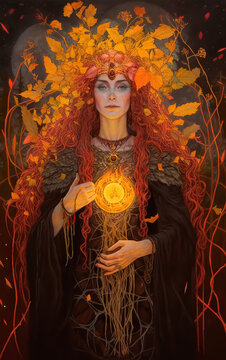
- Long, flowing auburn or fiery-red hair
- A warm, glowing radiance, more hearth-light than blinding sun
- Deep sea-blue eyes, often with a glint of mischief
- Frequently dressed in white, walking the woods as she wakes them from winter
- Almost always near a flame, usually cradling a sacred, ever-burning fire
- Sometimes appearing as a white swan, the bird that shares her link to poetry
Abilities
- Healing — she taught humans to mend the body with the plants of the earth
- Smithcraft — she works the hammer and anvil, forging tools and weapons
- Poetic inspiration — poets begged her to fill them with words as moving as her own
- Keeper of the sacred flame — she tends eternal fires and guards the hearth
- Prophecy and divination — she draws out hidden truths for those who ask
- Protector of livestock — she watches over cattle and the abundance they bring
Symbols
- Fire — the eternal flame, her most iconic symbol
- Sacred wells and springs — sites of healing pilgrimage across Ireland
- Cattle — standing for plenty, prosperity, and her care for the herds
- Brigid’s cross — woven from rushes to invite her protection into a home
- The white swan — her emblem of poetry and inspiration
- Snowdrops — the first flowers of Imbolc, heralding her return
Traits
- Compassionate and nurturing, quick to comfort anyone in need
- Fiercely protective of the weak and the vulnerable
- Endlessly creative, delighting in art and coaxing it out of others
- Warm on the surface, with a hard core of determination underneath
- Playful, with that flicker of mischief never quite hidden
Festivals and Rituals
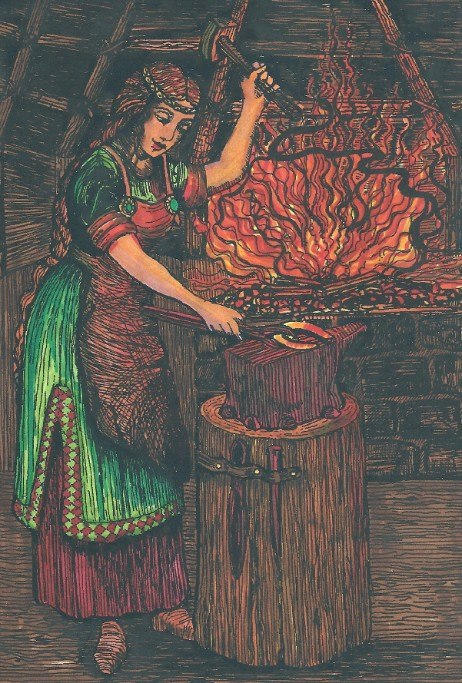
Source: The Green Man Store
Brigid’s day is Imbolc, the first of February, the old festival marking the turn from winter toward spring.
Communities once gathered in fields dotted with snowdrops to thank her for the renewal on its way. At dawn they lit candle after candle, a stand-in for the returning sun and for Brigid’s own flame, and a way of clearing out the last of winter’s dark.
The other great Imbolc tradition is the Brigid’s cross, woven from rushes and hung above the doorway to carry her protection into the house for the year.
Many of her holy wells still draw visitors today, who tie a ribbon or leave an offering and ask for her healing.
Legends associated with Brigid
Brigid may be eternal, but the old stories still give her a family, a beginning, and more than a few adventures. This is where she stops being a list of attributes and starts feeling like a person.
Where she comes from
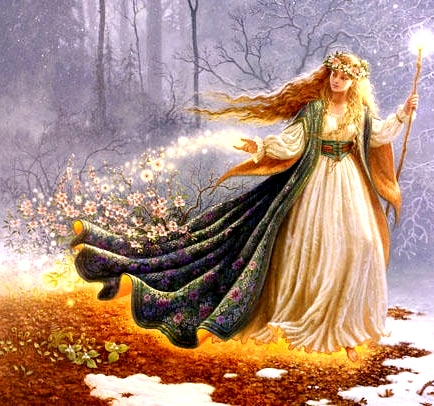
Source: Dark Emerald Tales
Brigid is a daughter of the Dagda, the great “good god” of the Tuatha Dé Danann, lord of abundance, magic, and wisdom. From him she inherits her divine blood and her deep tie to the natural world.
She married Bres, a king of the Tuatha Dé Danann who was half Fomorian. It was not a happy match for Ireland. Bres turned out to be a stingy, oppressive ruler, and his reign helped tip the Tuatha Dé Danann into war with the Fomorians.
Her name carries its own small mystery. Most scholars trace it to the Proto-Celtic Brigantī, “the exalted one” or “the high one,” linking her to the British goddess Brigantia. A ninth-century glossary offered a more poetic reading, breo-saighead, “fiery arrow.” That one’s now considered folk etymology rather than fact, but it stuck around because, well, it fits her perfectly.
The first keening in Ireland
There’s a moment in the medieval text Cath Maige Tuired, the Second Battle of Moytura, that turns Brigid from a goddess into a grieving mother.
Her son with Bres was a young man named Ruadán. During the great battle, Ruadán was sent to spy on and then kill Goibniu, the smith of the Tuatha Dé Danann. The plan failed. Goibniu struck him down with his own spear.
They carried the boy’s body back to Brigid.
What happened next, the old story says, had never happened before. “At first she shrieked, in the end she wept.” Standing over her dead son, Brigid made the first keening ever heard in Ireland, the wailing lament, half cry and half song, that Irish women would raise over their dead for the next thousand years.
The goddess of poetry invented grief’s own music. She did it the worst way anyone can, by needing it.
The sacred wells
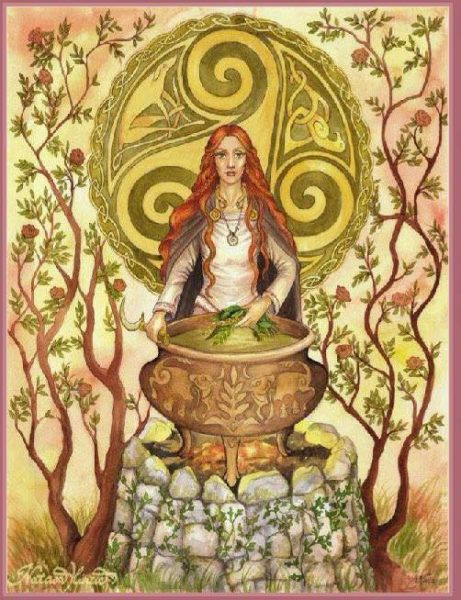
Source: Druidry
Brigid’s healing didn’t live only in the old tales. It pooled in water.
All across Ireland you’ll find holy wells that bear her name, and the tradition behind them is old and stubborn. The sick and the searching make the pilgrimage, drawn by tales of water that mends what medicine can’t.
The custom is simple and lovely. You approach the well, you make your prayer, and you tie a strip of cloth or a ribbon to the tree beside it. As the cloth weathers and fades, so, the belief goes, does the ailment you came to leave behind.
Whether or not the magic was ever real, the devotion was. Wells like the one at Kildare still draw a steady stream of visitors more than a thousand years on, their branches thick with ribbons.
Bride and the Cailleach

Source: Kickstarter
In Scotland, Brigid goes by Bride, and one of her best stories turns the entire turning of the year into a hostage drama.
The villain is the Cailleach, the blue-faced hag of winter. In the most common telling, she captures the young, beautiful Bride on the night of Samhain and locks her away inside Ben Nevis, the highest mountain in the land. The Cailleach is jealous. Bride is the personification of spring, so lovely that flowers bloom and ice melts wherever she walks, and the old woman of winter cannot stand the competition.
Bride waits in the dark of the mountain while the world stays frozen.
Then a young man dreams of her. He’s Angus Òg, the King of Summer and, in a twist worthy of any fairy tale, one of the Cailleach’s own sons. He sees the captive girl in his sleep and falls instantly in love. On the eve of Imbolc he rides out to find her and breaks her free of the mountain.
The moment they’re reunited, winter loses its grip. The snow softens. The first green pushes up through the ground.
The Cailleach rages, but her time is over. Accounts differ on her exact fate from here. In one strand of the tale she’s turned to stone until the cold returns. In another, she steals away to the Well of Youth, drinks its waters, and grows younger day by day, so that come autumn she can rise strong again, capture Bride, and start the whole cycle over.
That second version is the honest one. Spring always wins. And winter always comes back for a rematch.
Saint Brigid: the goddess who became a saint
Source: Adobe Stock
Here’s the twist that kept Brigid alive while the other Irish gods went quiet.
When Christianity arrived, the goddess wasn’t erased. She was absorbed. Her stories of compassion and healing carried over so completely that she re-emerged as Saint Brigid of Kildare, one of Ireland’s three patron saints, sharing the goddess’s feast day, her flame, and even her name.
Scholars still argue about how much of the saint is the goddess in disguise, and the honest answer is that the line was blurred on purpose. The miracle tales that grew up around Saint Brigid sound an awful lot like the deeds of a fire-and-abundance goddess. Here are three of the best.
The cloak that covered the Curragh
Brigid wanted land to build her monastery, so she went to the King of Leinster and asked him to grant her only as much ground as her cloak would cover.
The king looked at the small cloak on her shoulders and laughed, and agreed.
Brigid laid the cloak on the grass and had four of her followers each take a corner, walking east, west, north, and south. The cloak stretched. And stretched. It spread out across the whole fertile plain of the Curragh until the astonished king begged her to stop before she claimed his entire kingdom. He gave her the land, and her famous generosity began right there on that plain.
The cloak on the sunbeam
This one is small, but it’s the kind of story people remember.
Brigid came in from the wet Irish weather, took off her dripping cloak, and, with nowhere to hang it, draped it over a sunbeam slanting through the window. The cloak hung there in the light as if the beam were a wooden peg.
One version adds a perfect human touch. A monk named Brendan saw it and told his own servant to try the same trick. The servant’s cloak, of course, dropped straight to the floor.
Her generosity ran the same way as her miracles, freely and without much fuss. As a girl, the story goes, she was so quick to give away her father Dubthach’s food and possessions to the poor that he loaded her into a chariot to sell her to the King of Leinster, just to be rid of the expense. While he was inside negotiating, Brigid handed his jewelled sword to a passing beggar so the man could trade it for food for his family. The king, rather than being outraged, recognized her holiness and convinced her father to set her free.
The eternal flame at Kildare
At Kildare, the nuns of Brigid’s monastery kept a perpetual fire burning in her honor, and they kept it burning for centuries.
The clearest account comes from Gerald of Wales, writing in the late twelfth century. He recorded that nineteen nuns took turns guarding the flame, one each night. On the twentieth night, the last nun would lay the wood beside the fire and say, “Brigid, guard your fire. This is your night.” In the morning the wood would be burned and the fire would still be lit, tended, they believed, by Brigid herself.
The fire was ringed by a hedge that no man was permitted to cross.
It burned, by tradition, all the way from Brigid’s own lifetime until the suppression of the monasteries in the sixteenth century, when it was finally put out. And there it stayed, dark, for over four hundred years.
Then in 1993, the Brigidine Sisters relit it. The flame burns again today in Kildare, at their center, Solas Bhríde. Some fires, it turns out, are only resting.
Final thoughts
Brigid endures because she covers the things people never stop needing: healing when we’re hurt, words when we’re stuck, warmth when it’s cold, and a fierce protector when we’re small.
Light a candle on the first of February and you’re joining a chain of devotion that’s run unbroken for well over a thousand years. Through a goddess. Through a saint. And straight through to you.
Bibliography
- Cath Maige Tuired: The Second Battle of Mag Tuired. Trans. Elizabeth Gray. CELT: Corpus of Electronic Texts.
- Gerald of Wales (Giraldus Cambrensis). Topographia Hibernica, c. 1188.
- Gimbutas, Marija. The Living Goddesses. University of California Press.
- Monaghan, Patricia. Encyclopedia of Goddesses and Heroines. New World Library.
- Waldherr, Kris. The Book of Goddesses: Expanded Anniversary Edition. Art and Words Editions.
- “Bride, Angus and the Cailleach”. Folklore Scotland.
- “Brigid” and “Brigid of Kildare”. Wikipedia.
- “St. Brigid of Ireland”. Encyclopaedia Britannica.
- “The Perpetual Flame”. Solas Bhríde Centre.