Oya: The Yoruba Goddess of Storms and the Dead
Her name is a sentence. In Yoruba, ọ ya means “she tore,” and that is what the wind does to a roof, a field, a plan, or a life. The goddess is named for the sound of something being ripped open, and she has been called that for as long as anyone has been calling her anything.
Oya is the orisha of wind, lightning, and violent weather, the patron of the Niger River, and the one who stands at the gate of the cemetery. Everything about her sits on a seam: the moment before the rain, the border of the town and the graveyard, the crossing between the living and the ancestors. She is worshipped today across Nigeria, Benin, Brazil, Cuba, and the United States, in a tradition that has been practiced without interruption for centuries, which makes her a goddess in the present tense.
Overview of Oya
Oya belongs to the orisha, the powers of Yoruba religion who mediate between human beings and Olodumare, the supreme creator. She governs the winds that arrive ahead of a storm, the lightning that comes with them, and the tornado, which is her at full strength. She is also, at the same time, a river: the Yoruba call the Niger Odò-Ọya, Oya’s river, and she is understood to be the water as well as the weather over it.
Her worship has a geography and a history. Oya was traditionally venerated in the parts of Yorubaland that fell under the Oyo Empire, the powerful state centered on the city of Oyo in what is now southwestern Nigeria, and her cult spread outward with Oyo’s influence. When the transatlantic slave trade carried Yoruba people to the Americas, it carried her too. She is now worshipped in Brazilian Candomblé as Iansã, in Cuban Lucumí and Santería as Oyá or Yansá, and in the Yoruba revival communities of the United States and the Caribbean.
The most striking thing about her is the combination. She brings the destructive storm, and she brings the rain that ends the drought. She rules the cemetery, and she is a goddess of rebirth and fertility. She is a fighter who rides into battle beside her husband, and she is the one who oversees honesty in the marketplace. Yoruba tradition holds all of it together in one figure. The thing that tears open is the same thing that lets what is inside come out.
Her place in the tradition is drawn by relationship, and the genealogies shift from one lineage to the next. Oya married three times: first to Ogun, the orisha of iron and the forge; then to Shango, the thunder king; and finally to Oko, an orisha of farming and the hunt. Her fellow wives of Shango, Oshun and Oba, appear beside her constantly in the stories, sometimes as rivals and sometimes as allies. She is a close companion of Yemaja, the great water orisha, though the precise kinship between them varies from lineage to lineage and from country to country.
Titles
- Ọya-Ìyáńsàn — Mother of Nine
- Iansã, Yansá, Iyámsá — her names in Brazil and Cuba
- Ọya Orírí — the fierce one, one of her many named paths
- Patron of the Odò-Ọya, the Niger River
- Guardian at the gate of the cemetery
Characteristics
How Oya tends to be described, depicted, and danced:
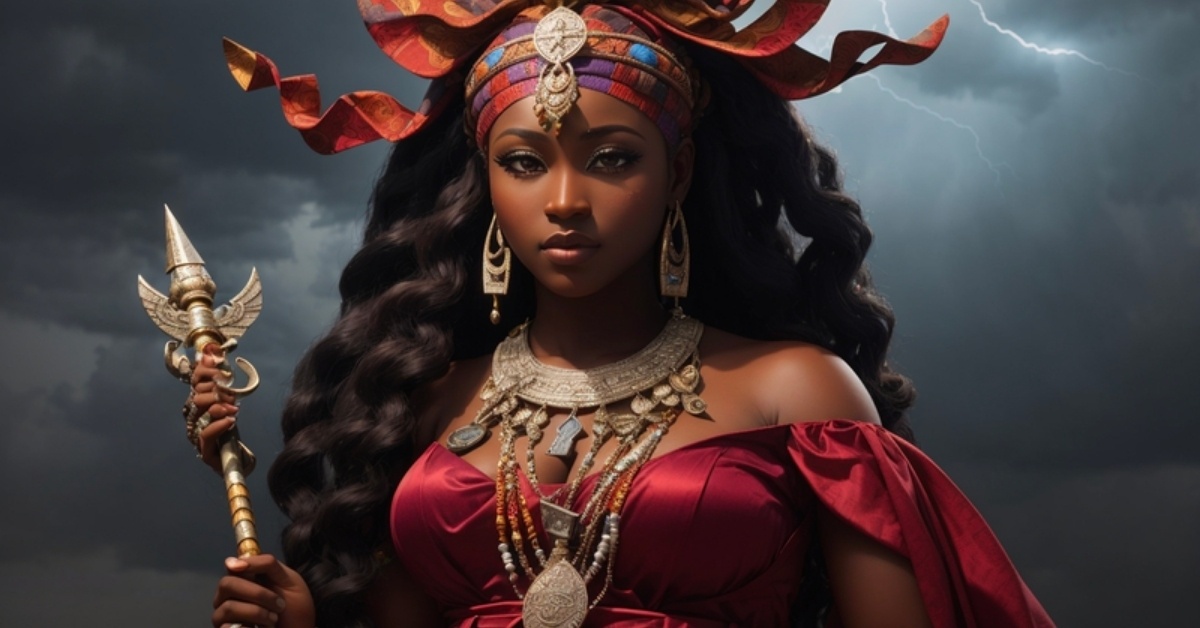
- A tall, formidable woman whirling in a skirt sewn from nine different colored cloths
- Crowned with buffalo horns, or carrying them, curved like a crescent moon
- Carrying the iruké, a horsetail whisk she uses to sweep spirits and misfortune away
- Armed with a copper sword or a machete, sometimes with a lightning bolt
- Never dressed in black, though her colors run to burgundy, deep red, and purple
- Masked, or moving among masked dancers, when she works with the ancestral dead
Symbols
- The buffalo — her other body, and forbidden to her priests to kill
- The whirlwind — the visible form she takes when she arrives
- Copper — her metal, worn as nine bracelets
- The number nine — in her cloths, her bracelets, the points of her crown, and her name
- The iruké — the horsetail flywhisk that moves the dead along
- The cemetery gate — the threshold she keeps, standing on the living side of it
The stories the Yoruba tell about Oya
Oya’s myths keep returning to a single question: what happens when something wild agrees to be domesticated, and then is insulted for what it is. The tellings differ from region to region and from lineage to lineage, and the differences are worth reading closely, because they are where the tradition does its arguing.
The buffalo woman and the hunter
The best-known story of Oya’s origin begins with a hunter who sees something he was never meant to see. In the version retold in most reference works, Ogun watches a magnificently horned water buffalo come out of the Niger, shed her animal form, and walk into the market as a beautiful woman. He follows her, falls in love, and, when she refuses him, tells her that he knows what she is. She agrees to marry him on one condition: he must never speak her secret aloud. Years later, in the middle of an argument, he shouts it. His other wives are listening at the door. Oya walks out of his house, takes back her buffalo shape, and returns to the river, which she has presided over ever since.
A markedly different telling is recorded in Patricia Ann Lynch and Jeremy Roberts’s African Mythology A to Z, under the title “The Red Buffalo Woman and the Chief of Hunters.” Here Ogun does not merely see the transformation, he steals what makes it possible. Watching from a platform in a tree, he sees the buffalo cow remove her hide at a termite mound and hides it in his house, so that when she comes looking for it she has no choice but to bargain. Her price is the same: the other wives must never know. In this version the betrayal is engineered. The senior wives get Ogun drunk until he lets the secret slip, then taunt the new wife for being an animal. She puts her hide back on, kills the wives who mocked her, and spares Ogun alone, because he had praised her. Before she goes she tells him her name is Oya, and gives him the right to call on her power by saying it.
The two versions put the emphasis in different places. In the first, the tragedy is a husband who could not hold his tongue. In the second, the story is about a woman whose skin was taken from her, who negotiated from that position anyway, and who took it back the moment she was insulted for what she was. The tradition holds both. What every version agrees on is the horns: Oya’s priests do not kill buffalo, and buffalo horns sit on her shrine.
Mother of Nine
Her most common praise name is Ọya-Ìyáńsàn, which is usually translated as “mother of nine,” and there are at least three attested explanations for it. The plainest is geographic. The Niger is traditionally described as having nine tributaries, and since Oya is the Niger, the nine branches are her nine children. A second explanation is mythological and painful: she gave birth to nine children who were all stillborn, and the number commemorates them. A third, recorded in the standard reference accounts, is the opposite of the second. In this version Oya was barren for most of her life, consulted a babalawo, a diviner of the Ifá tradition, and was told to make an offering of colored cloths, ram meat, and a great quantity of sea snails. She made it, and bore nine living children with her third husband, Oko.
The offering is the reason her devotees do not eat mutton, and the colored cloths are the reason her skirt is sewn from nine of them. Whichever explanation a lineage prefers, the nine ends up worn on her body. Nine cloths in the skirt, nine copper bracelets, nine points on the crown, nine charms hanging from it, and a river with nine mouths.
The one who can face the dead
Of everything attributed to Oya, this is the power that sets her apart from every other orisha. The Egúngún are the masked ancestral spirits of Yoruba religion, the returning dead who appear in cloth and dance among the living at festival. They are handled with enormous care, and contact with them is dangerous.
Oya is the orisha who can command them. The usual account credits Babalú-Ayé, the orisha of illness and healing, with granting her that authority after she danced before him without flinching when others would not come near. She is described as the only orisha capable of controlling the Egúngún, and her ritual whisk is the instrument she uses to move them. This is why her shrine sits at the edge of the cemetery rather than inside it, and why she is asked for at funerals: she is the one who conducts the newly dead from the town to wherever they are going, and the one who can turn them back at the gate.
Her work at the gate is a passage she manages. Yoruba tradition treats the cemetery as a place people move through, so her authority over the dead sits beside her fertility and her rain without any friction. She takes the wind out of the living world and puts it into the next one, then comes back for the harvest.
Oya and Shango
Her marriage to Shango, the thunder orisha and a deified Alaafin, or king, of Oyo, is the relationship most often depicted. Lightning and the wind that precedes thunder belong together, and the two of them fight side by side. In one widely told episode Oya takes a magical fire preparation belonging to Shango and gains the ability to breathe fire herself, and in some tellings of what follows she flees a quarrel with him and takes refuge with the water orisha Olokun and Olosa.
The two of them are presented as a pair with two jobs. Oya rides at the front of his campaigns; the wind arrives before the storm does. When Yoruba praise poetry describes them, Shango’s thunder is the arrival, and Oya is the announcement that something is coming.
Oya across the ocean
The forced migration that carried Yoruba people to the Americas changed the surface of Oya’s worship and left the core of it intact. Under Catholic pressure, enslaved practitioners matched their orisha to saints whose imagery could stand in for them, and Oya was matched to more than one. In parts of Cuba she is identified with Saint Barbara, the martyr whose legend ends in a lightning strike, and with the Virgin of Candelaria, whose feast falls on February 2. Elsewhere she is identified with Saint Teresa of Ávila, whose feast is October 15. The doubling is a good record of what happened: different communities reached for whichever saint was available to them, and the match worked as cover for a practice that continued underneath it.
In Brazil she is Iansã, one of the most prominent figures in Candomblé, greeted with the salute Eparrei! Her offerings include acarajé, the fried black-eyed pea fritters sold on the streets of Salvador that began as ritual food for her. She is associated with red in the Angola-Congo houses, and her day is Wednesday. Anyone who has eaten acarajé from a Bahian street vendor has eaten something that was made for a storm goddess first.
Her modern afterlife runs further than that. The scholar Judith Gleason spent years across West Africa and the Caribbean gathering her songs and praise poetry for Oya: In Praise of the Goddess, still the fullest single treatment of her in English. Readers also keep noticing the overlap between Oya and Marvel’s Storm, an African weather-controlling figure worshipped as a goddess in her own backstory, and a fair number of people have arrived at the orisha by way of the comic.
Final thoughts
Oya is the goddess of the moment the air changes. Her name is the sound of tearing, her body is a river with nine branches, her other body is a buffalo, and her post is the gate where the living hand the dead over. She is the only orisha the ancestral masqueraders will answer to, and the same goddess people ask for rain, for a fair market, and for the courage to walk away from a house where they have been insulted.
What the stories keep insisting on is the moment the marriage breaks. In every version of the buffalo myth, it happens when someone treats what she is as an embarrassment to be shouted about.
Oya put the hide back on the moment someone made her ashamed of wearing it. Which part of yourself are you ready to put back on?
Bibliography
- “Ọya”. Wikipedia. On the etymology of her name, the Oyo-Empire geography of her cult, the three marriages, the nine children, the Egúngún authority, and the Candomblé and Santería identifications.
- Lynch, Patricia Ann, and Jeremy Roberts. African Mythology A to Z, 2nd ed. Chelsea House. The source of “The Red Buffalo Woman and the Chief of Hunters”, the hidden-hide variant of the buffalo myth.
- Gleason, Judith. Oya: In Praise of the Goddess. Shambhala. Fieldwork on Oya’s songs, praise poetry, and ritual across West Africa and the Caribbean.
- Kapach, Avi. “Oya”. Mythopedia. On the buffalo association, the gate of death, and the fire-medicine episode with Shango.
- Fatunmbi, Awo Fá’lokun. Ọya: Ifá and the Spirit of the Wind. Original Publications. Cited in the standard reference accounts of her wind attributes.
- “Oya”. Encyclopedia of African Religion, SAGE Reference.
- “Oya, The Yoruba Rain Goddess”. The Guardian (Nigeria). On her contemporary reputation and the nine-children story.