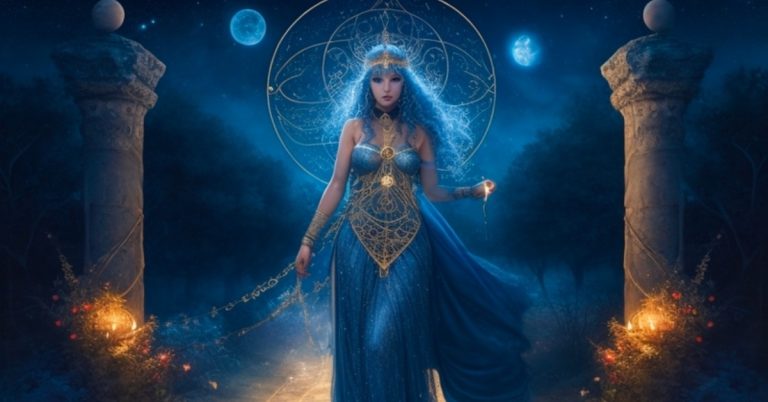
Freya: Goddess of Love, War, and Magic
Freya is the goddess Norse myth never quite manages to simplify.
Call her up and most modern retellings hand you the same two words: love and beauty. That’s true as far as it goes. But the oldest poems that mention her show someone harder to file away. A woman whose fury shakes the halls of Asgard hard enough to break jewelry off her own neck. A war leader who claims first pick of the battle-dead before Odin gets the rest. The one who taught the king of the gods the magic he later becomes famous for. Beauty was never the whole story, and the sources never treated it as one.
She is Freyja to the people who first told these tales, Old Norse for “Lady,” and in a mythology thin on surviving detail about its goddesses, she is one of the best documented figures in it.
Overview of Freya
Freya belongs to the Vanir, an older family of Norse gods tied to fertility, wealth, and magic, distinct from the war-and-sky-focused Aesir who include Odin and Thor. After a war between the two divine families ended in stalemate, Freya came to live among the Aesir in Asgard as a hostage of the peace, alongside her father Njörðr and her twin brother Freyr (Ynglinga saga, ch. 4). She never stopped being Vanir in spirit. She brought Vanir magic with her, and the Norse sources rank her among the most powerful figures in either family: in Snorri Sturluson’s Prose Edda, she is named second only to Frigg, Odin’s wife, among the goddesses of Asgard (Gylfaginning).
She keeps her own hall, Sessrúmnir, in a realm called Fólkvangr, “field of the host,” and travels by chariot, pulled by two cats.
Titles
- Freyja, “Lady,” the plain meaning of her name
- Vanadís, “Lady of the Vanir”
- Vanabrúðr, “Bride of the Vanir”
- Mistress of Fólkvangr
Abilities
- Seiðr: a form of Norse magic tied to prophecy and the shaping of fate. Ynglinga saga credits Freya as the one who taught it to the Aesir, “as was customary among the Vanir.” Odin’s own famous seiðr practice traces back to her.
- Shapeshifting flight: she owns a cloak of falcon feathers that lets its wearer travel between worlds. In Þrymskviða, she lends it to Loki without a moment’s hesitation so he can search for Thor’s stolen hammer.
- Choosing the slain: per Grímnismál, Freya governs Fólkvangr and takes first choice of half the warriors who die in battle each day. Odin gets the other half, for Valhalla. Where you ended up after death depended on how you died. Those who died of age or sickness went to a colder hall altogether, ruled by Hel.
- Turning grief to gold: her tears for her absent husband Óðr are said to fall as gold. Norse poets used “Freyja’s weeping” as a kenning, a poetic stand-in, for gold itself.
Symbols
- Brísingamen, her necklace, the center of two different origin stories (see below)
- The falcon-feather cloak
- Her cat-drawn chariot
- The boar Hildisvíni, who in one tale is her mortal protégé Óttar wearing a disguise
- Amber, tied in later folklore to her tears
Traits
- Direct and quick to fury. Offered as a bride to ransom Thor’s hammer, Freya refuses outright, and the poem says her anger shakes the halls of Asgard hard enough to snap Brísingamen from her throat.
- Openly wanting. The sources describe her desiring things, a necklace, a lover, safety for the people she favors, plainly and without apology. That’s unusual in a body of myth mostly written down by Christian scribes who were not especially comfortable with female desire.
- A teacher as much as a fighter. Ynglinga saga credits her as the one who actively taught seiðr to the Aesir.
Legends associated with Freya
Freya’s stories don’t stay in one lane. They move from a war between two families of gods to a stolen hammer to a magic only she could teach, each one complicating the “goddess of love and beauty” label a little further.
A hostage of a war between gods
Freya’s origin is bound up with a war. The Aesir-Vanir war ends without a clear winner, and the two families seal the peace by trading hostages: Freya, Freyr, and Njörðr go to live among the Aesir, while Hœnir and Mímir go to the Vanir (Ynglinga saga, ch. 4; Vafþrúðnismál, st. 39). Most scholars don’t read this as a record of an actual battle. It reads more like myth-logic, a story explaining how two distinct religious traditions, the sky-and-war Aesir and the fertility-and-wealth Vanir, ended up worshipped side by side in the same pantheon.
Her family ties come with an uncomfortable detail. The Poetic Edda preserves it as an insult: in Lokasenna, the trickster god Loki taunts Njörðr for having fathered Freyr on his own sister (st. 36). It’s ugly, and it’s in the source text. Norse scholarship treats it as exactly what it looks like: Loki scoring a cheap shot in an insult match.
The necklace with two different stories
Ask where Brísingamen came from and you’ll get two different answers, depending on which book you’re holding.
The older attested version, preserved in the Prose Edda‘s Skáldskaparmál (which quotes the earlier skaldic poem Húsdrápa), has Loki and the watchman god Heimdallr fighting over the necklace in seal form, Loki stealing it, Heimdallr recovering it. No dwarves, no bargain.
The version most people know today comes from Sörla þáttr, a much later short story preserved in the Flateyjarbók, compiled in the late 1300s by two Christian priests. There, four dwarf brothers forge the necklace and offer it to Freya for a price: one night with each of them. She agrees, and gets her necklace. It’s a vivid story, and worth telling, but it belongs to a text written some three centuries after Christianity had already reshaped how these old gods were remembered, folding them into a moralized, quasi-historical frame. The earlier telling and the later one aren’t really the same story wearing different details. They’re separated by hundreds of years and a different worldview.
Thor in a wedding dress
Freya’s best-known myth barely centers her, and that’s part of what makes her role in it so striking. In Þrymskviða, the giant Þrymr steals Thor’s hammer and will only return it in exchange for Freya’s hand in marriage. The gods ask her to go. She refuses so completely that the poem describes the halls of the Aesir shaking and her necklace falling from her neck in fury. So Heimdallr proposes a workaround: dress Thor as the bride instead. Thor, veiled and resentful, eats an ox and eight salmon at the wedding feast and reclaims his hammer once it’s laid in the disguised “bride’s” lap to bless the marriage.
The comedy in the poem targets Thor’s indignity. Freya barely appears past her refusal, and what she does get is treated with real narrative weight: her fury is the reason the whole absurd plan is necessary in the first place.
Fólkvangr and the choosing of the dead
Grímnismál names Fólkvangr as one of the great halls of the Norse afterlife and states plainly that Freya rules it, choosing half of every day’s battle-dead for her own hall before Odin claims the rest for Valhalla. It’s a detail modern retellings tend to skip in favor of her softer titles, but it’s right there in the primary source: Freya is a death goddess as much as a love goddess, presiding over slain warriors on equal footing with Odin himself.
Freya, Frigg, and the goddess before both of them
Here is where Freya’s story gets genuinely uncertain, and that uncertainty is worth sitting with.
Snorri’s Prose Edda ranks Freya “next to Frigg,” meaning just below her, among the goddesses of Asgard. The two also share a specific, oddly matched detail: both are credited, in separate sources, with owning a set of falcon feathers usable for shapeshifting. Norse scholars have long noticed that Frigg and Freya overlap in more ways than their names suggest. The scholar Stephan Grundy, surveying the question in The Concept of the Goddess, put it cautiously: whether Frigg and Freya were originally a single goddess “is a difficult one, made more so by the scantiness of pre-Viking Age references to Germanic goddesses,” and the most honest thing a modern account can do is lay out the arguments rather than declare a winner.
Some of those arguments reach back further still, to a goddess named Nerthus, described by the Roman historian Tacitus around 98 CE as a “Mother Earth” figure worshipped by a confederation of Germanic tribes, her image carried in procession on a sacred wagon (Germania, ch. 40). Linguistically, Nerthus is the earlier form of the name that becomes Njörðr, Freya’s own father. Scholars including Britt-Mari Näsström have pointed to this, along with watery, fertility-coded place-names tied to Frigg’s own halls, as evidence that Nerthus, Njörðr, Frigg, and Freya may all trace back to one older fertility deity that split, over centuries, into the more specialized gods the Eddas describe. Not every scholar agrees. Gro Steinsland has pushed back on the “Great Goddess” reading specifically for Freya, arguing she isn’t tied to earth and motherhood the way a true Nerthus-style figure would be. The debate stays open.
A second, separate mystery orbits the same territory. Völuspá describes a being named Gullveig, “gold-drunk” or “gold-greed,” who practices seiðr and is speared and burned three times by the Aesir yet keeps surviving, an event some read as the spark that starts the Aesir-Vanir war outright. A number of scholars, including Rudolf Simek, have proposed that Gullveig is Freya herself under another name. Others read her as a personification of gold or greed rather than a version of Freya at all. Like the Frigg question, this one has no settled answer, only a live scholarly conversation.
Freya today
Compared to some goddesses, surprisingly little survives about organized worship dedicated specifically to Freya. The clearest ancient ritual evidence from her wider family belongs to Nerthus’s wagon procession, and later, a similar wagon cult tied to her brother Freyr, recorded by the medieval chronicler Adam of Bremen at the temple in Uppsala.
One correction, since it circulates widely online: modern Heathen and Ásatrú communities keep a harvest holiday called Freyfaxi. It has no ancient attestation as a Freya festival, or as anyone’s festival. Freyfaxi is a horse in Hrafnkels saga, belonging to Freyr, her twin brother. The modern holiday was coined in 1974 by the American Ásatrú Free Assembly, modeled on the Wiccan calendar. It’s a real, sincerely observed modern practice. It just isn’t ancient, and it was never Freya’s to begin with.
These days, Freya lives on mostly through story. She’s a recurring figure in fiction, comics, and games (2018’s God of War recast her as “the Witch in the Woods”). Even her name lingers in an unsettled place: English speakers still can’t fully agree whether “Friday” was originally Frigg’s day or hers, the same tangled identity question raised above, playing out in a word people use every week without a second thought.
Final thoughts
Freya’s myths never settle for one version of her. She refuses a marriage that would save a god’s hammer, and her grief drips gold. She teaches magic to the king of the gods, and might, under another name entirely, be the spark that starts a war between two families of gods. Two different centuries wrote two different stories about how she got her own necklace, and neither one erased the other.
Eleven hundred years after the last of these poems was written down, scholars are still arguing about who she really is, and whether she was ever fully separate from Frigg to begin with. Most goddesses don’t draw that kind of scrutiny this far out. Freya does, and the argument shows no sign of ending.
Bibliography
- Freyja. Wikipedia.
- Freya. Norse Mythology for Smart People (Daniel McCoy).
- Seidr. Norse Mythology for Smart People.
- Folkvang. Norse Mythology for Smart People.
- Freyja. World History Encyclopedia.
- Brísingamen. Wikipedia.
- Sörla þáttr. Wikipedia.
- The Poetic Edda, translated by Carolyne Larrington. Oxford University Press.
- The Prose Edda, translated by Anthony Faulkes. Everyman.
- Heimskringla (Ynglinga saga), translated by Lee M. Hollander. University of Texas Press.
- Grundy, Stephan. “Freyja and Frigg.” In The Concept of the Goddess, edited by Sandra Billington and Miranda Green, Routledge, 1998.
- Näsström, Britt-Mari. Freyja: The Great Goddess of the North. University of Lund, 1995.
- Simek, Rudolf. Dictionary of Northern Mythology, translated by Angela Hall. D.S. Brewer, 1993.
- Lindow, John. Norse Mythology: A Guide to the Gods, Heroes, Rituals, and Beliefs. Oxford University Press, 2001.