Idun: Norse Goddess of Youth and the Golden Apples
The gods of Asgard aged like anyone else.
Odin, Thor, Freyja, the whole war-band of the north went gray on a schedule, and the only thing that reset the clock was a box of ash wood carried by a goddess with almost no lines. She opened it, handed around the fruit inside, and the gods were young again until the next time.
Her name is Idun. The Eddas give her one story, and it’s the story of the day she was stolen.
Overview of Idun
Idun (Old Norse Iðunn, also spelled Idunn, Ithun, or Iduna) is a goddess of the Aesir, the ruling family of the Norse gods, and the wife of Bragi, god of poetry. Her home is Asgard, and her whole job is a single one: she keeps the apples the gods eat to stay young.
Snorri Sturluson lays it out in the Gylfaginning section of his Prose Edda. Idun keeps in her ash-wood box the apples the gods must bite into when they grow old, and then they become young again, and so it will go until Ragnarök. His narrator adds the obvious worry: a great deal rides on Idun’s good faith and care.
She is a thin presence in the sources for a goddess that important. She turns up in a skaldic poem from around 900, in one flyting scene in the Poetic Edda, and in Snorri’s retellings. When Snorri gives his roll call of sixteen goddesses, Frigg first, Gefion fourth, wise Snotra thirteenth, Idun is missing from the list. She gets her entry earlier, tucked under her husband’s.
Her name is usually read as “the rejuvenating one” or “ever young.” That reading matters more than it sounds, and we’ll come back to it.
Titles
- Keeper of the Apples (a kenning from Skáldskaparmál)
- Wife of Bragi
- The Gods’ Lady (from the poem Haustlöng)
- The Maid Who Knew the Aesir’s Cure for Old Age (Haustlöng)
- Thjazi’s Booty (a kenning coined after her abduction)
Characteristics
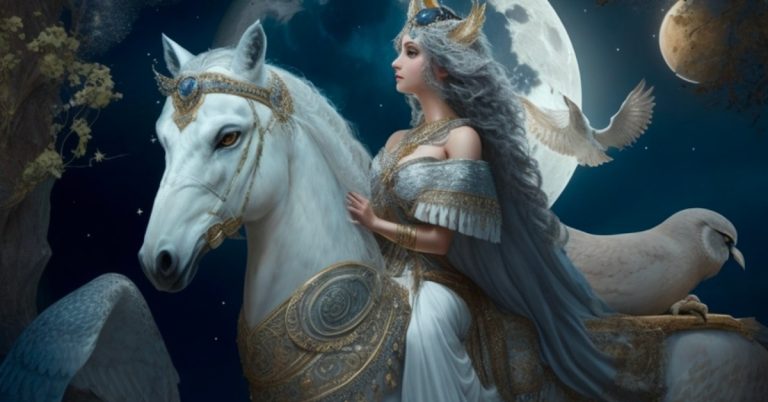
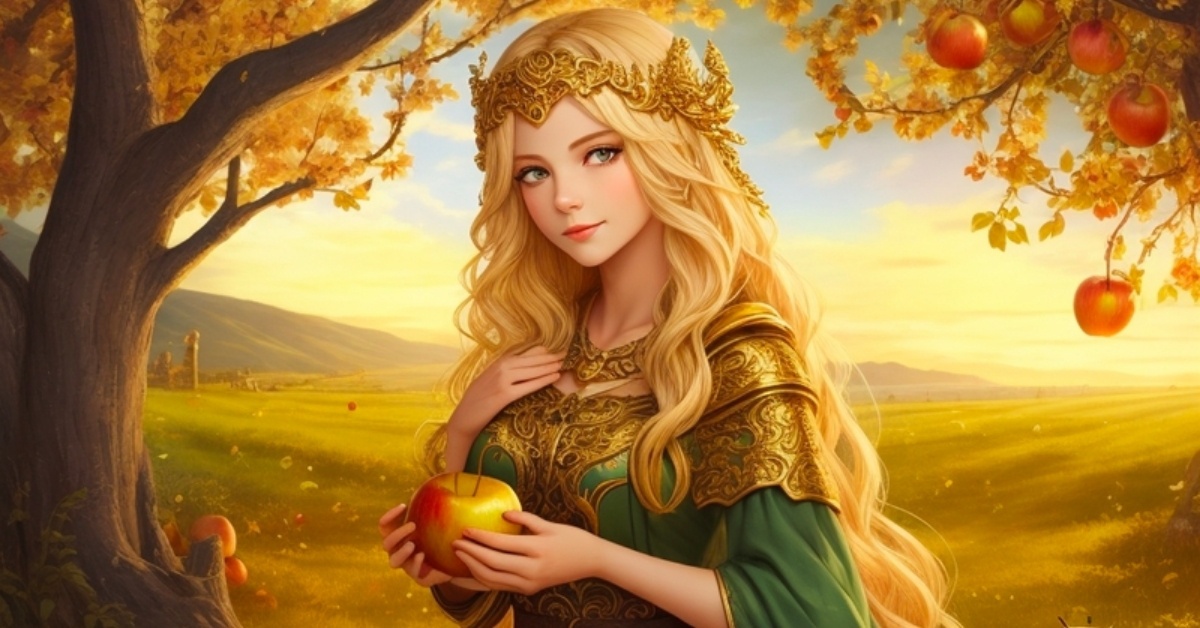
The Eddas describe her hardly at all. Loki mentions her “arms, washed bright,” and Haustlöng calls her a maid. The rest is later art, mostly nineteenth-century Scandinavian painters, and it settled into a type:
- Young, fair, with long golden hair
- Dressed in green or white, often in an orchard or at the foot of Yggdrasil
- Carrying a basket or a wooden box of apples
- Usually offering a fruit to another god
- Sometimes shown small against an eagle’s shadow, the moment of her taking
Abilities
- Guardianship of the apples — the gods keep their youth only while she holds the fruit and shares it
- Rejuvenation in her own right — if her name means “the rejuvenating one,” the power may sit in the goddess as much as in the box
- Peacemaking — at Aegir’s feast she is the one who tries to talk Bragi down before Loki’s insults turn to blows
- Trust — a double-edged one; she walks into the woods on Loki’s word, and that is the whole hinge of her myth
Symbols
- The apples — the Aesir’s remedy against old age, as the skalds called them
- The ash-wood box — the eski she keeps the fruit in
- The nut — the shape Loki turns her into to carry her home
- The eagle and the falcon — the two bird-shapes of her abduction and her rescue
- The orchard — a later symbol, but it stuck
Traits
- Trusting to a fault
- Loyal to Bragi, and quick to defend him
- Calm under insult; she answers Loki once and leaves it there
- A keeper, and the only god whose loss ages all the others
Festivals and Rituals
Here the honest answer is short. No temple, place-name, or festival for Idun survives from the Viking Age. Modern books that describe an “apple festival” in her honor are inventing.
What the ground gives us is fruit in graves. The Oseberg ship burial in Norway, from 834, held buckets of wild apples laid in with two women. Nuts and fruit turn up in other early Germanic graves in England and on the continent, which is the kind of offering you make when fruit means something beyond food.
Idun does have a modern cult. Heathen groups honor her at spring and at the equinoxes, and The Troth, the largest Heathen organization in the United States, named its journal Idunna after her.
Legends associated with Idun
Idun’s whole surviving story fits inside one myth and one feast. Both deserve a slow telling, because the myth is one of the best-built stories in the north: a trickster caught, a goddess stolen, the gods withering, and a chase that ends in fire.
The ox that would not cook
It starts with three gods on a road. Odin, Loki, and Hoenir were traveling through the mountains and came into a valley with a herd of oxen. They killed one, dug an earth oven, and waited.
The meat would not cook. They opened the pit, and it was raw. They closed it and waited again, and it was still raw.
A voice from an oak above them explained why. A huge eagle sat in the branches, and it told them the ox would cook the moment they gave it a share. The gods agreed. The eagle dropped down and helped itself to both hams and both shoulders.
Loki lost his temper and swung a pole at it with both hands.
Loki’s bargain in the treetops
The pole stuck to the eagle. Loki’s hands stuck to the pole. The eagle lifted off, low enough that Loki’s legs dragged over stones and gravel and trees, and he was sure his arms would tear out of his shoulders.
He begged. The eagle named its price. The bird was the giant Thjazi in feathers, and he would set Loki down only if Loki swore an oath to bring Idun out of Asgard, and her apples with her.
Loki swore. That’s the whole of his heroism in this story: he’d promise anything to stop hurting.
Idun walks into the woods
Back in Asgard, Loki went to Idun with a story. He’d found apples in a wood outside the walls, he said, and they looked to him finer than hers. Wouldn’t she come see? She should bring her own for the comparison.
She went. She took the box.
Thjazi came down as an eagle, took her up in his claws, and flew her north and east to Thrymheim, his hall in the mountains of Jotunheim. The gods’ cure for old age was gone, and so was the one person who knew how to keep it.
The gods go gray
Nobody noticed at first. Then the gods started to age. Their hair went gray, their skin loosened, and the change did not stop.
They called a Thing, the assembly where the Norse settled hard questions, and asked each other one thing: who saw Idun last? The answer came back the same from everyone. She was last seen leaving Asgard with Loki.
They seized him. The terms were plain: death and torture unless he brought her back. Loki, who had sold her to save his arms, now offered to fetch her to save his neck, on one condition. He needed Freyja’s falcon cloak, the feathered skin that let its wearer fly as a bird.
Freyja lent it.
A falcon, a nut, and a fire at the wall
Loki flew north to Thrymheim and found luck waiting. Thjazi had rowed out to sea, and Idun was alone in the hall.
Loki turned her into a nut, closed his claws around her, and went for home as fast as a falcon flies.
Thjazi came back, found his prize gone, and put on his eagle shape. He was the bigger bird by far, and the rushing of his wings closed the distance mile by mile. By the time the falcon crossed into Asgard’s sight, the eagle was almost on it.
The gods had been watching. They had heaped the courtyard inside the wall with wood shavings. The falcon dropped in over the rampart and, the instant it was safe, they put fire to the pile. The eagle could not check its speed. It plunged into the blaze, its feathers caught, and it fell inside the gate, where the gods killed it. Snorri adds that the killing is much talked of, which in Norse is high praise.
Idun was set back on her feet. The box was opened. The gods ate, and were young.
Skadi comes for her father
The story has an aftermath, and it’s one of the best turns in the Eddas.
Thjazi had a daughter, Skadi, and she came to Asgard in helmet and mail to avenge him. The gods, who had just finished killing her father in their own yard, offered terms. She could choose a husband from among them, sight unseen except for his feet. And they had to make her laugh, which she was certain they could not do.
She looked at the row of feet and picked the handsomest pair, thinking they were Balder’s. They belonged to Njord, the old sea-god. Then Loki tied one end of a cord to a goat’s beard and the other to his own testicles, and the two of them shrieked back and forth until Skadi laughed despite herself. To seal it, Odin took Thjazi’s eyes and threw them into the sky, where they burn as two stars.
Idun’s theft, in other words, put a giantess in the family of the gods. The ripples run a long way from one walk into the woods.
The feast where Idun speaks
The only place Idun opens her mouth is Lokasenna, the poem where Loki crashes a feast in Aegir’s hall and insults every god in turn.
When he rounds on Bragi, Idun steps in. She asks her husband to think of his kin, blood and sworn, and to let the taunt pass. Loki turns on her instead. Be quiet, he says; of all women you are the most man-crazy, since you put your bright-washed arms around your brother’s killer.
Idun answers once. She was calming Bragi, she says, who had been drinking. She wants no fighting between the two of them. That is her last line in the mythology.
As for the brother and his killer, no surviving story explains them. Scholars mostly read Loki’s charges here as barbs built to be impossible to disprove.
An older Idun?
Snorri wrote the word “apples.” His oldest source never did.
Haustlöng, composed around 900 by Thjodolf of Hvin, tells the abduction in full and names Idun only by what she knows: the Aesir’s cure for old age. The fruit goes unnamed. The word Snorri uses three centuries later, epli, is looser than the English “apple” too. In Old Norse it could cover any fruit or nut, and cultivated apples of the modern kind reached Scandinavia late in the Middle Ages. Turville-Petre and the folklorist Hilda Ellis Davidson both flag this. It sits oddly well with the story itself, where Loki brings Idun home as a nut.
Davidson pushed further. Apples and nuts, she noted, were laid in early Germanic graves as symbols of fertility, and they keep surfacing in the old poems at moments of new life. In Skírnismál, Freyr’s servant offers golden apples to win the giantess Gerd. In the Völsunga saga, Frigg sends a king an apple, his wife eats it, and the hero Völsung is born. An eleventh-century skald speaks of “apples of Hel,” fruit for the dead. On that evidence Davidson read Idun as a dim reflection of an older figure, a guardian goddess of the life-giving fruit of the otherworld.
The name points the same way. If Iðunn means “the rejuvenating one,” John Lindow observes, then the goddess herself may be the source of the gods’ youth, with the box a later prop. Rudolf Simek allows that the apple motif could have been touched by classical tales of the Hesperides, but adds that any such borrowing could have happened long before anything was written down. David Knipe went wider still and set the myth beside an Indo-European pattern, the eagle who steals the means of immortality, with an Irish cousin in the three brothers who turn themselves into hawks to raid a garden of sacred apples. Richard North, more cautiously, suggests she may be an aspect of Freyja, the goddess the gods rely on for beauty.
All of this stays open, and the honest version keeps it that way. Idun may have started as a fertility goddess whose fruit was fruit in general; she may always have had apples; the apples may be a poet’s gloss on a power that was hers by name. What every reading shares is the older shape underneath: the gods’ youth belongs to a woman, and she can be lost.
Idun across cultures
Fruit that keeps the gods young is a story people keep telling, and Idun’s neighbors are good company.
The Greeks had the golden apples of the Hesperides, Gaia’s wedding gift to Hera, planted at the western edge of the world and guarded by nymphs and the dragon Ladon. Heracles had to steal them for his eleventh labor. In China, the Queen Mother of the West keeps the peaches of immortality, which ripen once every few thousand years and are served at a banquet of the immortals. The Monkey King, Sun Wukong, is set to guard the orchard and eats the peaches himself, another guardian, another theft. Irish tradition has Emain Ablach, the Isle of Apples, where the sea-god Manannán’s fruit never fails and never rots; a silver apple-branch from that island is what sends Bran on his voyage, and the same island is a likely root of Arthur’s Avalon.
The pattern is close enough to notice and loose enough to distrust. Scholars have argued both ways: that these are cousins descended from a shared Indo-European myth, or that people who bury fruit with their dead will arrive at a fruit-of-life goddess on their own. Idun’s story can carry either answer.
Her afterlife is its own small comedy. Wagner folded her into Freia in Das Rheingold, so the goddess whose golden apples keep the gods young sings under Freyja’s name. Sweden’s women’s magazine Idun (1887–1963) put her and her basket on its masthead. A volcano on Venus is Idunn Mons. And in 2024 the Swedish Maritime Administration renamed an icebreaker Idun, saying the ship would “rejuvenate” an aging fleet. Eleven hundred years on, she is still the one you name when you want something to stop growing old.
Final thoughts
Strip Idun’s story to its bones and it is about dependence. The strongest gods in the north could kill giants, forge hammers, and read the future, and every one of them went gray the day one woman stepped outside the wall.
Asgard’s youth was kept for the gods by a goddess they left off the list, and they learned her worth by losing her. Snorri’s narrator said it first: a great deal rides on Idun’s good faith.
So here is the question she leaves behind: who, or what, is keeping you young right now, and when did you last notice them at work?
Bibliography
- Snorri Sturluson. The Prose Edda, “Gylfaginning” ch. 26 and 35. Trans. Arthur Gilchrist Brodeur, 1916. Sacred Texts.
- Snorri Sturluson. The Prose Edda, “Skáldskaparmál” (the Thjazi episode). Trans. Arthur Gilchrist Brodeur, 1916. Sacred Texts.
- Lokasenna, stanzas 16–18. The Poetic Edda, trans. Henry Adams Bellows, 1936. Sacred Texts.
- Thjodolf of Hvin. “Haustlöng”. Wikipedia.
- Mark, Joshua J. “Idunn”. World History Encyclopedia, 2021.
- McCoy, Daniel. “Idun”. Norse Mythology for Smart People.
- Davidson, Hilda Ellis. Roles of the Northern Goddess. Routledge, 1998.
- Lindow, John. Norse Mythology: A Guide to the Gods, Heroes, Rituals, and Beliefs. Oxford University Press, 2001.
- Simek, Rudolf. Dictionary of Northern Mythology. Trans. Angela Hall. D.S. Brewer, 2007.
- Turville-Petre, E.O.G. Myth and Religion of the North. Weidenfeld and Nicolson, 1964.
- “Iðunn”, “Þjazi”, and “Skaði”. Wikipedia.
- “Apples of the Hesperides”, “Peaches of Immortality”, and “Emain Ablach”. Wikipedia.
- “Idunna”. The Troth.