Izanami: The Goddess Who Made Japan and Became Death
Izanami made an entire country by stirring the ocean with a spear. She died giving birth to fire. Then she came back as the goddess who decides how many of us die every single day.
Most creation myths stop at the making. Izanami’s keeps going, past the islands and the other gods, straight into the underworld, and doesn’t apologize for what it finds there.
Overview of Izanami
Izanami-no-Mikoto, “she who invites,” is one of the two primordial deities of Shinto myth, paired with her brother and husband Izanagi. Together they are credited with creating the Japanese islands and giving birth to most of the kami who followed, the gods and spirits at the center of Shinto belief. The Kojiki and the Nihon Shoki, Japan’s oldest chronicles, are the main sources for her story, both compiled in the early eighth century from older oral tradition.
Izanami’s story runs in two acts. In the first, she is the mother of a nation, standing on the bridge between heaven and earth to bring land and gods out of the formless sea. In the second, after her death, she becomes Yomi’s ruler, the goddess of the underworld and, by her own word, of death itself.
Titles
- Izanami-no-Mikoto (“she who invites”)
- The mother of the eight great islands
- Goddess of creation
- Ruler of Yomi, the land of the dead
Characteristics
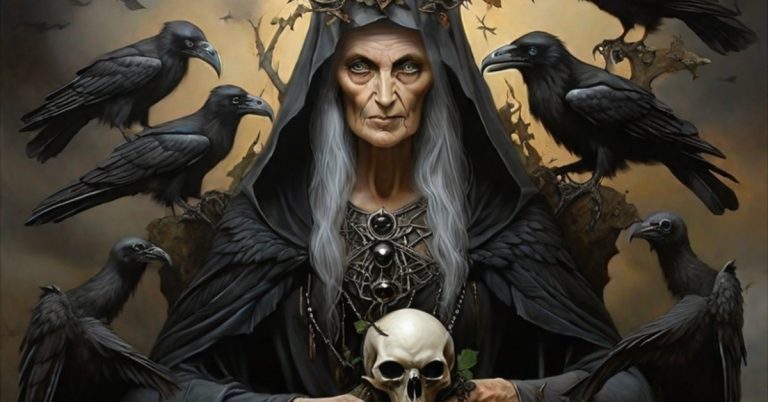
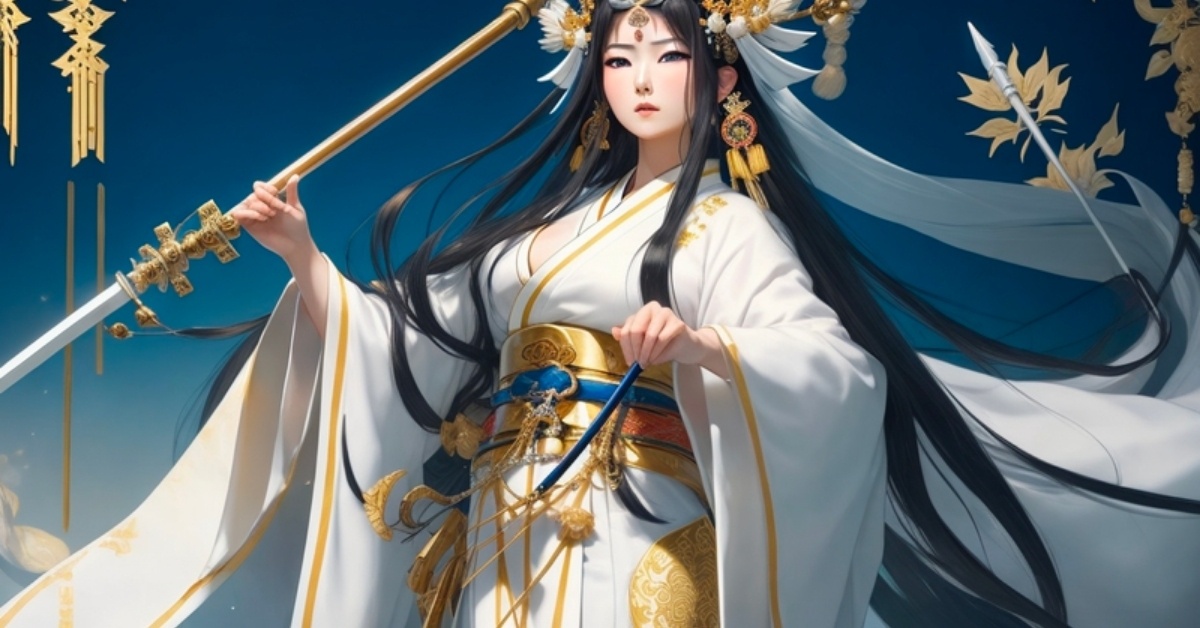
Izanami is shown in her living form as a young woman in flowing robes, holding the jeweled spear she used to stir the sea into land. After her death, Japanese art gives her a second, harder face: a decaying figure wreathed in maggots and rot, ruling from the shadows of Yomi, the underworld she never left.
Abilities
- Creation — with Izanagi, she formed the islands of Japan and gave birth to the kami of the sea, the wind, the mountains, and the trees
- Rule over Yomi — absolute authority in the land of the dead, hers alone once she chose to stay
- Command over mortality itself — the power, claimed in her own words, to end a thousand lives a day
Symbols
- The Ama-no-Nuboko — the jeweled spear Izanami and Izanagi used to stir the primordial sea and draw the first island up out of it
- The peach — the fruit Izanagi threw to drive off the underworld’s pursuers, later honored as a protective spirit in its own right
- The boulder — the great stone Izanagi set across the pass to Yomi, sealing his wife inside for good
Traits
- Powerful enough to shape a nation and, later, to rule the one place no living thing escapes
- Bound tightly to ritual order: the one time a rite was performed out of sequence, the consequences were immediate
- Unwilling to be shamed twice: once seen in death, she chooses fury and permanence over a return to the world above
- The origin point of one of Shinto’s oldest and starkest ideas, that death and birth answer to the same hand
Festivals and Rituals
Japan has no temple festival built specifically around Izanami. The closest the calendar comes is Obon, the mid-August Buddhist observance when ancestral spirits are believed to return home, honored with grave visits, food offerings, and lantern-lit welcomes. Obon belongs to Buddhist tradition rather than Izanami’s own Shinto cult, but the two ideas sit naturally together: a festival built around the dead crossing briefly back into the world of the living finds an easy echo in the goddess who first decided how that boundary would work.
Legends associated with Izanami
Izanami’s myths trace a single arc, from the labor of making a world to the fury of losing her place in it.
A wedding done wrong, then done right
Izanami and Izanagi were sent down to the floating bridge of heaven as the last of a long line of primordial pairs, tasked with bringing shape to the chaos below. Standing on the bridge, they stirred the sea with the jeweled Ama-no-Nuboko; the brine that dripped from its tip hardened into the first island, Onogoro, where they built a home and married.
Their wedding rite called for the two of them to circle a great pillar in opposite directions and greet each other on meeting. Izanami spoke first. It should have been Izanagi, and the mistake unmade the marriage before it began: their first child was born without bones, a “leech child” they named Hiruko and set adrift in a reed boat. They went to the elder gods for an answer and were told plainly what had gone wrong. They circled the pillar again, Izanagi spoke first this time, and the marriage held.
The making of Japan
With the ritual set right, Izanami and Izanagi returned to the work the elder gods had given them. Circling the pillar and joining as husband and wife, they bore island after island: Awaji, then Shikoku, Oki, Tsukushi, Iki, Tsu, Sado, and finally Oyamato, the eight great islands that became Japan. Alongside the land came the gods, more than eight hundred kami born of the couple, among them the spirits of the sea, the wind, the mountains, and the trees.
Death in the fire she made
Izanami’s last child was Kagutsuchi, the god of fire, and bearing him burned her from the inside as he was born. She lingered in agony rather than dying at once, and even in that pain kept creating: more gods are said to have sprung from her tears, her vomit, and her waste before death finally took her. Grief-maddened, Izanagi drew his sword and struck the newborn Kagutsuchi down, and from his blood and dismembered body came still more kami, born out of the same act of loss that had just cost him his wife.
What Izanagi found in Yomi
Unwilling to accept it, Izanagi followed Izanami down into Yomi, the land of the dead, to beg her back. From the darkness she told him she had already eaten the food of the underworld and could not simply leave, but asked him to wait while she pleaded her case to Yomi’s gods, on the single condition that he not look at her.
He looked anyway, lighting a comb from his hair like a torch. What it showed him was a body in full decay, wreathed in maggots, with eight thunder gods born of the rot and clinging to her limbs. Horrified, Izanagi fled, and Izanami, humiliated at being seen this way, sent the Ugly Women of Yomi, then the thunder gods, then an army of the dead after him. He held them off with his sword, then with a handful of peaches, hurled at his pursuers, which scattered them for good. Reaching the pass between the worlds, Izanagi rolled a great boulder across it, sealing his wife inside.
Then he washed the underworld off his body, and even that produced gods. From his left eye came the sun goddess Amaterasu, from his right the moon god Tsukuyomi, and from his nose the storm god Susanoo. The brightest figures in the whole Japanese pantheon trace back to a man scrubbing the land of the dead off his skin, which is another way of saying they trace back to Izanami, and to the day she chose to stay below.
The bargain that made death permanent
Face to face across the sealed boundary, Izanami told her husband that from then on she would take a thousand of his people’s lives every single day. Izanagi answered that he would then cause fifteen hundred to be born each day in their place. Between the two of them, in that one exchange, the world got its first fixed rate of death, and an even faster one of birth to outpace it.
Izanami across cultures
Strip away the setting and Izanami’s underworld chapter is a story told on every continent: a husband follows his dead wife into the land of the dead, is given one condition he cannot meet, and loses her for good by breaking it.
The clearest echo is Greek. Orpheus descends into the underworld for his wife Eurydice and is allowed to lead her back out on exactly one condition: don’t look back until you’ve both crossed into daylight. He looks. She’s gone. Scholars who study the two myths side by side point to the same bones under both: the descent, the single prohibition, the fatal glance, and a hero who leaves the underworld with less than he came for. The two traditions never touched each other, which is exactly what makes the overlap worth noticing. Persephone, whose own passage between the realm of the living and the dead defines her every year, is the Greek goddess closest to Izanami’s second life: both of them rule, or are ruled by, the same border Izanagi couldn’t cross twice.
Final thoughts
Izanami built a country and then built the rules death would run by, and she did both from the same unwillingness to be denied. She is the goddess standing at the exact point where creation runs out and something else has to take over, and she never once apologizes for choosing to stay there.
Bibliography
- “Izanami and Izanagi”. World History Encyclopedia.
- “Izanami”. Wikipedia.
- “Izanagi and Izanami”. Encyclopaedia Britannica.
- “Orpheus and Izanagi: How Japan and Greece Overlap in Love and Death”. Academus Education.
- “Izanagi and Izanami”. Shmoop, Orpheus & Eurydice study guide.