Danu: The Irish Mother Goddess
An entire race of gods carries her name. She herself has no story.
That is the puzzle of Danu. The Tuatha Dé Danann, “the peoples of the goddess Danu,” are the divine family of Irish myth: the Dagda with his cauldron, Lugh with his spear, Brigid at her forge. Their mother is invoked every time their name is spoken, and then the manuscripts fall silent about her.
What follows is a portrait built out of that silence, from the children who bear her name, the twin hills in Kerry that are called her breasts, and a river-word older than Ireland itself.
Overview of Danu
Danu is the mother goddess of the Irish pantheon, the figure from whom the Tuatha Dé Danann take their name. Her home is Ireland, and the oldest ground associated with her is Munster in the southwest, where two mountains near Killarney are still called the Paps of Anu.
She rules by lineage. Where Athena has a birth story and Isis has a grief story, Danu has a family tree. Everything the tradition says about her is said sideways, through the gods she is credited with mothering and the land that is shaped like her body.
Her name is a scholar’s reconstruction. The medieval texts give only a genitive, Danann, the “of Danu” tucked inside the name of her people, plus a separate goddess called Anu whom a ninth-century glossary names “the mother of the gods of Ireland.” Modern writers fused the two and gave her the nominative form Danu. That is the goddess we have.
She has no recorded festival of her own. The May Day gathering at the foot of the Paps, described below, is the closest surviving thing.
Titles
- Danu, also written Dana or Danann
- Anu or Ana (“the mother of the gods of Ireland,” in Cormac’s Glossary)
- Mother of the Tuatha Dé Danann
- Goddess of the Paps (Dá Chích Anann, “the two breasts of Anu”)
Characteristics
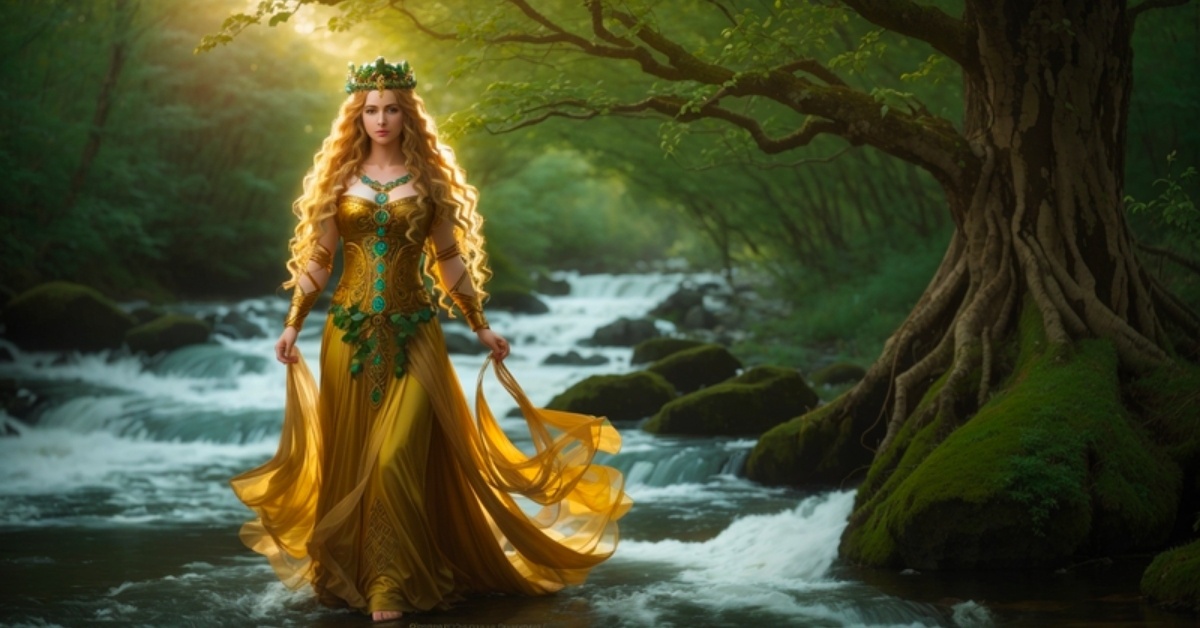
The medieval sources describe nothing about how she looks. What follows is how modern artists and pagan writers tend to picture her:
- A mature, full-figured woman, a mother in her prime
- Seated or standing on green ground, often between two hills
- Hair loose and long, sometimes worked through with leaves or grain
- Water somewhere in the frame, a river or a spring at her feet
- Calm, direct gaze, with a grandmother’s authority
Abilities
- Motherhood of the gods — the one power the sources agree on, a whole pantheon descended from her
- The land’s plenty — as Anu, the goddess “who fed the gods well” and to whom Munster owed its prosperity
- Skill and craft — one reading of her name ties it to Old Irish dán, “art, skill, gift,” which would make her children “the gods of craft”
- Flowing water — another reading ties her name to the ancient Indo-European word for river
Symbols
- The Paps of Anu — the twin breast-shaped mountains in Kerry, each crowned with a Bronze Age cairn
- Rivers — from the river-word many scholars find inside her name
- The sídhe mounds — the hollow hills her children withdrew into, the Earth as a mother’s body
- The cauldron — the Dagda’s vessel of plenty, the gift of a well-fed people
- Green land and grain — the fertility of Munster credited to Anu
Traits
- Sustaining, a goddess who feeds her children
- Distant, present in names and in hills
- Ancestral, the source everything else in the pantheon descends from
- Generous with the land, if the Munster tradition is hers
- Patient, a goddess who has waited a thousand years for someone to tell her story
Festivals and Rituals
Beneath the Paps stands a circular stone enclosure called Cathair Crobh Dearg, known locally as “the City.” Archaeologists think it has been a ritual site for close to four thousand years. It holds a holy well, an ogham stone, and the remains of older megaliths.
For as long as anyone recorded, people gathered there on May Day, the old feast of Bealtaine. Nineteenth-century accounts describe music, dancing, drinking, and champions “performing feats of valour.” Pilgrims walked rounds of the well while saying prayers, and farmers drove their cattle around it for a blessing on the year’s herd.
The rounds still happen. The pagan side of the gathering faded after the Second World War and the Catholic devotion carried it, but local people revived the wider festival in 1983. Whether the goddess was ever named there, the two breasts of Anu look down on a May Day crowd every year.
Legends associated with Danu
Danu’s legends are her children’s legends. She is the reason they have a name, and the great cycle of Irish myth is the story of what those children did after they arrived in Ireland. Two thin threads in the manuscripts reach back toward the mother herself, and both are told here.
The coming of the Tuatha Dé Danann
The Lebor Gabála Érenn, the medieval “Book of the Taking of Ireland,” tells of six peoples who settled the island in turn. The fifth were the Tuatha Dé Danann, and they were gods.
They came from four cities in the north of the world, Falias, Gorias, Murias, and Finias, where they had learned magic and druidry. From each city they carried a treasure: the Stone of Fál that cried out beneath a rightful king, the spear of Lugh, the sword of Nuada, and the cauldron of the Dagda from which no company ever went away unsatisfied.
They arrived in dark clouds and brought a darkness over the sun for three days and three nights. Then they burned their ships so that no one would think of retreating. Among them were Nuada their king, the Dagda, Ogma, Dian Cécht the healer, Goibniu the smith, and the Dagda’s daughter Brigid, goddess of poets, smiths, and healers. If Danu is their mother, this is the family she raised.
The two battles of Mag Tuired
Ireland was already held by the Fir Bolg, and the newcomers had to take it. At the First Battle of Mag Tuired the Tuatha Dé won, at a cost. Nuada lost his arm, and a king with a blemish could not rule.
Dian Cécht made him an arm of silver, but in the meantime the crown passed to Bres, a beautiful prince whose father was one of the Fomorians, the monstrous older powers of the sea. Bres taxed his people into misery and made the Dagda dig ditches. When he was finally deposed, he ran to his father’s people and raised an army.
Into this crisis walked Lugh, the master of every art, and the Tuatha Dé made him their war leader. At the Second Battle of Mag Tuired the Fomorian champion Balor, whose single eye killed whatever it looked upon, slew Nuada. Then Lugh drove a sling-stone through that eye and out the back of Balor’s skull, and the Fomorians broke. Lugh, Balor’s own grandson, became king.
The retreat into the hollow hills
The sixth people to take Ireland were the Milesians, the ancestors of the Irish themselves. The gods met them in battle and lost.
The Milesian poet Amergin gave the judgment that settled the island’s future. The world above ground went to the Milesians. The world beneath it went to the Tuatha Dé Danann. The gods walked into the sídhe, the ancient burial mounds that dot the Irish countryside, and from that day the mounds have been theirs. The fairies of later Irish folklore, the aes sídhe, “the people of the mounds,” are Danu’s children grown small in the telling.
Anu, mother of the gods of Ireland
Here is the first of the two threads that reach back toward the goddess herself.
Around the year 900, Cormac mac Cuilennáin, a bishop-king of Munster, compiled a glossary of difficult Irish words. Under Ana he wrote, in Latin, that she was mater deorum Hibernensium, “the mother of the gods of Ireland,” and added in Irish that “well did she feed the gods.” He tied her to the twin peaks in Kerry, Dá Chích Anann, “the two breasts of Anu,” and Munster, the province that held them, owed its wealth to her.
That is the whole entry, and it is the only place in early Irish writing where a mother of the gods is named and described. Most scholars think Anu and Danu are the same goddess, with Danu perhaps a contraction of día Anu, “the goddess Anu.” A few hold them apart. The Lebor Gabála muddies things further by giving “Anand” as another name for the Morrígan, so the mother of the gods and the goddess of battle may once have shared a name.
Danand and the three gods of Danu
The second thread is stranger. The Lebor Gabála names a woman called Danand, daughter of Delbáeth, and gives her three sons by her own father: Brian, Iuchar, and Iucharba. It calls them the trí dé Danann, “the three gods of Danu,” and says the whole Tuatha Dé Danann took their name from these three, without ever explaining why three alone should be gods.
The brothers have their own tale, one of the “three sorrows of storytelling.” In The Fate of the Children of Tuireann they murder Cian, the father of Lugh. Lugh demands a blood-price of impossible things: magic apples from the eastern world, a healing pigskin, a poisoned spear, a boat that sails itself. The brothers win every one of them. Then they die of their wounds at the end, while Lugh withholds the pigskin that could have saved them.
Whether Danand is Danu, a splinter of her, or a genealogist’s invention stays an open question. She is the one figure in the manuscripts who carries something like the goddess’s name and is called a mother.
An older Danu?
Trace a finger across a map of Europe from the Black Forest to the Sea of Azov and you keep meeting the same syllable: Danube, Dniester, Dnieper, Don. Linguists derive all four from a single ancient word for river, reconstructed as Proto-Indo-European *deh₂nu-, from a root meaning “to flow.” The Scythians who lived along the Dnieper and Dniester called them Dānu apara and Dānu nazdya, “the river behind” and “the river in front.” In Avestan, the old Iranian scripture language, dānu simply means river.
That same word appears as a goddess in the oldest text in India. In the Rigveda, Danu is a primordial mother, the parent of the serpent-demon Vritra whom the storm god Indra kills to release the waters, and her name carries the sense of stream, rain, and fluid. Put the Vedic Danu beside the Irish Danann and the Welsh Dôn, add the rivers, and a picture forms of an ancient river-mother, worshiped across the Indo-European world long before any of her peoples reached Ireland. On this reading the “children of Danu” are the children of the flowing water, and the Boyne’s own goddess Boann belongs to the same family of thought.
It is an attractive picture, and a contested one. J. P. Mallory and D. Q. Adams, in their Encyclopedia of Indo-European Culture, accept the word but doubt the goddess: the river-name correspondence is probable, they write, but “there is really no evidence for a specific river goddess” beyond India’s habit of deifying rivers. Others question whether the Irish name belongs to the river family at all. Eric Hamp derived Danu from *dueno-, “good.” Sharon Paice MacLeod connects Danann to dán, “skill,” which would make the Tuatha Dé “the tribe of the gods of craft,” a fit for a family that includes a smith, a healer, and the master of every art. Mark Williams, in Ireland’s Immortals, suggests the whole tag “Danann” may be a clerical addition of around the year 900, bolted onto the older Túath Dé, “tribe of the gods,” to keep the pagan gods distinct from the biblical “people of God.” John Carey’s summary stands: the origin of Danann “is still disputed.”
Even the Welsh cousin wobbles. Dôn is usually treated as the nearest thing to Danu outside Ireland, yet James MacKillop’s Dictionary of Celtic Mythology notes that her name more likely descends from a word for earth, and John Koch has asked whether the name was ever a goddess’s at all, or only a fossilized word for the ground. So the older Danu may be a river-mother who flowed across a continent, or she may be an Irish word for skill, or a churchman’s coinage. The evidence permits all three, and the most honest thing to say is that the mother of the Irish gods keeps her origins to herself.
Danu across cultures
The mother-of-a-divine-family is a shape that turns up wherever there are gods to be mothered, and Danu’s nearest relatives sit just across the Irish Sea.
In the Fourth Branch of the Welsh Mabinogi, the sorcerer Gwydion, his brother Gilfaethwy, and their sister Arianrhod are the “children of Dôn,” and later tradition adds Gofannon the smith and Amaethon the plowman to her brood. Gofannon is the Welsh twin of Ireland’s Goibniu, and Arianrhod’s son Lleu Llaw Gyffes is the Welsh Lugh. Two islands, two divine families, two mothers named in the genitive and never seen. Like Danu, Dôn is a name with a family attached and no story of her own.
India’s Danu, mother of the Danavas, has already been met above. Whether she is the same goddess or only the same word, she shows how far this figure of the ancestral mother of powers can travel.
Set her beside a well-attested Celtic goddess and the gap shows. Continental Celtic goddesses such as Epona, the Gaulish horse goddess, survive in hundreds of inscriptions, statues, and Roman-era altars. Danu survives in a genitive. One goddess was carved in stone by people who worshiped her; the other was reassembled from grammar by people who wanted her back. Writers on the ancient mother goddess, among them Monica Sjöö and Barbara Mor in The Great Cosmic Mother, read the Paps and the hollow sídhe mounds as the Earth’s own body, both breast and womb, and place Ana, Bride, and Danu together as the grain-and-earth mother of Britain and Ireland. It is one way of seeing her. The land, at least, is certain: the hills are there, they have names, and they have been climbed on May Day for longer than the written record reaches.
Final thoughts
The honest version of Danu is a name with a family attached, and that turns out to be enough.
Every god in Ireland answers to her. The Dagda’s cauldron, Lugh’s spear, Brigid’s fire, the hollow hills where the fairies live, all of it descends from a mother whose face the storytellers left blank. The scribes recorded every wound her children took and gave her a single line. A thousand years on, the two breasts of Anu still stand over Kerry with cairns for nipples, and people still climb them. That is a strange kind of immortality, to be remembered only in what you made.
Which would you rather have: a story that gets told, or a name that everyone else’s story depends on?
Bibliography
- “Danu (Irish goddess)”, “Anu (Irish goddess)”, and “Danand”. Wikipedia.
- “Tuatha Dé Danann”, “Paps of Anu”, and “Dôn”. Wikipedia.
- “Danu (Hindu goddess)” and “Proto-Indo-European mythology”. Wikipedia.
- Cormac mac Cuilennáin. Sanas Cormaic (Cormac’s Glossary). Early Irish Glossaries Database, University of Cambridge.
- Macalister, R. A. S., trans. Lebor Gabála Érenn: The Book of the Taking of Ireland. Irish Texts Society; via CELT, University College Cork.
- Slocum, Jonathan, and Patrizia de Bernardo Stempel. “Lebor Gabála Érenn”. Early Indo-European Online, University of Texas at Austin.
- Kapach, Avi. “Danu”. Mythopedia.
- “Is Danu a real goddess?”. We Are Star Stuff.
- “The Etymology of Tuatha Dé Danann”. Irish Myths.
- “Danube”. Wiktionary.
- Mallory, J. P., and D. Q. Adams. Encyclopedia of Indo-European Culture. Fitzroy Dearborn.
- Williams, Mark. Ireland’s Immortals: A History of the Gods of Irish Myth. Princeton University Press.
- MacKillop, James. “Dôn”. A Dictionary of Celtic Mythology, Oxford Reference.
- “Cathair Crobh Dearg: From Ancient Beliefs to the Rounds”. ResearchGate.
- Sjöö, Monica, and Barbara Mor. The Great Cosmic Mother. HarperOne.