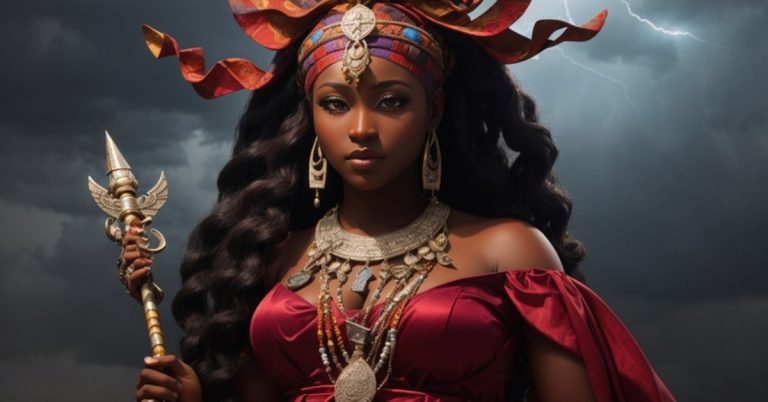
Sarahkka: The Sami Goddess of Childbirth and the Hearth
Pitch a Sámi tent and the first thing you set is the fire. The poles go up around the hearthstones, the door turns away from the wind, and the family sleeps in a ring with its feet toward the flames.
Under those stones lived a goddess. When a woman went into labor, this was the one who opened her body and let the child through.
Her name is Sáráhkká. Of all the Sámi goddesses, she was the one the missionaries found hardest to put out.
Overview of Sarahkka
Sáráhkká (also written Sarakka, Sarahkka, or Saaraahka in South Sámi) belongs to the Indigenous religion of the Sámi, the people of Sápmi, a homeland that runs across northern Norway, Sweden, Finland, and Russia’s Kola Peninsula. That religion is old, it varies from valley to valley, and parts of it are still practiced. Her place in it was the house.
She is one of three daughters of Máttaráhkká, the ancestral mother who gives each new soul its first life. The sisters split the making of a child between them, and Sáráhkká’s share was the largest. She took the child from her mother, set it in the woman’s womb, grew flesh around it, and, when the months were up, opened the mother so the child could be born. Her sisters, Juksáhkká and Uksáhkká, took the parts before and after, and each has her own page here.
Her home was the árran, the ring of hearthstones at the center of the tent (the lávvu) or the turf hut (the goahti). She lived beneath it. Fire, food, warmth, and birth all passed through the same square yard of ground, and she was under all of it. The old accounts place her among the Sámi of Norway and Sweden; the eastern Sámi of Finland and Russia seem to have known the mother without the daughters.
One more thing before the details. Everything written about her comes to us secondhand, through Lutheran priests and missionaries sent north to end her worship. Keep that in mind as you read. It gets its own section below.
Titles
- Sáráhkká, Sarakka, Sar-akka, Saaraahka (South Sámi)
- “The cleaving woman,” the gloss used by the Encyclopædia Britannica
- Goddess of childbirth
- Goddess of the hearth
- Guardian of girls and women
- The most worshipped of the áhkká sisters (áhkká means “woman” or “old woman”)
Characteristics
The Sámi built their gods no temples and carved them no statues, so her look comes down to a few things:
- A small figure painted in red alder-bark juice on the noaidi’s drum
- Placed in the lower band of the drum, near the signs for the tent, the door, and the storehouse, away from the sky gods
- Known by the heat of the hearth and the warmth of the ground beneath it
- In modern Sámi art, a woman seated at the fire, often with a child
Abilities
- Opening the body — she “divides” the mother in labor and lets the child pass
- Making the child’s body — she takes the soul from Máttaráhkká and grows flesh around it in the womb
- Easing pain — the pains of labor and of menstruation were hers to lighten
- Fertility of the herd — reindeer cows calved under her care as much as women did
- Keeping the household — she watched the family’s well-being from her place under the fire
Symbols
- The hearth (árran) — her home and her altar
- Fire — offerings went into it, and the first drops of any drink were hers
- Porridge — the ritual meal of the woman who had just given birth
- Split firewood — an offering that matched her name
- The reindeer cow — a female animal was the sacrifice made in her name
Traits
- Near: she lived in the ground of the home, with the family
- Practical: her gifts were a safe birth, a full belly, and a warm tent
- Daily: she received something at almost every meal
- Beloved: the old accounts call her the most worshipped of the three sisters
- Persistent: her offerings outlasted the drums the missionaries burned
Festivals and Rituals
The Sámi year turned on the seasons and the herd, and Sáráhkká’s rites followed the rhythms of the body and the house.
At meals, a share of food or drink went into the fire for her. Harald Gaski, a Sámi scholar of literature, describes a custom that lives on: when you make coffee, the first drop goes to Sáráhkká, or the last of the pot is poured out on the fire or beside it.
Before labor, a woman drank what the sources call Sáráhkká’s drink, a cup of spirits offered in the goddess’s name. After a safe birth she ate Sáráhkká’s porridge. Small tokens were dropped into the bowl and read for the child’s future, and a portion of the porridge was the goddess’s own.
A female animal, usually a reindeer cow, could be sacrificed to her after a birth or during an illness. Offerings of split firewood and fresh spring water were recorded too.
Porridge was food for the Sámi gods more broadly. The sun goddess Beiwe was fed a butter-rich porridge at midsummer to strengthen her for the return of the light. Sáráhkká’s bowl was the same kind of gift, made smaller and far more often.
Legends associated with Sarahkka
The Sámi carried their gods in practice. What survives of Sáráhkká is a set of things people did, at the fire and in the birthing tent, written down by outsiders who watched. Read in order, those practices make a story. It runs from conception to a child’s first days, and Sáráhkká is in nearly every scene.
The making of a child
A child began far from the tent. The ruling god, Radien-áhčči, sent a spirit down to Máttaráhkká, and she gave it life. Then she handed it to her daughter.
Sáráhkká carried the new soul into the woman’s body, placed it in the womb, and built flesh around it. The child grew there, under her hand, for the whole pregnancy. The pastor Christfried Ganander set this chain down in 1789, and by then it was already a memory in many districts.
Parents who wanted a son took that request to her sister Juksáhkká, whose story is told on her own page. The body itself, whatever its sex, was Sáráhkká’s work.
The opening
When labor came, the woman stayed near the hearth, close to the goddess who lived under it.
She drank Sáráhkká’s drink. Then the goddess did the thing her name may describe. One reading connects Sárá to a Sámi root meaning to split or cleave, so that Sáráhkká is the woman who opens. In the plainest telling, she divided the mother’s body so the child could come through. Other readings leave the first half of her name unexplained, and the question stays open. The act, though, is agreed on by every source. She was the one at the opening.
The child, once born, passed to Uksáhkká at the door. That handoff belongs to her sister’s story.
The porridge
After the birth came the meal.
The mother ate Sáráhkká’s porridge while the women who had helped her looked on. Small pieces were dropped into the bowl, and the way her spoon found them was read as a sign of the child’s future. Some accounts describe, for a son, the pieces of a tiny bow and arrow that were later hung by his cradle. A share of the porridge went back to the goddess.
Thanks, medicine, and a way of saying out loud that the dangerous part was over.
The woman’s month
Sáráhkká’s care went on between births. The sources say she was honored during menstruation, with observances that the priests noted but recorded thinly, and it makes sense: the goddess who opened the body in labor was the goddess of the body’s other openings too. The same ground covered the herd. When the reindeer cows calved in spring, they calved under her.
Baptized twice
The last story is the one the missionaries told on themselves.
After a Sámi child had been carried to the church and baptized, the family brought the child home, bathed it again, and gave it a name in Sáráhkká’s honor. Gaski describes the custom as a straightforward thing, one faith laid over another. In the mission-era reports it is a complaint. The priests had the water and the register. The goddess under the hearth had the child’s second name, and she kept it long after the drums were gone.
An older Sarahkka?
The people who wrote Sáráhkká down were the people sent to end her.
In the 1670s the Swedish crown asked its northern clergy for reports on Sámi life and “superstition.” Samuel Rheen’s report (1671) is one of the earliest, and Nicolaus Lundius, Olaus Graan, and Johannes Tornæus wrote others; Johannes Schefferus stitched them into Lapponia (1673), the book that told Europe what the Sámi believed. Rheen’s account of the drum names the thunder god, the ruling prince, and the sun. The goddess under the hearth is absent from it. The three sisters come into focus later, in the Norwegian mission of Thomas von Westen (1715–1735) and the papers of his colleagues: Johan Randulf’s Nærøy manuscript of 1723, Hans Skanke’s drum description of 1731, Jens Kildal, Isaac Olsen. Even there the record is shaky. Skanke ran Juksáhkká and Uksáhkká together as one goddess with two names. Ganander’s Mythologia Fennica came in 1789, and the last major collection, Lars Levi Læstadius’s Fragments of Lappish Mythology, was written in the 1840s and sat unpublished until 1997.
These were the years the religion was being dismantled. Drums were confiscated and burned. In 1693 a Sámi man named Lars Nilsson was executed at Arjeplog, in Swedish Sápmi, for drumming and sacrificing; Denmark-Norway treated the practice as witchcraft under its own laws. So the writers were watching a faith go underground while they described it. They recorded what men did with drums on mountainsides in some detail, because that was what they were hunting. What women did at the fire came through late, thin, and in spellings that shift with every dialect and every pen.
That is the record, and two honest readings of it sit side by side.
The first says the hearth goddess is the oldest thing in it. On this view, the drum cosmology of sky gods and thunder was the public face of Sámi religion, and under it lay a household religion centered on women, birth, and fire, with Máttaráhkká and her daughters at its heart. Sáráhkká, the one who opened the body, was the living center of that older layer. It would explain why the old accounts call her the most worshipped of the sisters, why her rites happened daily while the sky gods’ came with the seasons, and why she outlasted the drums: her altar was the family’s cooking fire, and a cooking fire stays.
The second reading points the other way. The three daughters are known only in western Sápmi. The eastern Sámi knew Máttaráhkká and had no sisters to go with her, and some scholars read that as a sign the daughters were a later western development, shaped by centuries of contact with Scandinavian neighbors and their own household spirits. On this view Sáráhkká is a relatively young elaboration of a much older mother.
The sources leave it open. What they do show is which goddess survived. Máttaráhkká was folded into the Virgin Mary. Sáráhkká was folded into the coffee pot. Gaski’s first drop to the fire, the child bathed a second time at home, the porridge after birth: these went on in Sámi households through the Læstadian revivals of the 1800s and into living memory. In 1988, after a Nordic women’s conference, Sámi women founded an organization and named it Sáráhkká; a year later it helped found an international council of Indigenous women. The goddess of the hearth had become the name women chose when they organized. Whatever her age, she is the one the Sámi kept.
Sarahkka across cultures
Put a fire in the middle of a house and a goddess tends to appear beneath it.
The Greek Hestia and the Roman Vesta lived in the hearth and received the first and last offering at every meal, the same small daily portion Sáráhkká got from the coffee pot. The Lithuanian Gabija was fed bread and salt and “put to bed” each night by the woman of the house, who covered the embers and spoke to her. Across the Baltic, the Albanian Nëna e Vatrës, the Mother of the Hearth, held the same post. In Ireland Brigid kept a perpetual fire at Kildare and, in later folk tradition, served as midwife at the birth of Christ; fire and childbirth, together in one figure, exactly as they are in Sáráhkká.
The Sámi case is the only one where the connection is put so bluntly. Sáráhkká was under the fire because that was where a woman labored. Her cult was the household’s own body, kept warm.
Final thoughts
The fire pit is still where a lávvu begins.
Sáráhkká was the goddess of the most ordinary and most dangerous thing a household did, and the record of her was written by people who wanted her gone. What came through anyway was a woman under the hearthstones who opened the body, took the first drop of the pot, and gave the child its second name. The missionaries wrote her down in order to erase her. Their notes are how we know her, and her people kept her without the notes.
What did your own family pour out, set aside, or say before a meal, and do you know who it was for?
Bibliography
- “Sáráhkká”, “Máttaráhkká”, and “Juoksáhkká”. Wikipedia.
- “Madderakka”. Encyclopædia Britannica.
- Bäckman, Louise, and Juha Pentikäinen. “Sami Religion”. Encyclopedia of Religion, via Encyclopedia.com.
- Gaski, Harald. “Gaski on Sámi Fire Traditions”. Seattle Sámi.
- Rydving, Håkan. The End of Drum-Time: Religious Change among the Lule Saami, 1670s–1740s. Uppsala.
- Læstadius, Lars Levi. Fragments of Lappish Mythology. Ed. Juha Pentikäinen. Aspasia Books.
- “A lost Lule Sámi drum recorded by Samuel Rheen in 1671” and “A lost South Sámi drum, described by Hans Skanke in 1731”. old.no Sámi drum archive.
- “Samuel Rheen”, “Nærøy manuscript”, and “Lapponia (book)”. Wikipedia.
- Halsaa, Beatrice. “The (Trans)National Mobilisation of Sámi Women in Norway”. Centre for Gender Research, University of Oslo.
- “Women in Saami Society”. Sámi Culture, University of Texas at Austin.
- Niskanen, Niina. “Saami Deities: List and Descriptions”. Patheos.
- “Sáráhkká”. Wiktionary.