Uksahkka: The Sami Door-Woman and Guardian of the Threshold
Picture a Sami tent in winter. The fire burns in the center, the family sleeps along both sides, and a baby who has just learned to crawl is heading straight for the flames.
Someone has to watch that child. Someone also has to watch the door, the one thin place where the cold, strangers, and worse can get in.
In the old Sami household, both jobs belonged to the same goddess, and she lived under the doorsill.
Overview of Uksahkka
Uksáhkká is the “door-woman” of pre-Christian Sami religion. The name is plain Sami: uksa means “door,” and áhkká means “woman,” “wife,” or “old woman,” the same ending her mother and sisters carry. Depending on the dialect and the writer, she appears as Uksáhkká, Uksakka, Uks-akka, or Oksaahka.
She is one of the three daughters of Máttaráhkká, the mother goddess who receives each child’s soul before birth. Her sisters are Sáráhkká, who lives under the hearth and opens the way for birth, and Juksáhkká, the bow-woman who decides whether a child will be born a boy. Uksáhkká takes over once the child is in the world. She watches who steps in and out of the tent, keeps harm from crossing the sill, and guards the small child through its first crawling and walking years.
The whole family of goddesses lives in the ground beneath the goahti, the turf-and-timber Sami dwelling, or the lávvu, its tent-shaped cousin. Each daughter has her own station. Sáráhkká sits under the central fire, Juksáhkká toward the back, and Uksáhkká under the door. The tent itself is her temple.
Her cult belongs to Norwegian and Swedish Sápmi. The sources from the Finnish Sami areas are silent on her.
Titles
- Uksáhkká, “door-woman” (uksa, “door,” + áhkká, “woman”)
- The one who guards the door
- Uksakka, Uks-akka, Oksaahka (spelling variants by dialect and source)
- One of the three áhkká sisters, daughters of Máttaráhkká
Characteristics
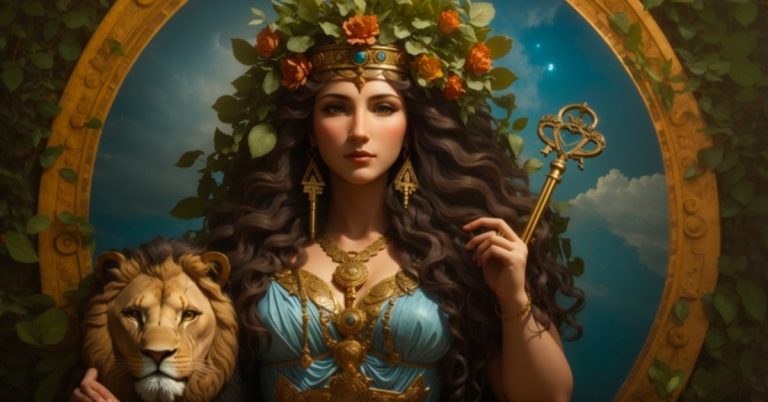
The written sources describe what Uksáhkká does and leave her appearance to the imagination. What survives:
- An old woman, as the áhkká ending implies
- Known by her place: the doorsill itself
- On some Sami drums she appears with her sisters as a small standing figure near the edge of the drumhead
Abilities
- Threshold guardian — she watches everyone and everything that passes through the door of the dwelling
- Keeper of the household — harm that tries to enter has to pass her first
- Protector of small children — she keeps the crawling and toddling child from the fire and from injury as it learns to walk
- Keeper of the wanderer — she keeps the small child within reach of the tent
- Receiver of the newborn — in some accounts she takes the child into the world at the moment of birth
Symbols
- The door and the doorsill — her home and her whole domain
- The poured drink — the offering tipped onto the ground at the entrance for her
- The goahti floor plan — door, hearth, back wall: the map of the three sisters
Traits
- Watchful and steady, a goddess of ordinary days
- Protective, especially toward the smallest members of the family
- Bound to place: she stays, and she keeps
- Close at hand, honored with everyday food and drink
Festivals and Rituals
The record gives Uksáhkká one place of worship: home, at the door, as part of daily life.
The offering recorded most often is a drink poured onto the ground at the entrance of the tent, where she lived. Her sister Sáráhkká received porridge and, into modern times, a share of the household coffee. The three sisters together were honored around a birth, the mother eating and drinking on their behalf. When a child was small, a family might address Uksáhkká directly as it began to move around the tent on its own.
Her name also survives on some of the Sami drums that missionaries confiscated in the 1600s and 1700s, where a row of small female figures near the rim is usually read as the áhkká sisters.
Legends associated with Uksahkka
What the Sami record preserves about Uksáhkká is a sequence, a spatial pattern, and a handful of practices, and those tell you a great deal about how a household understood her.
The child’s journey through the tent
The three sisters share one long job, and Uksáhkká has its final stage.
In the accounts that survive, a child’s soul comes down from the high god Radien to Máttaráhkká, who gives it a body. She hands it to Sáráhkká, who places it in the mother’s womb and eases the birth. If the child is to be a boy, Juksáhkká intervenes. Then the baby is born by the fire, Sáráhkká’s place, and within a year it is crawling away from the fire toward the door. That is where Uksáhkká waits.
So the tent lays out a life. Center for birth, edge for the first steps outward. The goddess of the threshold is the goddess of the moment a child first tries to leave.
The drink poured at the door
Uksáhkká’s offering is a small one, and that smallness is the point.
Sources describe drink being tipped onto the ground at the entrance, the spot where she was said to live. The altar was the doorway, and the priest was whoever happened to be passing through it. A member of the household gave her a share as they came or went, the way you might greet someone sitting by the door. It is the kind of everyday religion that missionary reports were least equipped to notice, and probably the part that lasted longest after the drums were gone.
Three sisters, one floor plan
Sami dwellings had a strict inner geography, and the sisters map straight onto it.
The main door opened onto the front section. The fire burned in the middle. Behind the fire lay the boaššu, the sacred back area where the drum was kept and where hunters brought game in through a second door, a space reserved for men. Sáráhkká held the hearth, honored by everyone. Juksáhkká, who made boys, belonged to the male back of the tent. Uksáhkká belonged to the front, to the door that everyone used, and to the women and children who spent their days near it.
Read that way, the three goddesses draw a diagram of a home.
An older Uksahkka?
Uksáhkká is the easiest of the three sisters to lose in the record. The outsiders who wrote it down kept mixing her up with the others, and the earliest of them left her out completely.
The Sami kept their religion in memory and practice. The written record of their religion begins with Swedish clergy reports of the 1670s, commissioned to describe and correct Sami “superstition,” which Johannes Schefferus compiled into Lapponia in 1673. Samuel Rheen’s 1671 account from Jokkmokk, one of the fullest, names Thor, the Storjunkare, and the Sun on the drums and leaves the áhkká sisters out. The sisters come mostly from the Danish-Norwegian mission a generation later: Johan Randulf’s Nærøy manuscript of 1723, written during Thomas von Westen’s campaign to convert the southern Sami, and Hans Skanke’s summary of von Westen’s papers from the late 1720s. Skanke muddles “Ugs-” and “Jugsakka” as if they were one name and adds their mother to fill out the count of three. Lars Levi Læstadius, a Lutheran pastor of partly Sami descent, gathered what was left in his Fragments of Lappish Mythology in the 1840s and complained about how little was left to gather.
Von Westen’s mission collected around a hundred drums from the southern districts, most of which burned in the Copenhagen fire of 1728. Drum owners were tried in Norway and Sweden in the 1690s. Every description of Uksáhkká passed through that filter, written in Danish, Swedish, or Latin by men who called her an idol, often recording one district’s practice as though it were everyone’s. The Finnish scholar Christfried Ganander, writing in 1789, mixed her up with her sister and credited her with changing a child’s sex in the womb, a confusion that still surfaces in modern retellings. Uno Holmberg, the great early-twentieth-century scholar of Finno-Ugric religion, untangled the two and compared Uksáhkká instead to the Swedish dörrkäring, the “door-hag” or door spirit of Scandinavian folk belief.
Set the sources aside and look at what she is, and Uksáhkká makes sense. A doorway is a boundary, and boundaries are dangerous. Cultures across the world have treated the threshold as a place that needs a keeper: Romans had Janus and a whole set of minor door gods, Slavs and Balts kept household spirits at the sill, and people still carry brides over it. The Sami answer was to give the threshold an old woman, put her under the sill, and make her the one who catches the child at the edge of the fire. Whether that is an ancient layer or a regional development of the 1600s stays an open question, because the record begins with the people who were burning it.
What the record can say is that the sisters were still honored long after the drums were gone. Sáráhkká’s coffee offerings persisted into living memory, and the Sami women’s organization founded in 1988 took Sáráhkká’s name. Sami artists, scholars, and practitioners today are reengaging with the áhkká sisters as their own heritage, on their own terms. Uksáhkká is a goddess of a living people, and the door she guards is still in use.
Uksahkka across cultures
The Sami had a whole set of powers arranged around the tent, and Uksáhkká’s door was one of several charged places in it. Fat smeared on the doorposts fed the ailing sun goddess Beiwe through the polar night, so the door was already a place where the household reached toward something larger than itself.
The idea of a guardian at the threshold is close to universal. In Rome, Janus faced both ways at the gate, and the Romans also named a god of the door leaf, a goddess of the hinge, and a god of the sill. Chinese households paste door gods on the gate each New Year. Jewish homes fix a mezuzah to the doorpost. In Scandinavian folk belief the dörrkäring, the old woman of the door, is the figure Holmberg thought Uksáhkká most resembled, and the two may share a northern root or may be two answers to the same worry.
What sets Uksáhkká apart is who she watches. Most threshold guardians face outward, against enemies and spirits. Uksáhkká faces both ways, and much of her attention is turned inward, toward the toddler at the fire’s edge. She is a door-keeper whose main charge is the smallest person in the house.
Final thoughts
The doorway of a Sami tent is a few feet wide, and the Sami put a goddess there.
That choice says something about what the household counted as sacred. The dramatic gods got the mountains and the drums. Uksáhkká got the sill, the drink tipped onto the ground, and the job of catching a child before it burned itself. Her whole religion was the size of a doorway, and the household treated that doorway as holy ground.
We know her through the notes of men sent to erase her, which means we know her thinly and at a slant. But she still comes through: an old woman under the door, facing both ways, with one eye on the world outside and one on the child crawling toward the fire. What would it change about a home to imagine someone like that at the entrance?
Bibliography
- “Uksáhkká”, “Sáráhkká”, and “Máttaráhkká”. Wikipedia.
- “Madderakka”. Encyclopaedia Britannica.
- Holmberg (Harva), Uno. Finno-Ugric, Siberian (The Mythology of All Races, vol. IV). Marshall Jones, 1927.
- “A lost Lule Sámi drum recorded by Samuel Rheen in 1671” and “A lost South Sámi drum, described by Hans Skanke in 1731”. old.no Sami drum archive.
- “Nærøy manuscript” and “Sámi drum”. Wikipedia.
- Læstadius, Lars Levi. Fragments of Lappish Mythology. Trans. Börje Vähämäki. Aspasia Books.
- “Gaski on Sámi Fire Traditions”. Seattle Sámi.
- “Women in Saami Society”. University of Texas at Austin, Sami Culture.
- “Goahti”. Wikipedia.