Yemaja: The Goddess of the Seas
Yemaja is the goddess who turned a river into an ocean.
She began as the guardian of a single river in what is now southwestern Nigeria. Then her people were carried across the Atlantic in chains, and she went with them. By the time she reached the other shore, she had become the Mother of the Sea itself.
Today she’s one of the most beloved orisha in the world: Yemaya in Cuba, Iemanjá in Brazil, Mother of All wherever her children have carried her name. People call on her for children, for safe passage, and for the nerve to keep going when the water turns rough.
Overview of Yemaja
The Yoruba people live across southwestern Nigeria and the neighboring edges of Benin and Togo. In their tradition, the world is run by spirits called orisha, and Yemaja (also spelled Yemaya, Yemoja, Yemonja, or Yemanja, depending on the region) ranks among the most senior of them all.
Her name comes from the Yoruba “Yeye omo eja,” Mother Whose Children Are the Fish, and it points straight at what she governs: motherhood, fertility, and the water that makes both possible. In Yorubaland she is tied to the Ogun River. Everywhere her people traveled, she went further out: into the tides, the moon that pulls them, and eventually the whole ocean.
Her great celebration today is Iemanjá’s Day, held every February 2nd on Rio Vermelho beach in Salvador, Brazil, where as many as 80,000 people gather to send her flowers, perfume, and small wooden boats out to sea.
Titles
- The Owner of the Seas
- The Mother of All
- Ocean Mother Goddess
- Mother Whose Children Are the Fish
Characteristics
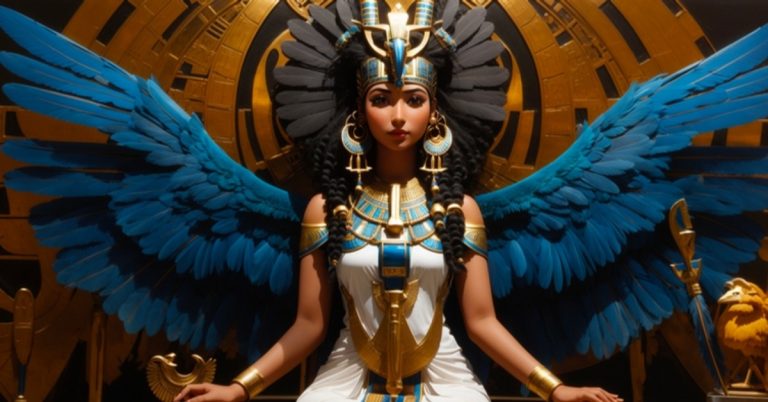
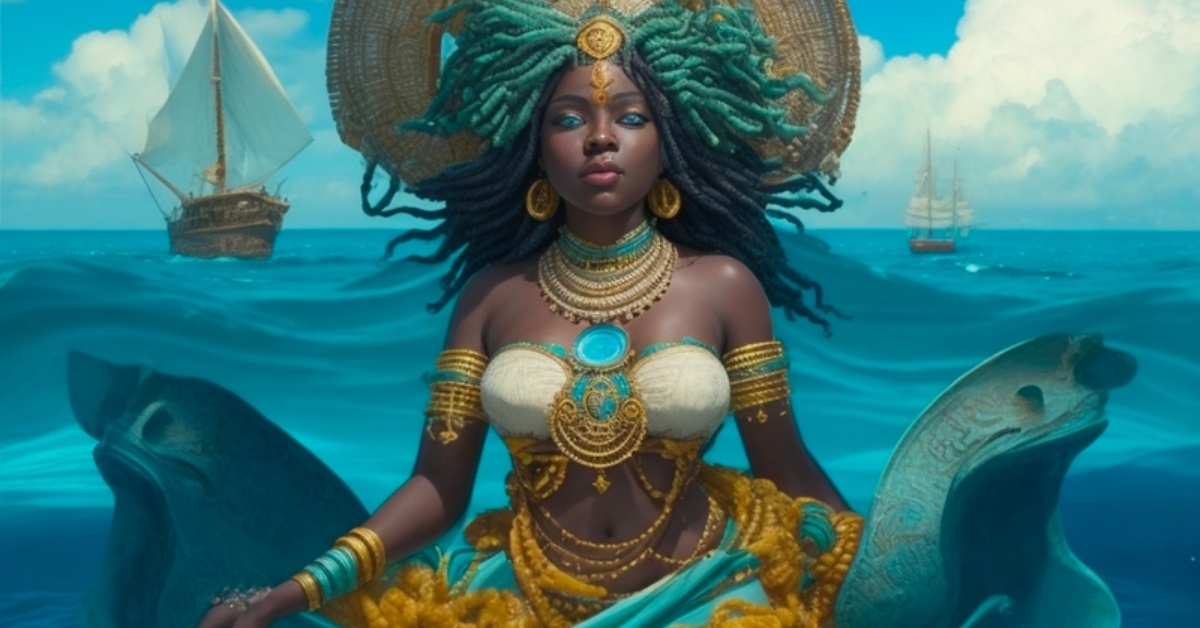
- Depicted as a woman of color, reflecting her African and Yoruba origins
- Long, flowing skirts in her colors of blue and white
- Elongated, low-hanging breasts, a mark of her nursing, world-feeding power
- Sevens worked through her dress and jewelry: her sacred number, tied to the seven seas
- A machete at her side in wartime, to defend her children
- Sometimes shown as a mermaid
Abilities
Yemaja commands water in all its moods. She can call a hurricane or a tsunami as easily as she can calm one. She cures infertility, helps women conceive, heals emotional wounds, and cleanses troubled spaces and spirits.
She’s also a diviner. Different tellings disagree on how she came to it: some say the art was closed to women until she learned it in secret and proved too skilled to refuse; others say she took it from the other orisha outright and then taught it back to them. Either way, she broke the ban.
Symbols
Her sacred animals are ducks, vultures, snakes, snails, fish, and peacocks. Pieces of them (feathers, scales, shells) turn up often on her shrines. Cowrie shells especially matter to her, in legend and in ritual alike. Her shrines, called ota, hold sacred stones and bowls of river water alongside nets and little boat carvings. Her other symbols are the number seven, Saturday, the moon, and the colors blue and white.
Traits
She’s deeply maternal, protective of her own children and of the humans who call on her, in the same soothing, nurturing register that runs through most of her stories. But like the sea she rules, her calm can turn as fast as a tide, and when her temper flares she is genuinely frightening. Her gentler side comes out in dancing, which she loves.
Festivals and rituals
Worshippers still build ota shrines for Yemaja and bring her offerings there: candles, ritual baths, and gifts arranged in sevens to strengthen the connection. A common devotional practice is the boat offering: setting objects sacred to her, along with a written request, afloat on the water, often used by women seeking fertility or by anyone asking for guidance or protection. Fishermen call on her before they go out, for luck and a good catch.
Her largest modern celebration by far is Iemanjá’s Day. Devotees dress in white, form dancing circles on the sand, and carry flowers and small offerings down to the water’s edge for her.
Legends associated with Yemaja
Yemaja’s stories tend to circle the same idea from different angles: however the water is disturbed, she is the one who calms it, feeds it, or transforms alongside it.
The flood that made her the Mother of All
Yemaja married the volcanic, wandering orisha Aganju (some tellings give her the iron-and-war god Ogun instead), and their son was Orungan.
Grown to manhood, Orungan attacked his own mother. Yemaja ran from him until she could run no further, and she fell to the ground. The earth answered her. Water broke from her body in every direction, cutting the first rivers, filling the first lakes, and opening hidden springs across the land. Sixteen orisha are said to have poured out of that flood with her, among them Shango, Ogun, and Obaluaiye. (Olokun is sometimes counted among them too, though this site’s Olokun page keeps the older telling, where the two are siblings or spouses and joint rulers of the waters. Accounts differ.)
Her children call her the Mother of All for what came out of her afterward: an entire pantheon, and the rivers they still drink from.
Yemaja and Olokun
In a separate legend, Olokun grew furious that humanity no longer honored the sea properly and sent wave after wave to punish them, each one taller than the last. People feared for their homes and their lives.
Yemaja went to Olokun and reasoned with him until the fury passed. Olokun calmed, the great waves sank back into the deep, and where they had risen, shells, pearls, and coral remained scattered on the shore: her gift, left behind for the people she’d just saved.
The gift of the seashell
One more legend, carried by her people through the Middle Passage and still told today: Yemaja gave humanity a seashell holding her voice, so she could always be reached. Hold a shell to your ear now, and the sound you hear is hers.
From river to ocean: Yemaja across the world
Yemaja’s story didn’t stop when the myths were first told. It kept moving, because her people did.
In Yorubaland she is, first, a river orisha: guardian of the Ogun River, senior among the water spirits, but tied to fresh water more than to the sea. That began to change when Yoruba people were forced across the Atlantic during the transatlantic slave trade. Enslaved believers carried her with them, and over generations at sea and in exile she grew into the ocean itself: the water that had witnessed the whole crossing.
In Cuba she became Yemayá, syncretized with Our Lady of Regla to survive under a faith that banned her worship outright. In Brazil she became Iemanjá, blended with Our Lady of the Navigators and honored every February on the beach at Rio Vermelho. Both names, both traditions, trace back to the same river goddess of the Ogun. The ocean her people had to cross reshaped her, and she remained herself.
She’s often paired with Oshun, her Yoruba sister across the water: Oshun is the sweet river of love and abundance, Yemaja the deep water of survival and motherhood. Together with orisha like Oya and Oba (by some tellings her own children, born in the flood), she anchors one of the largest living god-families still actively worshipped today.
Final thoughts
Yemaja endures because she proves a river can become an ocean and remain itself.
She is calm water and killing wave, a goddess who survives her own worst story and answers it with an entire pantheon. She is invoked by mothers, by fishermen, by anyone crossing water they’re afraid of. Centuries after the crossing that forced her hand, she is still the one people reach for when the water gets too big to face alone.
Bibliography
- “Yemonja”. Encyclopaedia Britannica.
- “Yemoja”. Wikipedia.
- “Yemaja”. Mythopedia.
- “Yemaya (Yemoja) – Yoruba Queen of the Sea”. Symbol Sage.
- “Orisha Yemaya: Queen of the Sea”. Original Botanica.
- “Yemaya the Santeria Goddess of The Ocean”. Goddess Gift.
- “Festival of Iemanjá”. Salvador Guidebook.