Oshun: The Goddess Of Love, Fertility, And Abundance
Oshun is the goddess who proved that sweetness is a kind of power.
When the other gods couldn’t populate the world, it was Oshun who brought it to life. When a furious war-god hid in the forest and no one could move him, it was Oshun who danced him out with honey. She is love, fresh water, and fertility, and she is not to be underestimated.
She’s one of the most beloved orishas of the Yoruba, worshipped from Nigeria to Cuba to Brazil, and still called on today by anyone seeking love, a child, or a fresh start.
Overview of Oshun
The Yoruba people live across the southwest of modern-day Nigeria and the southern edge of Benin. In their tradition, the world is run by spirits called orisha, and Oshun (also spelled Osun) is among the most powerful of them.
She is the orisha of sweet, fresh water, and she guards the River Osun in Nigeria, which carries her name. Her domains are love, fertility, sensuality, beauty, and prosperity.
She is gentle and life-giving, but she’s not only gentle. A flood or a drought can be Oshun’s doing too, her answer to people who fail to show her proper respect.
Her great celebration is the annual Osun-Osogbo festival, held over two weeks in Osun State and drawing worshippers from around the world.
Titles
- Goddess of Love
- Goddess of Fertility
- Goddess of Abundance
- Goddess of Sweet Waters
- Iyalode (a title of the highest-ranking woman, “queen of the marketplace”)
Characteristics
How Oshun is pictured and carries herself:
- Radiantly beautiful, sensual, and impossible to ignore
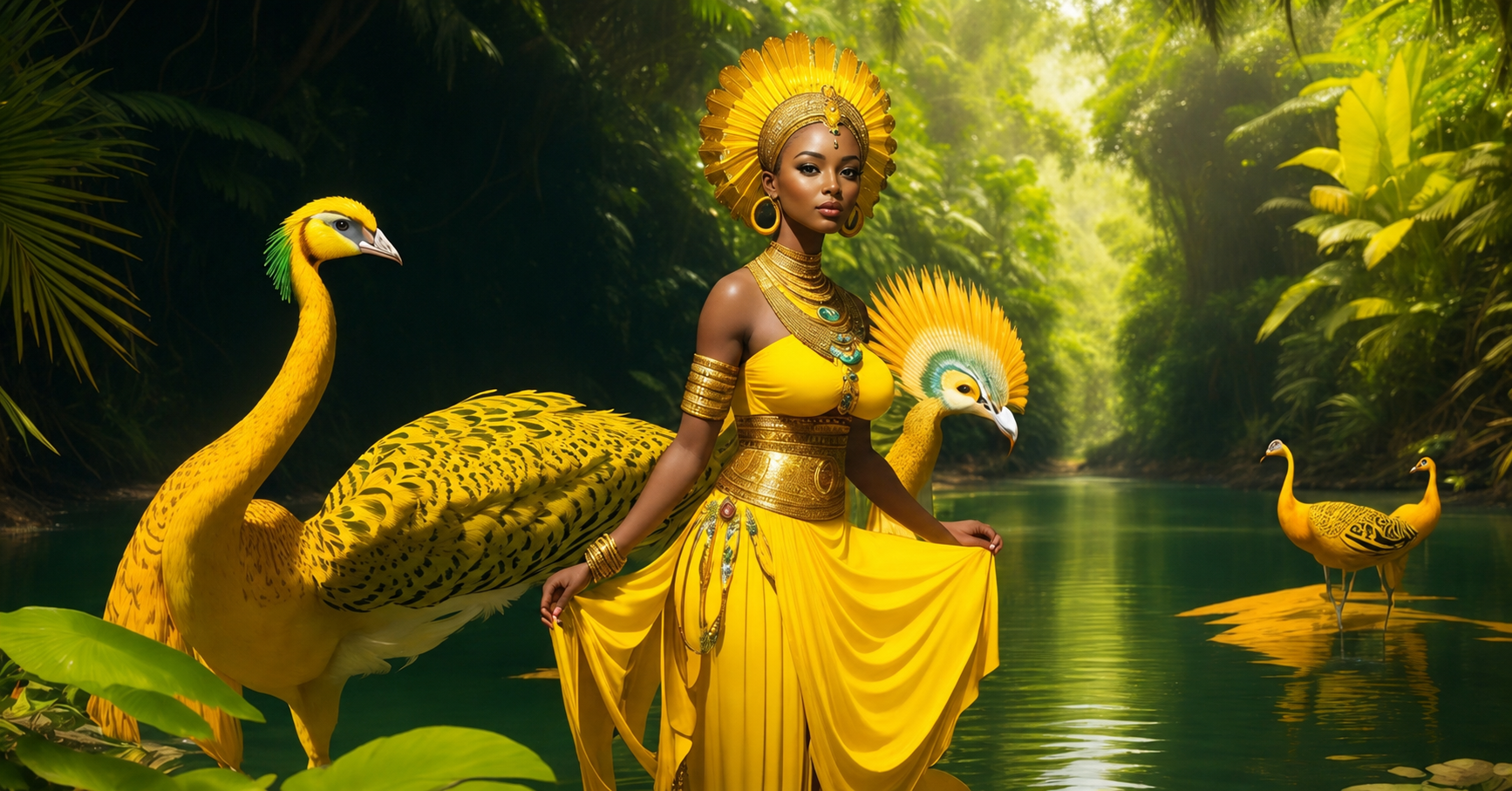
- Dressed in yellow and gold, her signature colors
- Adorned with brass, her sacred metal, and amber beads
- Forever holding a mirror to admire her own reflection
- Wreathed in the scent of honey, her favorite thing in the world
- A contagious laugh that can warm a room or chill it
Abilities
- Fertility — she helps women conceive and is said to have populated the earth
- Healing — she cures the sick and tends the poor and the orphaned
- Sweet water — she can give water freely or withhold it into drought
- Divination and wisdom — in some traditions she carries prayers to the supreme god and is tied to Ifá
- Love and reconciliation — she draws people together and cools hot tempers
Symbols
- Honey — her favorite offering, and a tool of seduction
- The mirror — her constant companion
- Brass and gold — her sacred metals
- The color yellow — worn by her devotees
- The peacock and the vulture — both tied to her flight to heaven (below)
- Sunflowers, oranges, cinnamon, and pumpkin — among her cherished things
- The number five — her sacred number
Traits
- Generous and nurturing, the protector of the poor
- Warm, charming, and magnetic
- Vain and jealous, with very human flaws
- Genuinely dangerous when disrespected or crossed
- Deeply loving, and sometimes heartbroken for it
Festivals and Rituals
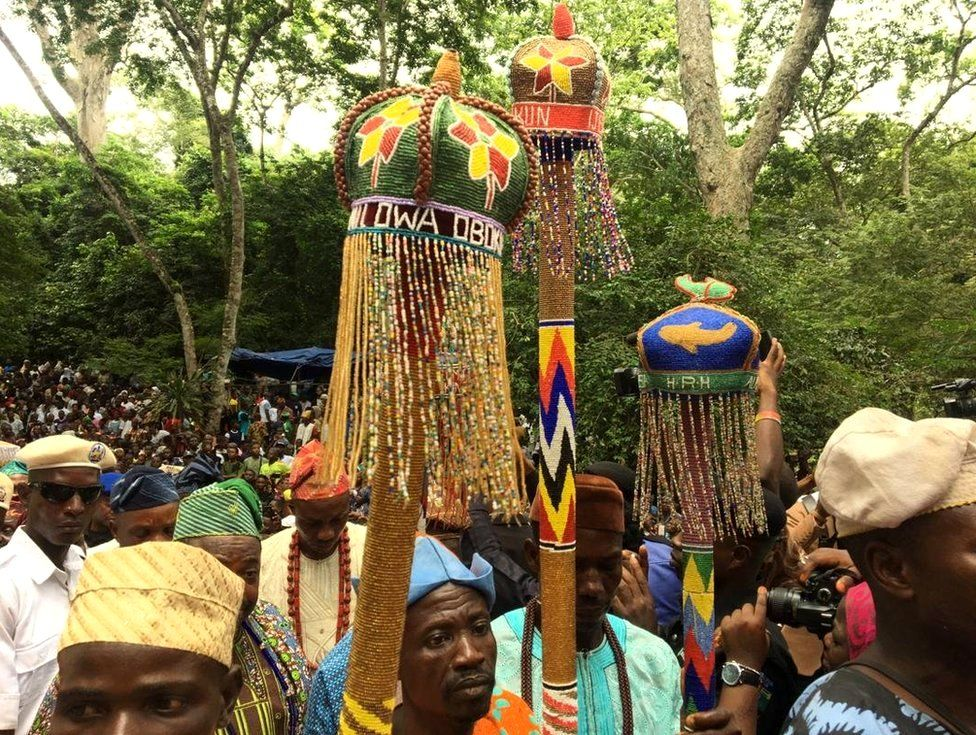
Source: BBC News
The city of Osogbo in Nigeria is where tradition places the first meeting between Oshun and human beings. The story goes that she gave the people permission to settle by her river, promising to provide for them and protect them as long as they honored her.
Each year that bond is renewed at the Osun-Osogbo festival, a two-week celebration that is the largest traditional Yoruba religious event in the world. It draws thousands of worshippers and visitors to the riverside.
The festival centers on the Osun-Osogbo Sacred Grove, a forest of shrines and sculptures honoring her along the riverbank. It was named a UNESCO World Heritage Site in 2005.
Legends associated with Oshun
Oshun’s stories tend to make the same point in different ways: leave her out, underestimate her, or disrespect her, and the whole world feels it.
The creation of humankind
Source: Medium
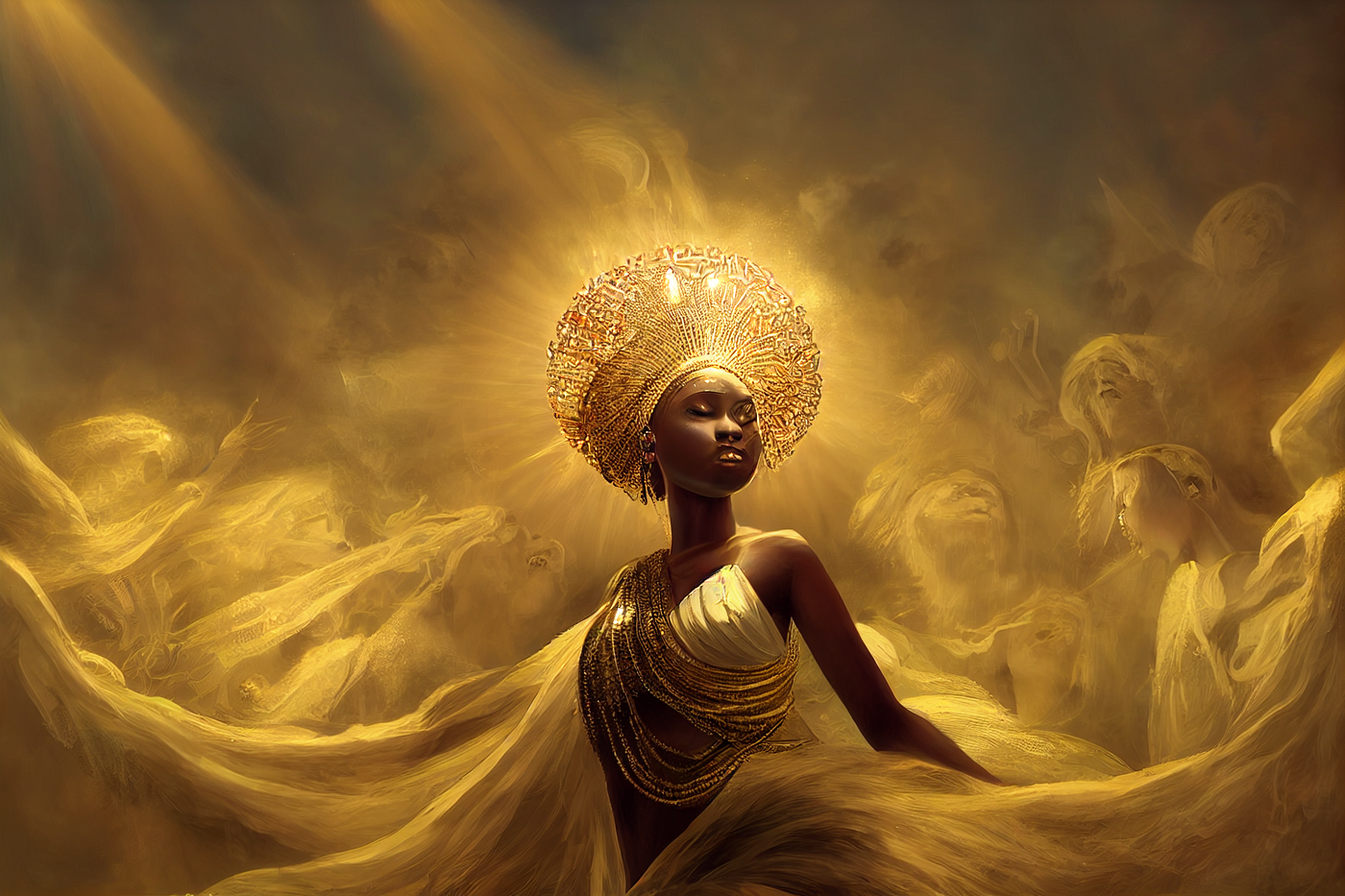
When the supreme god Olodumare first sent orishas down to shape the earth, Oshun was among them. By most tellings there were seventeen, and she was the only woman.
The male orishas got to work and ignored her. They tried to build the world without her ideas, brushing off her suggestions, never quite seeing her worth.
So she stopped offering. She left the earth entirely and withdrew to a quiet place, where she rested and admired herself in her mirror. She didn’t argue. She didn’t demand. She simply went, knowing what would happen.
The moment she left, the waters dried up. Nothing would grow. Nothing would live. The gods labored on and got nowhere, baffled, until they finally understood that the dead, parched world and the missing goddess were the same problem.
They went to Olodumare, who told them plainly: without Oshun, there is no creation. So they swallowed their pride and begged her to return. She agreed. She brought her sweet waters back, and with them, life. Humankind included.
Oshun’s flight to heaven

Source: Gods & Goddess Wiki
There’s a story about why Oshun, and only Oshun, can carry humanity’s prayers straight to the supreme god.
The orishas had grown rebellious and plotted against Olodumare, so he punished the world by shutting off the rain. Drought spread. Crops withered, and people and gods alike began to starve. Desperate, they decided to send a messenger to beg his forgiveness, but no one could make the long flight up to heaven.
Then a peacock stepped forward to try. It was Oshun in disguise, and the other orishas laughed at the vain, pampered bird.
She flew anyway. The journey was brutal. The closer she got to the burning sun, the more her gorgeous feathers scorched and fell away. By the time she reached the gates of heaven she was bald and blackened, no longer a peacock but a vulture.
Olodumare saw what the journey had cost her, and why she’d made it. Moved by her sacrifice, he sent the rains back to earth. To this day the vulture is sacred to Oshun, a reminder that the most beautiful among them gave up her beauty to save everyone else.
The seduction of Ogun
This story is the clearest proof of Oshun’s hidden strength.
Ogun, the fierce orisha of iron and war, had grown disgusted with the other gods and retreated deep into the forest. There he stayed, and the world suffered for it, because without Ogun there was no one to clear the land or forge the tools. One by one the orishas went to coax him out. One by one they failed.
Then Oshun asked for her turn. The elder god Obatala, doubtful, let her try.
She went to the edge of the forest and began to dance. She sang. She let her brass bangles chime, and from time to time she dipped her fingers in honey and touched them to her own lips, and then, when Ogun crept close enough to watch, to his.
Step by step, sweetened and entranced, the war-god followed her out of the trees and back into the world. No weapon had moved him. Honey did.
The lesson the Yoruba draw from it is simple: sweetness can be the most powerful weapon of all, and Oshun is far stronger than she looks. (Versions of this tale vary across Yoruba and diaspora tradition, but the honey and the dance are constant.)
Oshun and Shango
In Yoruba tradition, Oshun was also a queen.
She is remembered as a consort of Shango, the thunder-and-fire king of Oyo, and by many accounts his favorite wife. Three goddesses claim Shango as husband: Oya, Oba, and Oshun. Where Shango is heat and storm, Oshun is the cool, sweet water that balances him, which is part of why their pairing endures in the stories.
Why you taste the honey first
One small custom carries a warning inside it.
In the Santería tradition of the Americas, you never offer Oshun honey without tasting it yourself first. The reason, the story goes, is that someone once tried to poison her with a tainted offering. Ever since, untasted honey is refused, and the giver is eyed with suspicion. Even a goddess who loves sweetness learned to be careful with it.
Oshun across the world

Source: Wikimedia Commons
When the transatlantic slave trade tore the Yoruba people from their homeland, their gods went with them.
Oshun crossed the ocean and took root across the Americas. She’s known as Ochún in Cuba and Oxum in Brazil, and she remains a central figure in Santería, Vodou, and Candomblé, where Yoruba belief blended with Catholicism to survive. Worldwide, she’s counted among the great goddesses of love and fertility. She is often honored alongside Yemaja, the great mother of the waters, the ocean to Oshun’s river.
Her pull hasn’t faded. Women still adopt Oshun as their personal deity, drawing strength from her. Beyoncé built on her imagery for the 2016 album and film Lemonade, appearing in a flowing amber-yellow dress and gold jewelry, a direct nod to Oshun’s colors and her spirit of turning hardship into something sweet.
Final thoughts
Oshun lasts because she’s the whole of being human, gathered into one goddess.
She is beauty and vanity, generosity and jealousy, tenderness and a temper. She gives life and she can take it back. Above all she teaches a kind of grace: that you can forgive your own failings the way she forgives hers, and that sweetness, used well, can move what force never could.
Bibliography
- “Oshun”. Encyclopaedia Britannica.
- “Oshun”. World History Encyclopedia.
- “Oshun: African Goddess of Love and Sweet Waters”. Ancient Origins.
- “The Oshún Mythical Cycle: The Seduction of Ogún”. Society of Friends of Epicurus.
- “The History of Oshun and Ogun”. Original Botanica.
- “Oshun”. Santería Church of the Orishas.
- “Oshun”. Wikipedia.