Kannon: The Japanese Goddess of Mercy
Walk the length of Sanjusangendo in Kyoto and a thousand and one gilded figures watch you go, row on row, every one of them raising forty-two arms.
A hall like that gets built for one reason. Kannon is the most loved figure in Japanese Buddhism, the one who hears every cry in the world and has sworn to answer all of them. Japan calls her the Goddess of Mercy, and the word “goddess” is where her story gets interesting, because she began as a prince in India and became a mother somewhere on the road through China.
Overview of Kannon
Kannon, in full Kanzeon Bosatsu, is the Japanese form of Avalokiteshvara, the great bodhisattva of compassion in Mahayana Buddhism. Her name is a translation. The Chinese rendered the Sanskrit as Guanshiyin, “the one who perceives the sounds of the world,” and the Japanese shortened it to Kannon, the one who watches and listens. That is the whole job description. She hears the suffering of the world and moves toward it.
A bodhisattva is a being who has reached the threshold of full enlightenment and chosen to stay. Avalokiteshvara’s vow, told across the Buddhist world, is to free every sentient being from the cycle of birth and death before taking the final step into Buddhahood. In Japan that vow made Kannon the figure ordinary people pray to first. Farmers, fishermen, mothers in labor, travelers on a mountain road, the dying, and the grieving all call on her, and every major school of Japanese Buddhism, from Tendai and Shingon to Zen and the Pure Land sects, gives her a place.
One nuance matters more than any other. In Buddhist doctrine a bodhisattva of Kannon’s rank is free of any fixed body or sex. The Lotus Sutra says she takes whatever form will save the person in front of her, a monk for one, a girl for another, a god or a dragon for a third. Avalokiteshvara was pictured as a man in India, and the earliest images in China and Japan follow suit. Over centuries of devotion in East Asia the figure softened into a woman, and by the medieval period Guanyin in China and Kannon in Japan were most often shown as a serene, maternal lady in white. So when Japan calls Kannon a goddess, it is describing how she is loved. The theology behind her is roomier than any single gender.
Kannon reached Japan in the late sixth century, soon after Buddhism arrived by way of Korea and China. Statues of her from the Asuka period, Japan’s first Buddhist age, survive today as National Treasures. The eighteenth day of every month is her holy day.
Titles
- Kanzeon Bosatsu, “the bodhisattva who perceives the sounds of the world,” her full Japanese name
- Kannon-sama, the everyday, affectionate form of address
- Kanjizai, “the one who gazes in freedom,” the name she carries in the Heart Sutra
- Bodhisattva of Compassion
- Goddess of Mercy
- Bestower of Fearlessness, her epithet in the Lotus Sutra
- Avalokiteshvara in Sanskrit, Guanyin in Chinese, Chenrezig in Tibetan
Characteristics
How Kannon tends to appear in Japanese art:
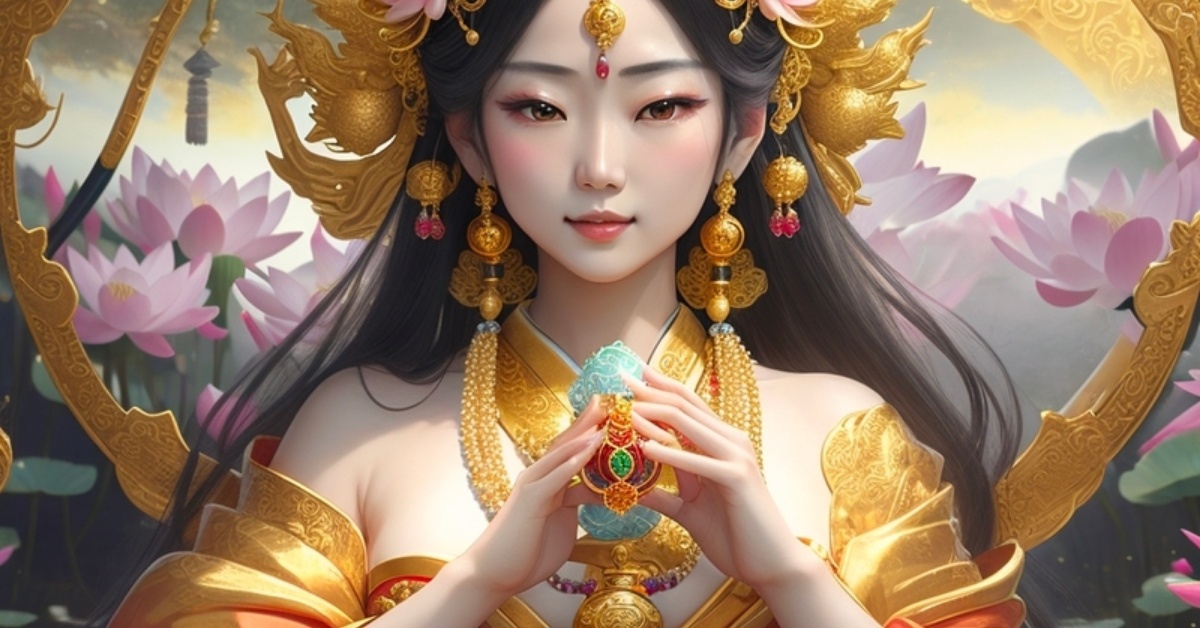
- A calm, youthful face, often deliberately hard to read as male or female
- In the older style, the dress of an Indian prince: bare shoulders, flowing scarves, a jeweled crown and necklaces
- In the later style, borrowed from China, a hooded white robe and a mother’s bearing
- A tiny image of Amida Buddha set in the front of her crown, the surest way to tell her from other bodhisattvas
- Standing or seated on a lotus, sometimes on a rock above the sea
- Holding a lotus bud, a slender water vase, or a willow branch
- In her esoteric forms, many arms, many heads, or the head of a horse
Abilities
- Hearing the world — she perceives every cry of suffering, everywhere, at once
- Rescue — the Lotus Sutra promises that anyone who calls her name is saved from fire, flood, shipwreck, bandits, and the executioner’s sword
- Taking any form — thirty-three shapes named in scripture, and in practice as many as compassion requires
- Safe childbirth — as Koyasu Kannon she watches over mothers and infants
- Guiding the dead — she descends with Amida Buddha to welcome the dying into the Pure Land
- Protecting the road — as Bato Kannon she guards travelers, horses, and cattle
- Healing — devotees have brought illness to her for fourteen centuries
Symbols
- The lotus — purity rising clean out of the mud
- The water vase — the vessel of compassion, holding the water that eases suffering
- The willow branch — used to sprinkle that water, and a sign of her yielding gentleness
- The wish-granting jewel — the nyoi hoju, which answers every worthy prayer
- The wheel — the Buddhist law turning through the world
- A thousand arms and a thousand eyes — her reach and her sight, with an eye in every palm
- Amida in the crown — the Buddha whose compassion she carries into the world
Traits
- Compassion without limit, and without a waiting list
- Patience, since the vow has no end date
- Practical, changing shape to fit the need instead of asking the need to fit her
- Fearless, and a giver of fearlessness to others
- Tender toward the small, the lost, and the unborn
- Committed to bringing everyone along, which is the whole reason she is still a bodhisattva
Festivals and Rituals
Kannon’s worship runs on a calendar of small, steady devotions rather than one great annual feast.
The eighteenth of every month is her ennichi, her day of connection, when prayers at a Kannon temple are said to carry extra merit. Sensoji in Tokyo pushes this to its limit on July 9 and 10, the days called Shiman-rokusen-nichi, when a single visit is counted as worth forty-six thousand days of prayer and the temple grounds fill with the Hozuki-ichi, a market of ground-cherry plants sold as charms against summer sickness.
The deepest ritual is the pilgrimage. The Lotus Sutra gives Kannon thirty-three forms, so Japan gave her thirty-three temples. The Saikoku circuit in the Kansai region runs from Seiganto-ji beside the Nachi waterfall to Kegon-ji in the hills of Gifu, and it has been walked for well over a thousand years. The Bando circuit in the east adds thirty-three more, the Chichibu circuit thirty-four, and together they make the Hundred Kannon of Japan. Pilgrims still wear white, carry a staff, and collect a red stamp and a line of brush calligraphy at each temple in a nokyocho, the stamp book that becomes the record of a life.
Devotees chant the twenty-fifth chapter of the Lotus Sutra, known simply as the Kannon Sutra, and the short Heart Sutra, in which Kannon herself is the speaker. Grieving parents bring small Jizo statues and offerings to temples like Hase-dera in Kamakura, where Kannon and Jizo share the care of children who died before or soon after birth. And in May the Sanja Matsuri, Tokyo’s largest festival, carries three portable shrines through Asakusa to honor the fishermen and the village headman who founded her temple there.
Legends associated with Kannon
Kannon’s stories are told in three countries and two thousand years, and they keep circling one idea: compassion will change its own shape, break its own body, or hide its own face if that is what it takes to reach someone.
The vow, and the head that broke
Avalokiteshvara, so the story goes, looked out over the world and swore never to rest until every being in it was free of suffering. Then he set about the work.
He labored for eons. He emptied the hells, only to look back and see them filling again. When he finally understood how much suffering remained, his head split into pieces from grief. Amida Buddha, his teacher, gathered the fragments and rebuilt them into eleven heads, so that the bodhisattva could hear the cries of the world from every direction. Then his two arms shattered from the strain of the work, and Amida gave him a thousand in their place, with an eye in each palm so that no hand would ever reach out blind.
This telling belongs to Tibet, where Avalokiteshvara is Chenrezig, and it explains two of the forms Japan loves best: Juichimen, the Eleven-Headed Kannon, whose ten small faces ring a larger one, and Senju, the Thousand-Armed Kannon. The convention among Japanese sculptors is forty-two arms, two joined in prayer and forty more each said to save twenty-five worlds, which brings the count to a thousand for anyone who cares to multiply. The eleven heads and the thousand arms are the shape compassion took after it learned how big the job was.
Thirty-three faces
The twenty-fifth chapter of the Lotus Sutra is the scripture that made Kannon. It is short, it is chanted daily across Japan, and it makes a promise with no fine print.
Call the name of the bodhisattva who perceives the sounds of the world, it says, and you will be saved. A great fire cannot burn you. A flood will set you on the shore. Shipwrecked sailors, travelers among bandits, prisoners waiting for the sword, all are freed the moment they call. And the chapter explains how, listing thirty-three forms Kannon takes to teach and rescue beings: a Buddha, a monk, a nun, a householder, a king, a minister, a boy, a girl, a wife, a god, a dragon, a demon. If a woman can be reached only by a woman, Kannon appears as a woman. If a general is needed, a general arrives.
This is the passage behind the pilgrimages, the thirty-three temples answering the thirty-three forms. It is also the doctrine behind Kannon’s gender. The sutra leaves her sex open. It says she is whatever you need, and Japan, in the end, needed a mother.
The princess who gave her eyes
The Thousand-Armed Kannon has a second origin, this one Chinese, and it arrived in Japan alongside the form.
In the year 1100 a Song dynasty official named Jiang Zhiqi visited Xiangshan, the Fragrant Mountain monastery, famous for its great statue of the thousand-armed and thousand-eyed Guanyin. The abbot told him a story, and Jiang had it carved on a stone stele. A king named Miaozhuang had three daughters. The youngest, Miaoshan, refused to marry and asked instead to become a nun. Her father sent her to a convent and ordered the nuns to work her until she gave up. She held firm. He burned the convent. She walked out of the fire. He ordered her executed, and when the swords broke against her, she accepted death willingly, and a spirit in the form of a tiger carried her body to the mountain.
Miaoshan went down into hell and, by her presence, turned it into a paradise, which so alarmed its king that he sent her back to the living world. She settled on the Fragrant Mountain to meditate. Years later her father fell gravely ill, and a monk told him the only cure was a medicine made from the eyes and the arms of one who had never known anger. There was a hermit on the Fragrant Mountain, the monk said. Go and ask. The hermit gave her eyes and her arms without hesitation. The king recovered, climbed the mountain to thank the hermit, and recognized his daughter. In some versions he prays that she be made whole again, and she appears before him as the Thousand-Armed, Thousand-Eyed Guanyin, restored past anything he asked.
This is the story that turned Guanyin into a woman in the Chinese imagination, and the Guanyin who came to Japan brought it with her.
The statue in the river
Tokyo’s oldest temple began with a catch of fish.
In the year 628, two brothers, Hinokuma Hamanari and Hinokuma Takenari, were casting their nets in the Sumida River when they pulled up a small golden statue instead. They put it back. It came up again. The village headman, Haji no Nakatomo, recognized it as an image of Kannon, took Buddhist vows, and turned his own house into a temple to house it. That temple became Sensoji, and the district around it became Asakusa. The statue, about the height of a hand, was declared a hibutsu, a hidden Buddha, in 645, and it has stayed hidden ever since. Thirty million people a year walk through the Thunder Gate to pray to an image none of them has seen. The fishermen and the headman are still honored every May at the Sanja Matsuri.
The Kannon that chose its own shore
In 721 a monk named Tokudo found a camphor tree so enormous that he carved two statues of the Eleven-Headed Kannon from a single trunk. One he enshrined at Hase-dera in Nara. The other he set adrift on the sea with a prayer, asking it to find the place it was karmically bound to.
The statue drifted for fifteen years. In 736 it washed ashore on the Miura Peninsula near Kamakura, and a temple was built where it landed. That is the founding story of Hase-dera in Kamakura, whose gilded Kannon stands more than nine meters tall, one of the largest wooden statues in Japan, with each of its eleven heads said to represent a stage on the road to enlightenment. Below the hall a cave shrine belongs to Benzaiten, the goddess of music and water who walked the same road out of India, and the hillside is lined with thousands of small Jizo figures left by parents for the children they lost.
Mary in a Kannon’s robes
The most moving Kannon story in Japan involves people who were praying to someone else.
In 1614 the Tokugawa shogunate banned Christianity, and over the following decades it enforced the ban with executions, forced renunciations, and the fumi-e, images of Christ and Mary that suspects were made to step on. The Christian communities of Nagasaki, the Goto Islands, and the Urakami valley went underground and stayed there for two and a half centuries. They became the Kakure Kirishitan, the Hidden Christians. Their prayers were reshaped to sound like Buddhist chant while keeping scraps of Latin and Portuguese inside them. Their scriptures were passed by mouth because paper could be seized.
And their Virgin Mary became Kannon. Families kept small figures of the Koyasu Kannon, the child-giving Kannon holding an infant, most often white porcelain pieces imported from the kilns of Dehua in China. To an inspector they were ordinary Buddhist images. To the family they were the Madonna and child. Some carry a cross hidden in an inconspicuous place on the figure. One, found inside a statue of Amida in Kawaguchi, dates to about 1714. These are the Maria Kannon, and when Father Bernard Petitjean opened Oura Church in Nagasaki in 1865, the descendants of those families came to him and told him they had been Christians all along. Kannon, who takes whatever form will save the person in front of her, had spent two hundred years as the mother of Christ.
An older Kannon?
Some of the oldest paintings of this bodhisattva, in the cave temples of Dunhuang on the Silk Road, give Guanyin a thin mustache.
That detail is a doorway. Avalokiteshvara begins in India as a male figure, a princely bodhisattva in scarves and jewels, and stays male through Tibet, Nepal, and Southeast Asia to this day. The Chinese pilgrim Faxian saw him venerated at Mathura around the year 400, and Xuanzang, two centuries later, described statues honored by kings and monks and laypeople alike. The Karandavyuha Sutra, composed around the fourth or fifth century, introduced the six-syllable mantra still recited on prayer beads across the Himalayas, om mani padme hum, and its Avalokiteshvara is a lord who descends to the hells, a cosmic being with worlds in his pores, and unmistakably a he.
The change came in China, slowly, over the Tang and Song dynasties. Scholars who have traced it, most fully Chün-fang Yü in Kuan-yin: The Chinese Transformation of Avalokiteśvara, point to several forces working together. The Lotus Sutra had already licensed any form, including a woman’s. Chinese devotion reached for a compassionate, approachable figure, and the miracle tales of the period, followed by the Precious Scrolls of later centuries, gave that figure a woman’s biography, above all in the Miaoshan legend recorded in 1100. The White-Robed Guanyin, a form that answers prayers for children, grew enormously popular in exactly these centuries. By the twelfth century Guanyin was more often a woman than a man in Chinese art, and the maternal, white-robed lady became the default across East Asia. Japan, which received its Buddhism from China and kept receiving it, followed. Its earliest Kannon, the slender Kudara Kannon at Horyuji from the seventh century, is a graceful, androgynous figure in the older Indian mode. The Kannon of the Kamakura period and after is a mother.
Within the tradition all of this sits comfortably, for a plain reason. A bodhisattva at this level has passed beyond the body. The sutras say so, and the Lotus Sutra makes the changing of forms a virtue, the method of compassion itself. The gender of Kannon is, doctrinally, whatever gender helps. What the history shows is something about the people who prayed. Across a thousand years and two civilizations, when devotees were free to imagine perfect compassion, they imagined it as a woman, and specifically as a mother. The mustache at Dunhuang and the Madonna in Nagasaki are the two ends of the same road.
Kannon across cultures
Kannon is the same being as Guanyin in China, Gwaneum in Korea, Quan Am in Vietnam, and Chenrezig in Tibet, where the Dalai Lamas are held to be his living manifestations and the Potala Palace in Lhasa takes its name from Potalaka, the island-mountain paradise of the bodhisattva. In Tibet the goddess Tara is said to have been born from a single tear Avalokiteshvara shed over the suffering of the world, which makes her a daughter of compassion itself.
Within Japan, Kannon has company on the road she traveled. Kichijoten, the Japanese form of the Hindu Lakshmi, and Benzaiten, the form of Saraswati, both came out of India through China as Buddhist goddesses, and both were absorbed into Japanese devotion alongside her. When Buddhism met the native gods, the Japanese did what they did with Kannon’s gender and made room. Under the medieval doctrine of honji suijaku, the kami of Japan were understood as local appearances of Buddhist figures, so that Amaterasu could be the sun goddess and the cosmic Buddha Dainichi at once, and Inari, the rice god of the red gates, could be worshiped in a Buddhist form as Dakiniten. Kannon herself was named the true form behind several shrine gods. At Nachi, where the Saikoku pilgrimage begins, the deity of the great waterfall was identified with the Thousand-Armed Kannon, and the Shinto shrine and the Buddhist temple still stand side by side above the falls.
Look further out and the shape repeats. A figure of perfect mercy, usually a mother, who hears the prayer of anyone in trouble and is pictured with a child, over water, in white: the Hidden Christians of Nagasaki noticed the resemblance to Mary before any scholar did. The Egyptian Isis nursing Horus was drawn the same way a thousand years earlier, and the image of the mother with the infant on her knee passed from her to the Madonna. Each of these stands on her own. And when people in different centuries reach for an image of the compassion that comes when called, their hands keep finding the same one.
Final thoughts
The word to hold onto is the one inside her name: listening.
Kannon is what a religion produced when it asked what perfect compassion would look like if it had a face, and then kept asking for two thousand years. The answer changed from a prince to a mother, grew eleven heads and a thousand arms, went out to sea on a camphor log, and spent two centuries in a Nagasaki cupboard as the Virgin Mary. Through all of it the essential thing held. Someone is listening, and will come. She even turns up in camera bags. The camera maker Canon took its name from Kannon in the 1930s, a company of lenses named for the one who sees everything. Which leaves the question her sutra opens: when compassion takes whatever form will reach you, what form has it taken in yours?
Bibliography
- Schumacher, Mark. “Kannon Bodhisattva (Bosatsu): Goddess of Mercy, One Who Hears Prayers of the World”. A-to-Z Photo Dictionary of Japanese Buddhist Statuary.
- Schumacher, Mark. “Maria Kannon & the Virgin Mary: Hidden Christians in Japan”. A-to-Z Photo Dictionary of Japanese Buddhist Statuary.
- Yü, Chün-fang. Kuan-yin: The Chinese Transformation of Avalokiteśvara. Columbia University Press, 2001.
- Dudbridge, Glen. The Legend of Miaoshan, revised edition. Oxford University Press, 2004.
- Watson, Burton, trans. The Lotus Sutra, Chapter 25: “The Universal Gateway of the Bodhisattva Perceiver of the World’s Sounds”. Soka Gakkai Nichiren Buddhism Library.
- “Guanyin” and “Avalokiteśvara”. Wikipedia.
- “Sanjūsangen-dō”, “Sensō-ji”, and “Hase-dera (Kamakura)”. Wikipedia.
- “Saigoku Kannon Pilgrimage” and “Kakure Kirishitan”. Wikipedia.
- Tokyo National Museum. “Researching and Conserving Artifacts of Early Japanese Christianity”.
- “Kannon”. Mythopedia.