Tefnut: Egyptian Goddess of Moisture
Egypt’s oldest goddess arrived as a mouthful of spit.
That is the story the Pyramid Texts tell, carved into royal tombs more than four thousand years ago. The creator god sat alone on the first mound of earth, and out of his mouth came the first pair of children. One of them was air. The other was Tefnut, and she was water.
She is the goddess of moisture, dew, rain, and the damp breath of the morning, older than the sky and older than the ground under it. And once, when she stormed out of Egypt in a rage, the whole country dried up until somebody talked her into coming home.
Overview of Tefnut
Tefnut belongs to the Ennead of Heliopolis, the nine gods at the heart of Egypt’s most influential creation story. In it the sun god Atum (later merged with Ra as Atum-Ra) brings himself into being out of the dark waters of Nun, then produces the first divine pair: Shu, god of air and dry light, and Tefnut, goddess of moisture. Brother and sister, husband and wife, they are the twins the rest of the family descends from. Their children are Geb, the earth, and Nut, the sky. Their grandchildren are Osiris, Isis, Set, and Nephthys.
That puts her in the second generation of the universe. Everything solid came after her.
Her name is the oldest clue to who she is. The Egyptian verb tefen means “to spit,” and scribes of the late periods sometimes wrote her name with a picture of a mouth spitting. Egyptologists read it as something close to “She of Moisture,” with the spit built into the spelling. The pun is on purpose. Atum spat, and what landed was wet.
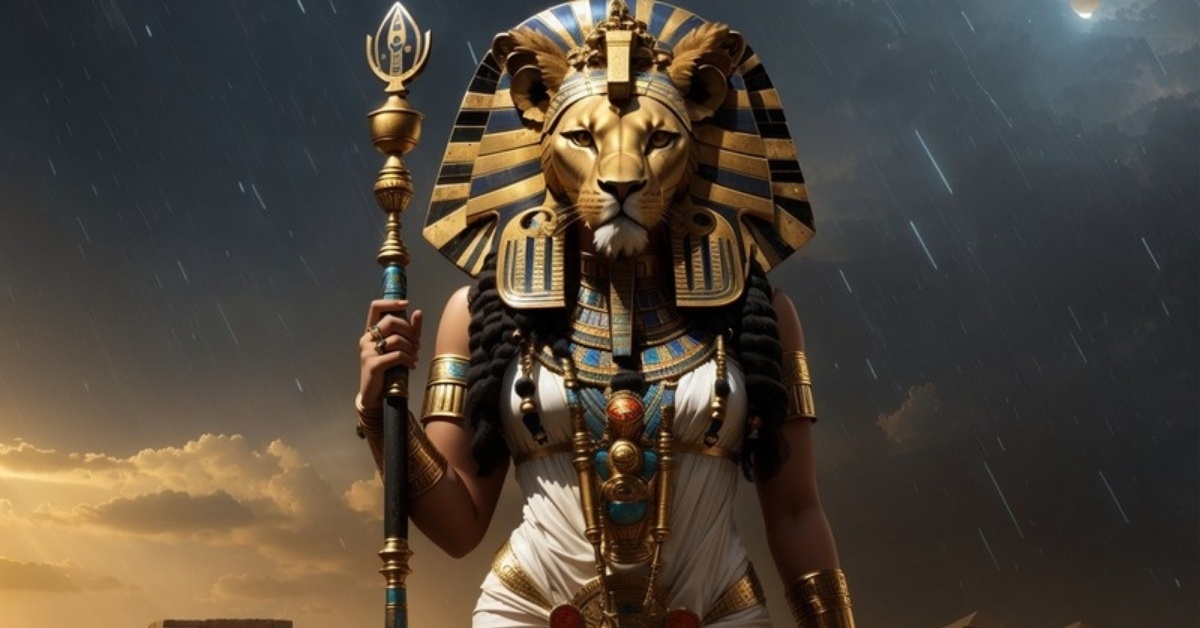
She shows up as a lioness far more often than as a woman. She is also, in one of her most important roles, the Eye of Ra, the fierce daughter who acts as the sun god’s protector and enforcer. That title travels between goddesses, and Tefnut shares it with Hathor, Sekhmet, and Bastet.
Her cult had two main homes: Heliopolis, where she held a sanctuary called the Lower Menset, and Leontopolis in the Nile Delta, where she and Shu were honored together as a pair of lions.
Titles
- Tefnut, or Tefenet (“She of Moisture”)
- The Eye of Ra
- Lady of the Flame
- Uraeus on the Head of All the Gods
- One of the Ruty, “the Two Lions,” with Shu
- “Maat is her name” (Coffin Texts, spell 80)
Characteristics
How Tefnut tends to be shown in art:
- A woman with the head of a lioness, or a lioness outright
- A sun disk on her head, wrapped by the rearing cobra called the uraeus
- A was scepter in one hand, an ankh in the other
- Occasionally a cobra, or a lion-headed serpent
- In Amarna-period art, a low flat-topped crown close to the one Nefertiti wears in her famous bust
Abilities
- Moisture and rain — dew, mist, humidity, the damp that lets anything grow in a desert country
- Drought and heat — when she withdraws, the water goes with her
- The Eye of Ra — the sun’s own fury, sent out against his enemies
- Holding up the sky — one Pyramid Text has the earth raised under the sky “by your arms, O Tefnut,” beside her brother Shu
- Order itself — Coffin Texts spell 80 has Atum name her Maat, the principle of rightness
Symbols
- The lioness — her body, her temper, and her form as the Eye
- The sun disk and uraeus — the solar crown that marks her as Ra’s daughter
- The ankh — life, which she and Shu bring into the world
- Water — the Book of the Dead speaks of “the water of Tefnut,” which some read as the morning dew
- The double lion — she and Shu back to back, guarding the horizon
Traits
- Fierce, quick to anger, slow to forgive
- Bound to Shu; the twins are rarely pictured apart
- Protective of her father to the point of violence
- Able to cool. Her whole story turns on fury that can be soothed
- Easily offended, and the whole country depends on her
Festivals and Rituals
At Heliopolis, Tefnut was worshiped as one of the Ennead, with her own sanctuary in the temple precinct. At Leontopolis (Tell el-Muqdam) she and Shu were the resident lion pair, and the Roman-era writer Aelian describes living lions kept and fed in the town.
The great celebration tied to her is the Return of the Distant Goddess, the festival of her homecoming from Nubia. Its scenes survive in more than twenty temples of the Ptolemaic and Roman periods, strung along the Nile from Bubastis in the Delta to Dakka in Lower Nubia, where a whole run of reliefs shows Tefnut on her way home. The festival fell around the New Year, when the Nile began to rise, and it was celebrated the way the goddess herself was said to have been welcomed: with music, dancing, and a great deal of drinking.
Legends associated with Tefnut
Tefnut has fewer stories than Isis or Hathor, and most of the ones she has are about the beginning of the world. Two things run through all of them. She comes first, and she leaves.
Spat into being
Before anything existed there was Nun, a dark and endless water. Atum rose out of it onto the first mound of dry land, alone.
So he made company. The Pyramid Texts say he sneezed, and the Coffin Texts split the act in two: Shu came out with a sneeze, and Tefnut “was spat out like saliva.” A blunter version, told in the same texts and in the later Bremner-Rhind Papyrus, has Atum bring the twins forth by pleasuring himself. Either way, the first two gods were fluid that left the creator’s body. Air and moisture, the dry and the wet, came out together and stayed together.
Tefnut and Shu then bore Geb and Nut, and the two of them lay wrapped so tightly that the space between them was closed. Shu forced his way in and lifted Nut up over his head, and the sky was separated from the earth. In one Pyramid Text, Tefnut’s arms hold it up beside his. The gap they opened is the world.
Lost in the waters, and the tears that made us
The Coffin Texts and the Bremner-Rhind Papyrus add a second chapter.
The twins were young, and they wandered off into the dark of Nun. Atum lost them. He tore out his own Eye and sent it into the waters to search, and the Eye brought them back. Overcome, the creator wept for joy, and where his tears fell on the ground the first human beings stood up. The Egyptian words for “tears” and “people” sound alike, and the myth leans on the pun.
The Eye, meanwhile, came home to find that Atum had grown a new eye in its place. It raged. To calm it, Atum set it on his own brow as the rearing cobra, the uraeus, so that the Eye would guard him forever. That cobra on the crown of every king and every solar goddess starts here, with a jealous, wounded piece of the creator that had to be given a place of honor before it would settle.
Keep that pattern in mind. Tefnut is about to repeat it.
The Distant Goddess goes to Nubia
This is the story Tefnut owns.
She was living as the Eye of Ra, the sun god’s daughter and his strong right hand, when she quarreled with her father. The reasons shift between tellings. In one she was furious with Ra himself; in another she felt the younger gods, her own grandchildren, were being honored above her. Whatever set it off, Tefnut left. She went south, past the cataracts and into Nubia, the land the Egyptians called Kush, and there she turned into a lioness and raged through the desert, killing whatever she came across.
She took the water with her. Without moisture in the air, Egypt dried out. The dew stopped, the crops failed, the Nile fell, and the country slid toward chaos. Ra, cut off from his Eye, was weakened and exposed to his enemies.
So he sent for her. Shu went, and so did Thoth, the god of wisdom and writing, the one god who could reasonably be expected to out-talk a lioness.
The return of the water
Thoth’s approach was a slow one. In the fullest surviving version, a Demotic papyrus from the second century CE now in Leiden, he arrives in Nubia in the form of a small ape and finds the goddess sitting as a cat. He flatters her. He reminds her how much Egypt loves her and how empty the temples are without her. And he tells her stories, animal fables one after another, the lion and the mouse among them, each of which has a moral tucked into it about mercy, or gratitude, or the folly of a strong creature who refuses help.
She is a difficult audience. More than once she flares from cat into a fire-breathing lioness and Thoth has to start over. But the stories work, and she agrees to come home.
The journey back is the festival. At the First Cataract, where the Nile enters Egypt at Philae, the goddess bathes in the river and her heat is cooled; in some tellings she steps out of the water as Hathor, goddess of love and music, the lioness gone. From there she travels north from town to town with Shu and Thoth beside her, met at every stop by musicians, dancers, and crowds with wine. The water returns with her. The Nile rises. Ra takes his daughter back as his Eye, and the year begins again.
Egyptians tied all of this to the sky. The star Sirius vanished from view for weeks each summer and then reappeared just before dawn, right as the flood began, and its return was the return of the goddess. The lioness had been away in the south. Now she was home, and the fields would drink.
An older Tefnut?
The Pyramid Texts are the oldest body of religious writing on earth, and Tefnut is already in them. Utterance 527, cut into the Old Kingdom pyramids at Saqqara around 2300 BCE, describes Atum’s sneeze at Heliopolis and names the twins it produced. By the time Egyptians were writing anything down about their gods, she had been in place for as long as anyone could remember, and she was the second thing that ever existed.
Scholars read that position as a clue to what she was before she was a character. In the Heliopolitan system the first act of creation is a division: the creator splits himself into a dry principle and a wet one, and everything that follows, sky and earth, gods and people, descends from that pair. Coffin Texts spell 80 says it outright. Atum tells Nun that his two children are the forces that woke him into life, and gives them their true names: “Life is his name, Maat is her name.” Shu is the breath in the body, Tefnut is Maat, the order of things. Read that way, Tefnut is the wet half of the world’s first idea, the moisture the breath needs in order to move through anything at all. Her lioness, her temper, and her stories came later, the way a personality grows around a principle.
The second layer is the myth she shares. Egyptologists group the story of the goddess who leaves for the south and must be brought back under one name, the “Distant Goddess” or “Wandering Goddess” cycle, and they note that it was told of several goddesses, each of them a form of the Eye of Ra. Hathor goes to Nubia and is fetched home by Thoth. Sekhmet rampages in the desert and is tricked into calm with red-dyed beer. Bastet’s festival at Bubastis was a riot of music and wine that Herodotus described in detail, and the Ptolemaic scenes of the goddess’s return run from her city all the way south. Mut and Wadjet take the role too. Barbara Richter, who traced the cycle through the temples, reads it as a single myth-complex tied to the inundation and the rising of Sirius, mapped onto whichever local goddess held the Eye. In that reading the lioness who leaves is a role, and Tefnut, Hathor, Sekhmet, and Bastet are all names for the one who plays it.
Which of them held the role first is an open question. The Demotic papyrus names Tefnut, and the temple reliefs at Dakka and Philae show her, so some treat hers as the primary telling; others point to Hathor, whose Dendera festival is the best documented. The texts we have are late, most of them Ptolemaic and Roman, and they were written down long after the story had been shared around. What can be said with confidence is that an old goddess of moisture, older than the sky, ended up carrying the story of a country’s water going away and coming back. Given what she was made of, the fit is close to perfect.
Tefnut across cultures
A divine daughter storms off, the world suffers for it, and the gods have to throw a party to get her back. That story was told in a lot of places besides Egypt.
In Japan the sun goddess Amaterasu shut herself into a cave after a quarrel with her brother, and the world went dark. The other gods gathered outside and staged a raucous dance until her curiosity got the better of her and she looked out, and the light came back. In Greece Demeter withdrew in grief for her daughter, and the fields went barren until a deal brought Persephone home for part of the year. The details differ, but the engine is the same one that drives Tefnut’s return: the thing the world runs on is held by a goddess, and when she is wronged she takes it with her.
Her other story, the first pair and the raising of the sky, has cousins too. Māori tradition tells of the sky father Ranginui and the earth mother Papatūānuku locked in an embrace so close their children lived in darkness between them, until the forest god Tāne braced his back against his mother and pushed his father up into the sky. It is Shu’s move exactly, made half a world away. What sets Tefnut apart is where she stands in that story. Most sky-and-earth myths begin with the pair being separated. Egypt’s begins one generation earlier, with the wet and the dry, and she is the wet.
Final thoughts
The lioness who took the rain with her is a strange thing to build a creation story around, and Egypt built its oldest one around her.
Tefnut is what the desert country could feel on its skin at dawn and could lose by noon. She is the dew, the mist off the river, the humidity that decides whether anything grows. And she is the reminder that the source of all that has moods. Egyptians honored her by telling her story every year at the flood, with the same music and wine that had coaxed her home the first time, on the theory that a goddess worth having back is worth welcoming properly.
What do you make of a myth where the fix for a drought is a good storyteller and a party?
Bibliography
- “Tefnut” and “Eye of Ra”. Wikipedia.
- “Tefnut”. Ancient Egypt Online.
- Butler, Edward P. “Tefnut”. Henadology.
- Richter, Barbara A. “On the Heels of the Wandering Goddess: The Myth and the Festival at the Temples of the Wadi el-Hallel and Dendera”. In 8. Ägyptologische Tempeltagung, 2010.
- Faulkner, R. O. The Ancient Egyptian Coffin Texts. Aris & Phillips.
- Faulkner, R. O. The Ancient Egyptian Pyramid Texts. Oxford University Press.
- Pinch, Geraldine. Handbook of Egyptian Mythology. ABC-CLIO.
- Wilkinson, Richard H. The Complete Gods and Goddesses of Ancient Egypt. Thames & Hudson.
- “A Tale of Two Tongues? The Myth of the Sun’s Eye and Its Greek Translation”. Proceedings of the 25th International Congress of Papyrology.
- “Scenes of the Goddess Tefnut in the Temple of Dakka in Lower Nubia”. Academia.edu.
- Kabir, S. R. “Tefnut: Egyptian Goddess of Moisture and Rain”. History Cooperative.