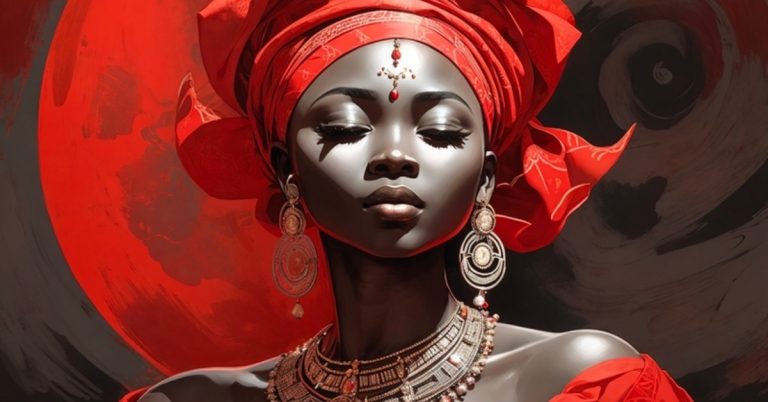
Tyche: Greek Goddess of Fortune and Chance
Around 300 BC a king founded a city on the Orontes River and ordered a statue before the walls were finished. It showed a woman seated on a rock, a sheaf of wheat in her hand, a crown shaped like battlements on her head, and a young man swimming out from under her feet.
The woman was the city’s luck. The swimmer was its river.
Cities copied that statue for the next eight hundred years, because every city wanted her on its side. She could hand a footrace to the slower runner, a famine to a good king, and a throne to a nobody. The Greeks called her Tyche.
Overview of Tyche
Tyche’s name is the Greek word for luck. That’s the whole job description: she is what happens when nobody planned it. The Romans knew her as Fortuna, and by the end of antiquity the two had merged so thoroughly that their statues are hard to tell apart.
She is a strange kind of goddess. Most Olympians own a territory, a sea or a forge or a hearth. Tyche owns the gap between what you intended and what you got. She has almost no stories of her own, and an enormous amount of cult, because people in trouble pray to the thing beyond their control.
Her rise was late. In Homer she is nowhere. In Hesiod she is one nymph among three thousand. By the time Alexander’s generals were carving up his empire, she had temples in every major city, her face on the coins, and philosophers arguing about whether she existed at all.
Titles
- Agathe Tyche (“Good Fortune,” the form most cities worshiped)
- Tyche Soteira (“Savior Fortune,” Pindar’s title for her)
- Tyche Protogeneia (“First-born,” at Itanos on Crete)
- Tyche Poleos (“Fortune of the City,” each city’s own)
- Automatia (“She Who Acts on Her Own,” the shrine Timoleon built her at Syracuse)
- Lady Luck (the modern survival)
Characteristics
How Tyche tends to be shown in art:
- A grown woman in a long chiton and cloak, standing or seated on a rock
- A crown shaped like city walls, or a tall cylindrical polos
- A ship’s rudder in one hand, often resting on a globe
- A cornucopia cradled in the other arm, spilling fruit and grain
- Sometimes winged, to show how fast she moves on
- Sometimes holding the infant god Plutus, Wealth, as if she were his nurse
Abilities
- Turning outcomes — Pindar says she can steer a ship, swing a battle, and hand victory to the weaker athlete
- Guarding a city — every Hellenistic city had its own Tyche who held its fate
- Pouring out plenty — harvests, trade, and wealth arrive through her cornucopia
- Withholding all of it — Polybius blames her for floods, droughts, and frosts, the things no one can explain
- Ignoring merit — she gives to the undeserving and takes from the good, and answers to no one
Symbols
- The rudder — she steers the course of events
- The wheel — fortune turns, and whoever is on top comes down
- The cornucopia — the horn of Amaltheia, pouring out abundance
- The ball or globe — the unstable footing under everything she gives
- The mural crown — a ring of city walls, marking her as a city’s guardian
- Dice — the hero Palamedes dedicated the first pair to her
Traits
- Capricious, moving on without warning
- Impartial, with no favorites among gods or mortals
- Generous by whim and cruel by the same whim
- Unaccountable, the one power even Zeus’s plans bend around
- Kept in check by one goddess only, her companion Nemesis
Festivals and Rituals
Tyche’s worship was constant and civic, built into the paperwork of Greek life, and it came with no Panathenaia.
Athenian decrees opened with the words agathei tychei, “with good fortune,” the way a modern contract opens with a date. At the end of a dinner party the last cup of unmixed wine went to Agathos Daimon, the Good Spirit, and his partner Agathe Tyche, Good Fortune, as thanks for the meal and a request for the next one.
Her temples were everywhere. Pausanias, touring Greece in the second century AD, found her at Thebes carrying the baby Plutus, at Megara in a statue by Praxiteles, at Elis beside the local child-god Sosipolis, and at Smyrna in the oldest image of her he knew, carved by Bupalus with the sphere of heaven on her head and the horn of Amaltheia in her hand. Antioch built her the Tychaion. Alexandria built her a temple that ancient writers said outshone every other in the Hellenistic world.
Founding a city meant founding her cult. She was the first citizen, and the walls on her head were the city’s own.
Legends associated with Tyche
Tyche is short on myths and long on meaning. The Greeks kept her out of most stories because she was the force underneath the stories, the reason the plan went wrong. What she has instead is a handful of tellings, each one a window onto how the Greeks thought about luck.
Three fathers and a sea
Nobody could agree on where she came from, which is fitting.
Hesiod makes her an Oceanid, one of the daughters of the Titans Oceanus and Tethys, and the Homeric Hymn to Demeter has her gathering flowers in the meadow with Persephone on the day Hades came. That’s the oldest layer: a sea-nymph, a girl among many, with nothing yet to mark her out. Water suits her. It shifts, it carries you somewhere you never chose, and it drowns the careful and the careless alike.
Pindar, writing in the fifth century BC, gave her a promotion. In his hands she became a daughter of Zeus the Deliverer, a savior goddess with real power over ships and battles and councils. Later Hellenistic writers went further and made her the child of Aphrodite by Zeus or Hermes, which made her a sister to Eros. The poet Alcman had his own version, calling her the daughter of Forethought and sister to Good Order and Persuasion.
Pick the parentage and you pick your theory of luck. Daughter of the ocean, and luck is weather. Daughter of Zeus, and luck is the will of heaven working sideways. Daughter of Aphrodite, and luck is the thing that makes you fall in love with the wrong person at a party.
The first dice
Pausanias saw a temple of Tyche at Argos and was told it was ancient. The proof was a story.
Palamedes, the cleverest of the Greeks at Troy and the hero credited with inventing letters and numbers, invented dice too. When he had finished, he brought the first pair to this temple and dedicated them to Tyche.
It’s a small story with a sharp point. The Greeks understood that dice belong to her, and that a gambler is a worshiper whether he knows it or not. Every time a pair of dice hits the table, someone is asking Tyche a question.
The runner from Himera
In 466 BC a man named Ergoteles won the long footrace at Olympia, and Pindar wrote him a victory ode. It opens with a prayer to Tyche.
Ergoteles was a Cretan. Civil war had driven him out of his home city of Knossos, and he had washed up in Himera, a Greek town in Sicily, as an exile. Pindar’s ode says, in effect, look what she did. Had Ergoteles stayed home, he would have been a fighting cock scrapping by his own hearth, his fame dropping like leaves. Instead exile threw him onto the biggest stage in Greece, and he won.
The poem is one of the earliest places where a Greek looks straight at luck and calls her a goddess. Pindar even says, in another fragment, that Tyche is one of the Moirai, the Fates, and stronger than her sisters. Pausanias read that line and agreed with it.
The mother of Wealth
At Thebes, Pausanias found a statue of Tyche holding the child Plutus, the god of wealth, in her arms. He liked it enough to explain the joke: the sculptors had made her his mother or his nurse.
That is the whole theology in one image. Wealth is a baby. It gets born, carried, and handed off, and the one doing the carrying is Chance. In this picture wealth is something you are handed. Tyche has him, and she can put him down anywhere she likes.
The city on the rock
Around 300 BC Seleucus I, one of the generals who inherited a piece of Alexander’s empire, founded Antioch on the Orontes and commissioned a Tyche for it. He hired Eutychides of Sicyon, a pupil of the great Lysippus.
Eutychides made her sitting on the rock of Mount Silpius, the mountain behind the city. She wore a crown of towers. She held a sheaf of wheat for the fields that fed the town. And at her feet, half out of the stone, swam a young man with his arms spread: the river Orontes, running under the city and bearing its trade to the sea.
The original bronze is lost, but Roman copies survive, and the type spread through the Mediterranean. Cities across the eastern Mediterranean minted coins with their own seated, wall-crowned Tyche. She was still on the coins of Antioch under the Christian emperors Justin and Justinian in the sixth century AD, more than a century after her temples had closed. A city needs its luck longer than it needs its gods.
Fortune and the goddess with the wheel
Tyche had a companion, and the companion had a leash.
Nemesis is the goddess of retribution, the one who levels out excess. Where Tyche hands out undeserved fortune, Nemesis arrives to take back the surplus. By the Roman period the two were worshiped together and sometimes shown as a pair, and Nemesis picked up Tyche’s own wheel and rudder as if to say the same hand that raises you is the hand that brings you down.
Greek moral logic runs through this pairing. The Greeks feared good luck almost as much as bad, because a man with too much of it had drawn the attention of the gods. Polycrates of Samos threw his ring into the sea to buy off his own good luck. The sea returned it in the belly of a fish, and his friends knew then that he was doomed.
An older Tyche?
Tyche’s family tree tells the story on its own: she starts small and gets bigger, and the reason she grows is history.
The Greeks of Homer’s age had a different word for what happens to you. It was moira, your portion, the share of life measured out to you at birth, and it was fixed. Hesiod made the portion personal in the three Moirai, daughters of Night (Nyx), who spin, measure, and cut the thread. That system has no goddess of luck. It has no room for one, because everything in it happens on purpose. Tyche in this period is a name on a list of Oceanids, and the word tyche itself means something closer to “what befalls you” than “your lucky break.”
Then the world changed. Pindar’s fifth-century prayer to Tyche is an early tremor, and the earthquake was Alexander. After his death in 323 BC his generals fought for forty years over an empire that had risen from nothing in a decade. Cities were founded and burned within a generation. Kings were made from soldiers and unmade by a single battle. Demetrius of Phalerum, writing around 310 BC, pointed at the ruin of Persia and said that Fortune makes no lasting bargains with anyone; Polybius quoted him a century and a half later while watching Macedon go the same way. The comic poet Menander put Tyche on stage. Ordinary people put her on their walls.
Scholars read the shift plainly. The old Moirai belonged to a world of small cities, family land, and a life you could see the end of from the beginning. Tyche belonged to a world of empires, mercenaries, and sudden fortunes, where the reasonable response to what happened was to shrug and name it Chance. Her mural crown, borrowed from Near Eastern city-goddesses, was a Hellenistic invention. So was the seated Antioch type. In that reading she is a late goddess, a personification that grew a body because people needed something to pray to.
There is a wider reading too. When the Greeks reached Egypt, Tyche met Isis, and the meeting produced Isis-Tyche, a goddess with Isis’s crown and Tyche’s rudder and cornucopia, worshiped as the luck of port cities and of Alexandria above all. The Isis of the Greek-era hymns claims the power Tyche stood for. In the aretalogy from Kyme she announces that she conquers Fate, and that Fate obeys her. In Italy she met Fortuna, an older Latin goddess with her own oracle at Praeneste, where a boy drew inscribed lots from a chest, and a festival at Rome where people floated down the Tiber and came home drunk and garlanded. Both of those goddesses were old when Tyche arrived. On this view Tyche gave a Greek name and a Greek face to an ancient idea, the great goddess who holds fate in her hands and can turn it, and the Hellenistic crowds who took her up were reaching for something their grandmothers would have recognized.
Either way, the goddess with the rudder marks the moment the Greeks stopped believing the thread was fixed. That’s a bigger event than any myth.
Tyche across cultures
The idea of Tyche traveled further than her cult ever did.
The most direct heir is Fortuna, who took over Tyche’s rudder, wheel, cornucopia, and globe, and outlived the Roman gods by a thousand years. Boethius, writing in prison around 524 AD, turned her wheel into the great medieval image of rise and fall. The Rota Fortunae appears in cathedral windows, in the tarot deck, and in the opening of Carmina Burana, where a whole choir sings her name. The wheel on the casino floor is hers too.
She went east as well. The Parthians kept Tyche on their coins for two centuries. Further along the Silk Road the Kushan kings of Central Asia and northern India struck coins with a cornucopia-bearing goddess named Ardochsho who stands exactly as Tyche stands, and scholars trace a line from her to the way the Hindu goddess Lakshmi came to be shown pouring out gold.
Other cultures kept the idea and skipped the goddess. The Norse had hamingja, a person’s luck, which could be inherited, lent to a friend, or lost, and the sagas treat a lucky man as someone carrying a real possession. And the Greek city that best understood her paired her with a goddess who is her opposite in every way: Athena, the planner, the strategist, the one who wins by thinking ahead. Athens honored them both. You make the best plan you can, and then you pour the last cup to Tyche.
Final thoughts
Every casino on earth is a temple of Tyche with the name filed off.
She matters because she is honest. The Greeks built a goddess out of the part of life that refuses to be earned, and then they did something braver than pretending it away: they gave it a rudder and a face and asked it to be kind. Two thousand years later we still touch wood, still carry the lucky coin, and still call her Lady when the dice are in the air.
When something good lands in your life unplanned, who gets the thanks: your work, the gods, or her?
Bibliography
- Atsma, Aaron J. “Tykhe” and “Tykhe Cult”. Theoi Greek Mythology.
- Miate, Liana. “Tyche”. World History Encyclopedia, 2022.
- Pindar. Olympian 12, for Ergoteles of Himera. Trans. Diane Arnson Svarlien, Perseus Digital Library.
- Pausanias. Description of Greece 7.26 (Tyche as one of the Fates) and 9.16 (Thebes). Trans. W. H. S. Jones, via Theoi.
- Hesiod. Theogony 346-370 (the Oceanids). Trans. H. G. Evelyn-White, via Theoi.
- Lendering, Jona. “Tyche of Antioch”. Livius.org.
- “Eutychides of Sicyon”. Encyclopaedia Britannica.
- Smith, William, ed. “Tyche”. A Dictionary of Greek and Roman Biography and Mythology, Perseus Digital Library.
- Forrest, M. Isidora. “What Does the Rudder Have to Do with Isis?” Isiopolis.
- “Tyche”, “Tyche of Antioch”, “Fortuna”, and “Agathodaemon”. Wikipedia.