Eir: Norse Goddess of Healing
Three medieval Icelandic texts name a healer called Eir, and they disagree about what she is.
One seats her among the goddesses and calls her the best physician of them all. One files her with the valkyries, the women who ride over battlefields choosing who falls. One puts her on a hill where the sick climb up and come down whole.
That is the whole record. Small as it is, it asks a bigger question than most full-length myths do: what kind of being gets to decide who heals?
Overview of Eir
Eir is a goddess of the Norse pantheon, the one Snorri Sturluson’s thirteenth-century Prose Edda names as the healer among the gods. Her name is an Old Norse common noun, eir, meaning help, protection, or mercy, and it kept that plain meaning alongside the divine one. Skaldic poets used “Eir” for centuries as a building block in kennings for women, so a poem could call a lady “Eir of gold” or “Eir of riches” and the audience heard both the goddess and the word. A rune stick carved in Bergen around 1300 still uses her name that way, in a few lines of verse about a man’s lovesick misery.
What survives beyond the name is short. Snorri lists her third among the Ásynjur, the goddesses, right after Frigg and Sága, with a single line: she is the best of physicians. A list of valkyrie names attached to his Skáldskaparmál includes her. The Eddic poem Fjölsvinnsmál seats her among nine maidens who attend the lady Menglöð on Lyfjaberg, the hill of healing. There is no temple, no festival, and no story in which she acts. Everything below is built from those three placements and from what healing looked like in the world that wrote them down.
Titles
- Eir, “help” or “mercy,” the name itself a title
- The best of physicians, Snorri’s one-line description in Gylfaginning
- Ásynja, one of the goddesses of Asgard
- Valkyrie, by the Nafnaþulur name-list
- Handmaiden of Menglöð, one of the nine on the hill of healing
Characteristics
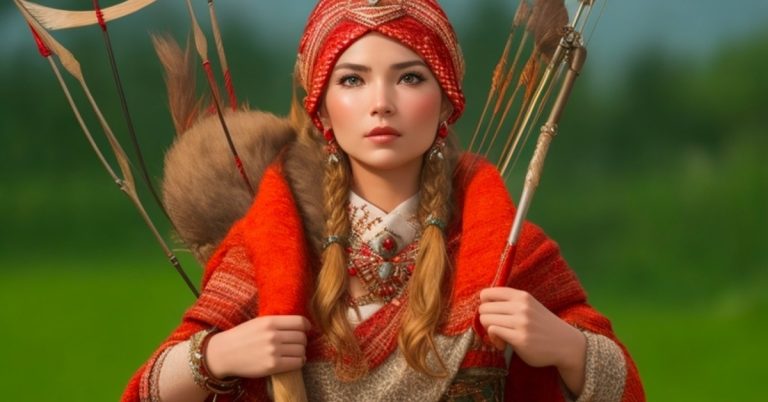
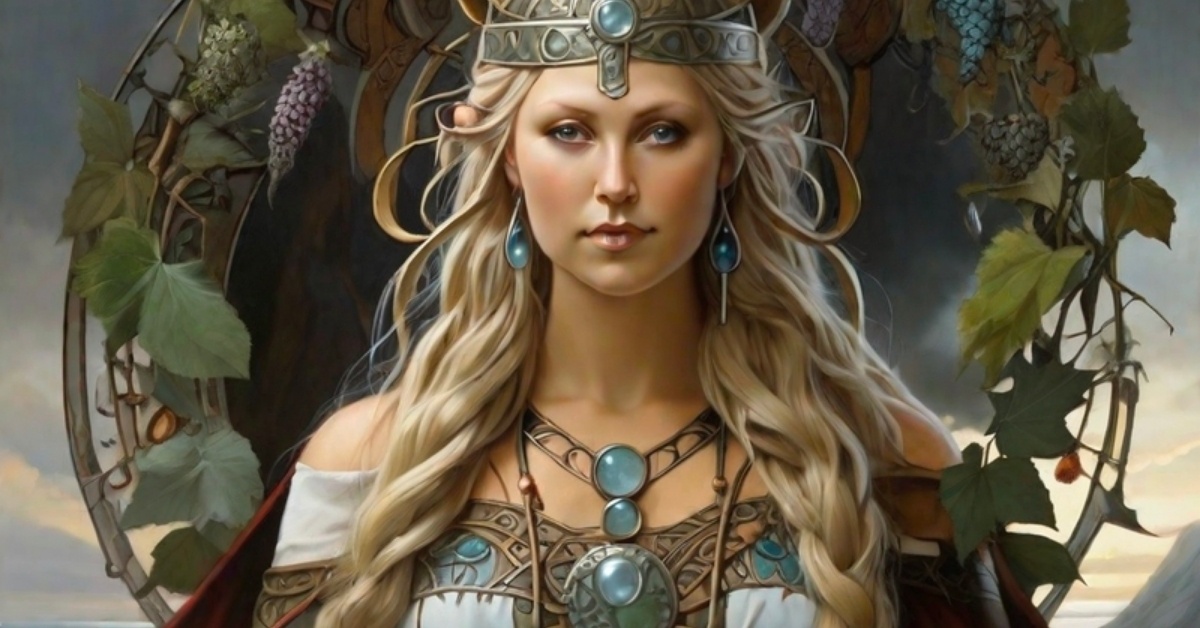
No medieval source describes her face, her dress, or her age, so every picture of Eir is a modern one. Artists tend to build her from the two roles the texts give her:
- A grave, composed woman with the bearing of a physician
- Often in the mail or winged helm of a valkyrie, paired with a healer’s satchel
- Carrying herbs, a bowl, or a bandage in place of a spear
- Shown outdoors on high ground, a nod to Lyfjaberg
- Older and calmer than the goddesses of love and war she stands beside
Abilities
- Healing — Snorri’s whole description of her, and the one domain every later reader agrees on
- Warding off harm — Fjölsvinnsmál says the maidens of Lyfjaberg guard from ill anyone who makes offerings to them
- Judgment over the wounded — if she is a valkyrie, she belongs to the beings who decide who falls and who stands up
- Runes and herbs — the two tools a Norse healer worked with, according to the Eddic poem Sigrdrífumál and the sagas
Symbols
None are attested. These are the ones modern practice has settled on:
- Healing herbs, above all the leek, the plant Norse healers used to test a belly wound
- The mortar and bowl, for grinding and steeping
- The hill, for Lyfjaberg
- Clean water, the first thing a saga healer heated
- A valkyrie’s helm, marking the harder half of her story
Traits
- Merciful, if the name is any guide: eir is the mercy of sparing someone
- Patient with long illness, the specific gift of Lyfjaberg
- Decisive, in the valkyrie sense: healing on a battlefield is a choice about who receives it
- Silent in the record, which modern devotees read as a healer’s discretion
Festivals and Rituals
No festival for Eir survives from the Viking Age, and no hall or shrine is named for her in the sources.
Fjölsvinnsmál gives the one ritual clue. Asked whether the maidens of Lyfjaberg help those who worship them, the watchman answers that they aid all who make offerings on the high altars, and that when they see danger coming for the sons of men, each one guards against it. Offering and protection, the oldest bargain in religion, is the only rite the texts attach to her.
Around that bargain sat the actual practice of healing. Sigrdrífumál tells a warrior that anyone who would be a healer must learn the limb-runes, carved on bark and on trees whose boughs bend east. The sagas add herbs, hot water, and hands. Modern heathens who honor Eir tend to do it in that spirit: a candle set out for a sick friend, herbs on an altar, her name spoken over a wound.
Legends associated with Eir
Eir has no myth in which she speaks, moves, or heals anyone by name. What she has is three placements, each in a different kind of text, and each telling us something about how the medieval Norse sorted their supernatural women. Read together, they are her legend.
Third among the goddesses
Snorri wrote Gylfaginning around 1220 as a handbook for young poets, a guide to the old gods that Christian Iceland’s skalds still needed to know. In chapter 35 he has the figure called High count off the goddesses. Frigg is first, with her hall Fensalir. Sága is second. “The third is Eir: she is the best physician.” Then the list moves on through Gefjun, Fulla, Freyja, and the rest, down to Snotra, “prudent and of gentle bearing,” and Gná, who rides Frigg’s errands across sky and sea.
It is a court, and Eir sits high in it. Most of the women near her on the list are Frigg‘s attendants, each holding a single office: Fulla keeps the queen’s casket, Gná carries her messages, and Snotra supplies the good sense. Eir holds the medicine. Whether these were living goddesses with cults of their own, or names Snorri arranged into a tidy household, is the question the later section takes up.
A name on the valkyrie roll
Appended to Snorri’s Skáldskaparmál are the Nafnaþulur, verse lists of names a poet could draw on. Among the valkyries, the “choosers of the slain,” stands Eir. The same chapter’s list of goddesses leaves her out.
Valkyries in Snorri’s telling are sent by Odin to every battle, where they decide which men are fated to die and award the victory. The dead they choose ride to Valhalla, or to the hall of Freya, who takes half. A healer on that roll is a striking thing. Every other valkyrie decides who dies; a valkyrie named Mercy would be the one deciding who lives. Battlefield medicine is exactly that decision. There is never enough of the healer to go around, and someone chooses.
The hill of healing
Fjölsvinnsmál, the second half of the poem-pair called Svipdagsmál, follows the hero Svipdag to a fortress guarded by a giant watchman, Fjölsvith. Inside waits the lady Menglöð, “necklace-glad,” whom Svipdag is fated to win. He and the watchman trade questions about the place, and one answer is about a hill.
Its name is Lyfjaberg, the hill of healing, and it will long be a joy to the sick and the sore. Every woman who climbs it grows well, the watchman says, even one who has lain sick a whole year. Svipdag asks who the maidens are, sitting so gladly at Menglöð’s knees, and Fjölsvith names nine: Hlíf, Hlífþrasa, Þjóðvarta, Björt, Blíð, Blíðr, Fríð, Eir, and Aurboða. Their names read like a litany of comfort. Hlíf means protection, Þjóðvarta a guardian of the people, Björt bright, Blíð gentle, and Fríð fair. Do they help those who make offerings to them? They help everyone who does, and they ward off harm.
This is the only place Eir is put on a map. A hill where long illness lifts, a lady who presides over it, nine women whose names are the words a sick person wants to hear, and one of them is Mercy.
What “physician” meant
Eir has no scene of her own, but the sagas show her trade. In Heimskringla, chapter 234 of the Saga of Saint Olaf, the wounded from the battle of Stiklestad in 1030 are carried into a barn where a woman is tending them. She has water heating over a fire to wash wounds, and she has made a porridge of crushed leek and herbs. She feeds it to any man with a belly wound and then smells the wound: if the leek comes through, the blade reached the gut and the man is past saving.
The skald Þormóð walks in with an arrow in his side and refuses the porridge, saying he is not porridge-sick. She looks at the wound and tells him she can do nothing for it, and he pulls the arrowhead out himself and dies composing verse. Snorri, who wrote that scene, is the same man who called Eir the best physician. When he pictured a healer, this is what he saw: a woman in a barn with hot water, a knife, herbs, and the authority to say who would live.
An older Eir?
The honest answer to the question in the heading is that nobody knows, and the reasons nobody knows are the most interesting thing about her.
The specialists disagree, and their disagreement is a good map. Rudolf Simek, in his Dictionary of Northern Mythology, reads the name as “the helper” and suggests Eir may originally have been a valkyrie, with Snorri’s goddess a later promotion; he treats Menglöð’s maiden of the same name as a separate figure. John Lindow, in Norse Mythology, is blunter: “whether we should trust Snorri and imagine the existence of a goddess Eir is problematic.” Hilda Ellis Davidson, in Roles of the Northern Goddess, allows that “virtually nothing” is known of her beyond the link to healing, yet takes all three mentions as the same being and sets her among the guardian spirits who watched over household and childbirth across the Germanic north. Andy Orchard adds that the name’s meaning, help, suits a goddess’s servant best, while noting that valkyries too were credited with the power to bring the dead back.
Three scholars, three readings, and each fits the evidence. That is the source problem in miniature. The Norse had many categories of supernatural woman, goddess, valkyrie, norn, and dís, and the categories leaked. A protective spirit could be called a dís in one poem and sit at a goddess’s knee in another. Snorri, writing two centuries after the conversion and working to make the old religion teachable, sorted names into lists, and a name like Eir could land on more than one.
So the possibilities run like this. Eir was an old healing goddess, once worshiped in her own right, whose cult faded until only a name and a job survived, and later compilers filed that name wherever it seemed to fit. Or she began as the common noun, help, personified the way the Norse personified Fulla (plenty) and Snotra (good sense), and Snorri’s list gave a word a face. Or she was one of the guardian women the Lyfjaberg stanzas describe, and “goddess” and “valkyrie” are two later labels for the same protector.
The hill favors the third reading a little. Lyfjaberg is a healing site of a familiar type, a high place the sick visit, and its nine attendants carry names that are all forms of protection and comfort. Davidson connects that circle to the guardian spirits of birth and household, and the stanza’s promise to the woman who has lain sick a year points the same way, toward the long illnesses of women’s lives. Set beside the valkyrie list, it gives Eir two battlefields: the one where men fall, and the longer one where women lie ill. A healer who stands on both would be an old and useful figure to keep, even after the stories about her were lost.
Proof is beyond what three lines of text can give. What can be said is that every source that names her agrees on the one thing, and it is the thing her name means.
Eir across cultures
The pairing Eir embodies, the healer who also decides, shows up elsewhere.
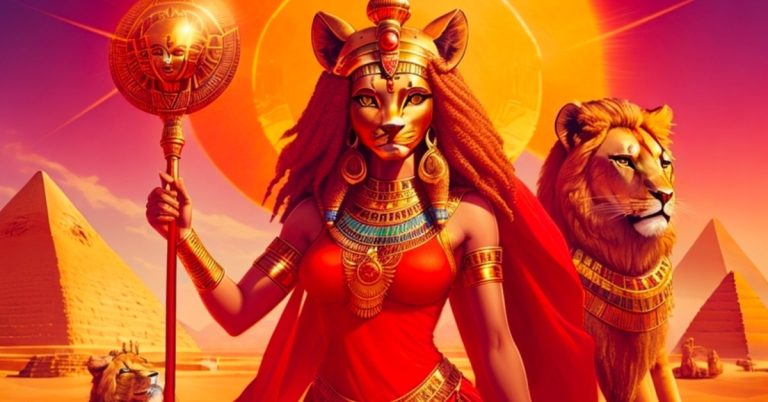
Greece kept the two halves apart: Asclepius and his daughter Hygieia healed, and other powers dealt death. Egypt joined them in Sekhmet, the lioness who sent plague and whose priests were the physicians who cured it. Ireland gave the office to Brigid, whose holy wells still draw the sick, and whose feast day was a day for blessing the house. Brigid’s wells and Lyfjaberg’s hill are the same idea: a place in the land where illness is left behind.
What unites them is a belief older than any one pantheon, that healing is a power and powers have owners. The Norse gave that ownership to a woman named Mercy and then, in character, put her on the list of those who choose the slain.
Final thoughts
Eir is proof that a culture holds onto its healers even after it has forgotten almost everything else about them. Poets carried her in their kennings for four hundred years. A lovesick carver scratched her into a stick in Bergen. Snorri, sorting the old gods into rows, put the healer third, ahead of Freyja.
Eir is what the record leaves when the stories go: a job, a name that means the job, and the uncomfortable truth that healing and choosing are the same act. Which reading do you find most convincing, the faded goddess, the personified word, or the guardian on the hill?
Bibliography
- Snorri Sturluson. The Prose Edda, Gylfaginning XXXV–XXXVI. Trans. Arthur Gilchrist Brodeur, 1916.
- “Svipdagsmol” st. 52–54 (Fjölsvinnsmál st. 36–40 in the separate numbering). The Poetic Edda, trans. Henry Adams Bellows, 1936.
- “Sigrdrifumol” st. 10 (the limb-runes). The Poetic Edda, trans. Henry Adams Bellows, 1936.
- Fjölsvinnsmál st. 36–40 and Gylfaginning ch. 31–40. Völuspá.org.
- Simek, Rudolf. Dictionary of Northern Mythology, p. 71. D.S. Brewer, 1993.
- Lindow, John. Norse Mythology: A Guide to the Gods, Heroes, Rituals, and Beliefs, p. 105. Oxford University Press, 2001.
- Davidson, Hilda Ellis. Roles of the Northern Goddess. Routledge, 1998.
- Orchard, Andy. Dictionary of Norse Myth and Legend. Cassell, 1997.
- “Eir”, “Menglöð”, and “List of valkyrie names”. Wikipedia.
- “Eir: Goddess, Valkyrie and Healer”. We Are Star Stuff, 2020.
- “The Leaky Viking Age Test to Determine the Depth of a Torso Wound” (Heimskringla, Saga of Saint Olaf ch. 234). The Historian’s Hut, 2022.