Bastet: The Egyptian Cat Goddess of Home, Joy, and Protection
When a cat died in an ancient Egyptian house, everyone who lived there shaved off their eyebrows.
They wept for it, paid to have it embalmed, and if they could afford the trip, carried the little mummy downriver to a city in the Delta so it could lie near its goddess. That’s the pull Bastet had. Lady of the house, keeper of the granary, patron of music and wine and childbirth, and the reason the biggest party in Egypt happened every year in a town called Bubastis.
Overview of Bastet
Bastet is the cat goddess of ancient Egypt, and a great deal more than that. She is a daughter of the sun god Ra, one of the goddesses the Egyptians called the Eye of Ra, and the divine lady of the home. Under her care fell everything that happened inside the walls: pregnancy, childbirth, the health of children, the secrets women kept among themselves, and the ordinary joys of a household that eats well and sleeps safe. Music, dance, perfume, and wine were hers too. So was the darker work of keeping evil out, whether it came as a demon, a fever, or a rat in the grain.
Her city was Bubastis, Per-Bast in Egyptian, “the House of Bast,” in the eastern Nile Delta near modern Zagazig. Its ruins are called Tell Basta today. Her name is written with the hieroglyph for a sealed ointment jar, and Egyptologists such as Geraldine Pinch and Stephen Quirke read it as “She of the Ointment Jar,” which fits a goddess of protective oils and the perfumed side of life. Egyptians wrote it as Bast for most of her history; the doubled feminine ending that gives us “Bastet” was a later scribal habit, added to make sure the final t got pronounced.
The Greeks called her Ailuros, plainly “the cat,” and when they met her at Bubastis they decided she was their own Artemis under another name.
Titles
- Bast, the older form of her name, and Bastet, the later one
- Lady of Bubastis (Per-Bast, “the House of Bast”)
- Eye of Ra
- Lady of the East, the Delta’s own goddess, with Sekhmet holding the West
- Ailuros (“the cat”), her Greek name
- “She of the Ointment Jar,” the likeliest meaning of the name itself
Characteristics
How Bastet tends to be shown in art:
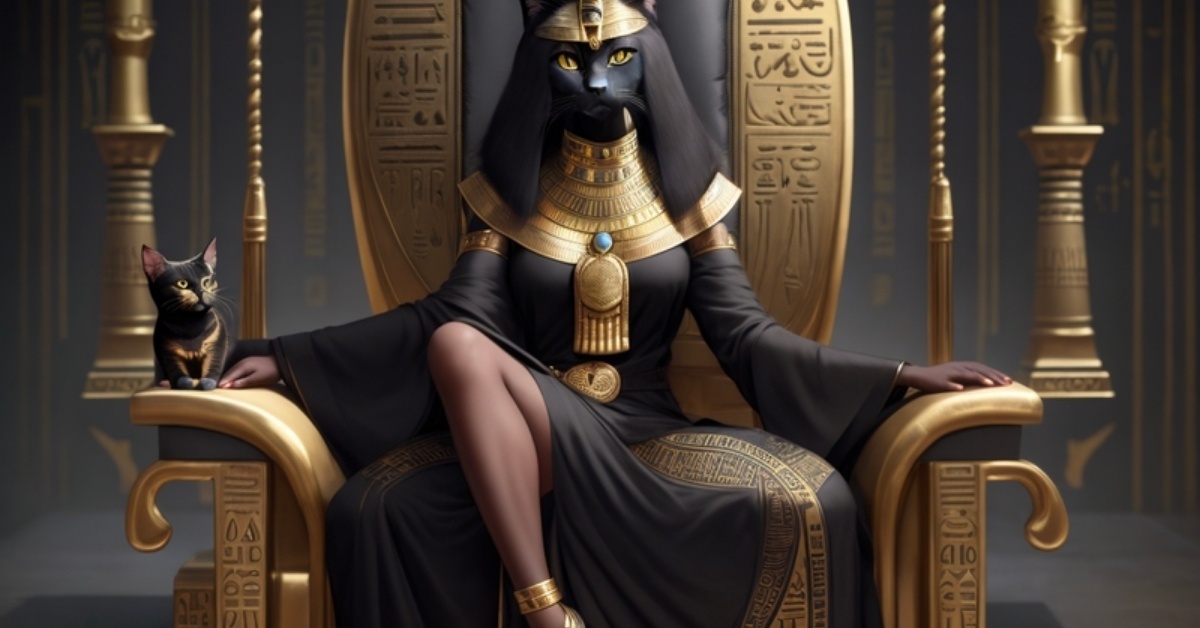
- A slender woman with the head of a cat, in a long, close-fitting dress, often patterned in stripes or scales
- A sistrum rattle raised in one hand and an aegis, a broad collar topped with a lioness head, held in the other
- A basket on her arm, sometimes with kittens spilling out of it, and more kittens at her feet
- Alone as a seated cat, alert and composed, in the bronze figures of the Late Period, often with a gold ring in her ear or nose and a scarab on her brow
- In her oldest images, a woman with the head of a lioness, a twin of Sekhmet
Abilities
- Guardian of the home — she keeps demons, sickness, and vermin out of the house
- Protector of women and children — pregnancy, childbirth, and nursing are under her care
- Bringer of joy — music, dance, feasting, and wine belong to her festivals
- Solar fury — as an Eye of Ra she can still burn like the lioness she once was
- Defender of the king — in the Pyramid Texts she nurses and shields the pharaoh
- Keeper of the dead — her ointments protect the body, and cats were buried in her name
Symbols
- The cat — her living image, sacred throughout Egypt
- The sistrum — the rattle she shakes, and the sound of her festival
- The aegis — the lion-headed collar she carries, a shield against harm
- The ointment jar — the hieroglyph that spells her name
- The lioness — her older shape, kept in her collar and in her sister Sekhmet
- The kitten basket — motherhood and the fullness of the house
Traits
- Warm, playful, and fond of a party
- Fiercely protective of what is hers, with claws she rarely needs to show
- Motherly, toward children and kittens alike
- Watchful, with the patience of a cat at a mousehole
- Two-sided by nature, since the Egyptians never forgot the lioness inside the cat
Festivals and Rituals
The festival of Bastet at Bubastis was the biggest holiday in Egypt, and we have an eyewitness.
Herodotus, the Greek traveler who visited Egypt in the fifth century BCE, describes whole boatloads of pilgrims sailing down the Nile toward the city, men and women crowded together on the decks. The women shook rattles and the men played flutes the whole way; everyone else sang and clapped. Each time the barges passed a riverside town they pulled in close, and some of the women would shout taunts at the local wives, some would dance, and some would hitch up their skirts and flash the shore. Then on to the next town.
At Bubastis they sacrificed, feasted, and drank, and Herodotus was told that more wine went down during those few days than in the whole rest of the year. He gives the attendance as seven hundred thousand, counting only the adults. Even if the number is inflated, it describes a festival on a scale nothing else in Egypt could touch.
The temple itself, he says, stood on an island ringed by canals, with the city built up around it so that you looked down into the sacred grove of tall trees from every side. A paved road lined with trees ran from the temple toward the market. Édouard Naville dug at Tell Basta in the 1880s and found what was left of it, along with the other thing pilgrims brought to Bastet: their cats. Cemeteries of mummified cats, hundreds of thousands of them, lay at Bubastis and at Saqqara, and later diggers found more at Beni Hasan, in a mass grave so vast that shiploads of ancient cat mummies were hauled to England and sold by the ton as fertilizer.
Closer to home, her worship was a matter of amulets. Small figures of Bastet, of cats, and of cats with kittens were worn on the body, and her image decorated the flasks Egyptians gave each other at New Year, to keep the household safe and fertile for another twelve months.
Legends associated with Bastet
Bastet’s stories circle a single question: what happens when a goddess with a lioness inside her decides to be kind. Some of them are myths in the old sense. Others are things Greek travelers saw with their own eyes and wrote down in astonishment.
The daughter who ran away to Nubia
Ra’s daughter was also Ra’s Eye, the fierce, blazing power he sent out to do his will. She had a temper to match. In the story the Egyptians called the myth of the Distant Goddess, the Eye grew angry with her father and left him, striding off into the deserts of the far south, into Nubia. There she roamed as a wild lioness, dangerous to anyone who came near, and Egypt suffered without her: the sun lost its strength, the river dropped, and the land went dry.
Ra sent a god to bring her home. In some tellings it is Thoth, the clever one, who talks her back with stories; in others it is Shu, the air god, or Onuris, whose name means “he who brings back the distant one.” Whoever it was had to coax, flatter, and reason with her mile after mile, because a lioness cannot be dragged. When at last she agreed to come home, she cooled as she came north, and by the time she crossed the border her rage had left her. The lioness had become a cat.
Egypt celebrated her return every year with drinking, music, and dancing, since that was when the Nile rose and the year began again. The Egyptians read her change as a real transformation: the same goddess, tamed. Bastet was the name of what came back.
The red beer
Her sister’s story explains what the Egyptians were so afraid of.
In the tale of the Destruction of Mankind, preserved on the walls of royal tombs, humanity plotted against the aging sun god, and Ra sent his Eye to punish them. She went as Sekhmet, the lioness, and she did her job too well. She waded through the rebels and kept going. The fields ran red, and she developed a taste for it. Ra called her back and she ignored him. He realized that if he let her continue there would be no one left to worship him.
So he cheated. He had thousands of jars of beer brewed and dyed red with ochre, and had it poured out across the fields where Sekhmet would pass at dawn. She came, saw what she took for a plain of blood, and drank until she could no longer stand. She slept for three days, woke with no memory of the slaughter, and came home to her father calmed.
Some versions say she came home as Hathor, the lady of love and music; some say she came home as Bastet. The point is the same: the Egyptians pictured the protective fury of their goddess as something that had to be pacified with wine, and the parties at Bubastis were the pacifying. They were drinking on Bastet’s behalf so she would stay a cat.
The Great Cat and the serpent
Every night the sun god sailed through the underworld, and every night the serpent Apep tried to swallow him whole. Apep was chaos itself, coiled and endless, and the gods took turns holding him off.
One of the best-loved images of that fight is a cat. In the Book of the Dead, spell 17, a great tomcat sits beneath the sacred ished tree of Heliopolis with a knife in its paw, and the head of Apep lies severed on the ground. The text names the cat as Ra himself, but Egyptians saw the connection at once: the god who killed snakes had taken the form of the animal that killed snakes in their kitchens, and the goddess of cats was his daughter. Painted tomb scenes of the Great Cat cutting Apep’s head off were still being copied centuries later, and Bastet’s followers claimed the victory as hers. The cat that protected the house from cobras was the same power that protected the sun from the dark.
The cats in the fire
Herodotus was so struck by how Egyptians treated cats that he wrote down things nobody had asked him about.
When a house caught fire, he says, the Egyptians left the building to burn and stood in a line around it, watching for the cats. Their whole concern was keeping the animals out of the flames. The cats, being cats, slipped between people’s legs or leapt over them and dashed into the fire anyway, and when that happened the Egyptians went into deep mourning. If a cat died at home of natural causes, everyone in the household shaved their eyebrows. When a dog died they shaved their whole bodies, head included. The dead cats were taken to Bubastis, embalmed, and buried in sacred ground.
Four hundred years later the Greek historian Diodorus saw the other side of the same devotion. A visiting Roman accidentally killed a cat in Alexandria at a moment when Egypt’s king was courting Rome and wanted no trouble. A mob formed at the man’s door anyway. Royal officials came to plead for him, the crowd was reminded of what Rome would do, and it made no difference. They killed him. Diodorus adds that he watched it happen.
The cats at Pelusium
The story the Egyptians would rather forget is the one where their reverence was used against them.
In 525 BCE the Persian king Cambyses II marched on Egypt and met the Egyptian army at Pelusium, the fortress guarding the Delta’s eastern gate. According to the later writer Polyaenus, Cambyses ordered his men to drive the sacred animals of Egypt in front of the Persian line: dogs, sheep, ibises, and above all cats. Some retellings add that the Persians painted Bastet’s image on their shields. The Egyptian archers, faced with the choice of shooting the goddess’s own creatures or losing the battle, lowered their bows. Pelusium fell, and Egypt with it.
Polyaenus wrote seven centuries after the fact, and Herodotus, who was far closer to the events, says nothing about any cats. Historians treat the story as a legend. It has stuck anyway, because it tells the truth about the Egyptians even if it tells a lie about the battle: there were people who would surrender a kingdom before they would harm a cat.
An older Bastet?
The oldest Bastet has no whiskers.
Her name first appears on stone vessels of the Second Dynasty, around 2900 BCE, found in the galleries beneath the Step Pyramid at Saqqara, and the goddess they name is a lioness. For the next two thousand years that is how she was drawn: a woman with a lion’s head and a lion’s stare, standing beside Sekhmet and looking just like her. In the Pyramid Texts of the Old Kingdom she nurses and guards the dead king. In the valley temple of Khafre at Giza she and Hathor appear together, Bastet for the north and Hathor for the south, the two goddesses standing for the two Egypts. A Middle Kingdom text called the Loyalist Teaching tells the reader that the king “is Bastet, who protects the Two Lands,” and in the next breath that he “is Sekhmet against him who transgresses his command.” Same king, same power, two faces. The Egyptians had the lioness and the cat in a single goddess long before they gave them different bodies.
What changed was the cat. By the Middle Kingdom, cats were living in Egyptian houses, and by the New Kingdom a miu sat under its owner’s chair in tomb paintings, eating fish and wearing a collar. Cats earned their place by hunting the mice in the granary and the cobras in the courtyard, the two enemies of a household with children. A lioness kept the king safe; a cat kept your family safe, and did it in your kitchen. As the animal moved into the house, the goddess moved with it. During the Third Intermediate Period, and above all under the Twenty-second Dynasty (about 945 to 715 BCE), when a line of Libyan kings made Bubastis a royal city, Bastet’s lioness head gave way to a cat’s, and her image eased into the figure we know: the mother with the kittens, the lady with the rattle. The cat specialists Dennis Turner and Patrick Bateson date the switch to that dynasty, and the Egyptologists Richard Wilkinson and Geraldine Pinch describe it as a real change in her character, a milder goddess under the old name.
Her fierce side moved next door, to Sekhmet. The two had always been paired, and once Bastet became the cat, Sekhmet kept the lion’s share of the anger. The whole set of solar daughters, Sekhmet, Hathor, Tefnut, Bastet, and Wadjet, were all the Eye of Ra, and any of them could be the raging lioness who left for Nubia or the calmed goddess who came home. The myth of the Distant Goddess, in fact, is Bastet’s own history told as a single event: a lioness walks south, and a cat walks back. The name shifted with her. Bast, with its single t, is the older spelling; the extra feminine ending that makes Bastet appears in the New Kingdom and after, as scribes fussed over sounds the spoken language was dropping. Monica Sjöö and Barbara Mor, in The Great Cosmic Mother, read all of Egypt’s goddesses as one ancient mother wearing a different animal face for each job, and however far you go with that, the Egyptians left the evidence in plain sight: they kept the lioness on her collar.
The cat goddess who came out of all this is a survivor. The lioness who guarded pharaohs became the cat who guarded everyone, and the Egyptians, who had watched the real animal make the same journey from desert to doorstep, understood exactly what they were looking at.
Bastet across cultures
Bastet’s neighbors and heirs kept recognizing her.
The Greeks who settled in Egypt saw a goddess of women and childbirth surrounded by sacred animals and named her Artemis. Herodotus reports the Egyptian priests telling him that Artemis was the daughter of Isis, hidden away on a floating island in the Delta to keep her safe from Set. Isis, the great mother of the Egyptian pantheon, was often named Bastet’s mother in the same later tradition, and Ptolemaic Egypt was full of Greek women wearing cat amulets.
The pattern goes further than Egypt. Ancient China honored a cat spirit at the year-end harvest sacrifice: the Book of Rites lists it among the powers to be thanked because it ate the field mice that ate the grain, exactly the bargain the Egyptians made. In Norse myth Freyja, goddess of love and fertility, rides in a chariot drawn by two cats, and her domain, love, women, pleasure, and a share of the dead, overlaps with Bastet’s to a surprising degree. Japan’s maneki-neko, the beckoning cat in the shop window, is a household protector and bringer of good fortune with a paw raised in welcome. Wherever people stored grain and kept cats to guard it, the cat ended up with a place near the altar. Egypt got there first, and gave her a name.
Final thoughts
The animal asleep on your windowsill was a god once, and the Egyptians would say it still is.
Bastet’s gift was to take the most frightening power in the sky, the burning Eye of Ra, and bring it indoors, where it curled up by the hearth and watched the door. She is the goddess of the safe house, the good party, and the healthy child, and she keeps them with claws she keeps sheathed. That was the deal the Egyptians made with her, and it held for three thousand years.
Which would you rather have guarding your door, the lioness or the cat?
Bibliography
- Herodotus. The Histories, Book II, §§59–60, 66–67, 138, 156 (Macaulay trans.). Wikisource.
- Diodorus Siculus. Library of History, Book I, ch. 83 (Oldfather trans.). LacusCurtius.
- Polyaenus. Stratagems, Book 7.9. Attalus.
- Mark, Joshua J. “Bastet”. World History Encyclopedia.
- Pinch, Geraldine. Egyptian Mythology: A Guide to the Gods, Goddesses, and Traditions of Ancient Egypt. Oxford University Press.
- Wilkinson, Richard H. The Complete Gods and Goddesses of Ancient Egypt. Thames & Hudson.
- Turner, Dennis C., and Patrick Bateson, eds. The Domestic Cat: The Biology of Its Behaviour. Cambridge University Press.
- Sjöö, Monica, and Barbara Mor. The Great Cosmic Mother. HarperOne.
- “Bastet”, “Eye of Ra”, “Cats in ancient Egypt”, and “Battle of Pelusium (525 BC)”. Wikipedia.
- “Bastet”. Encyclopaedia Britannica.