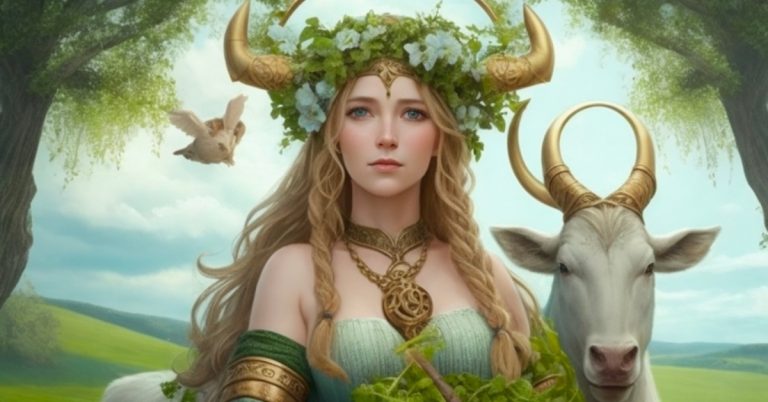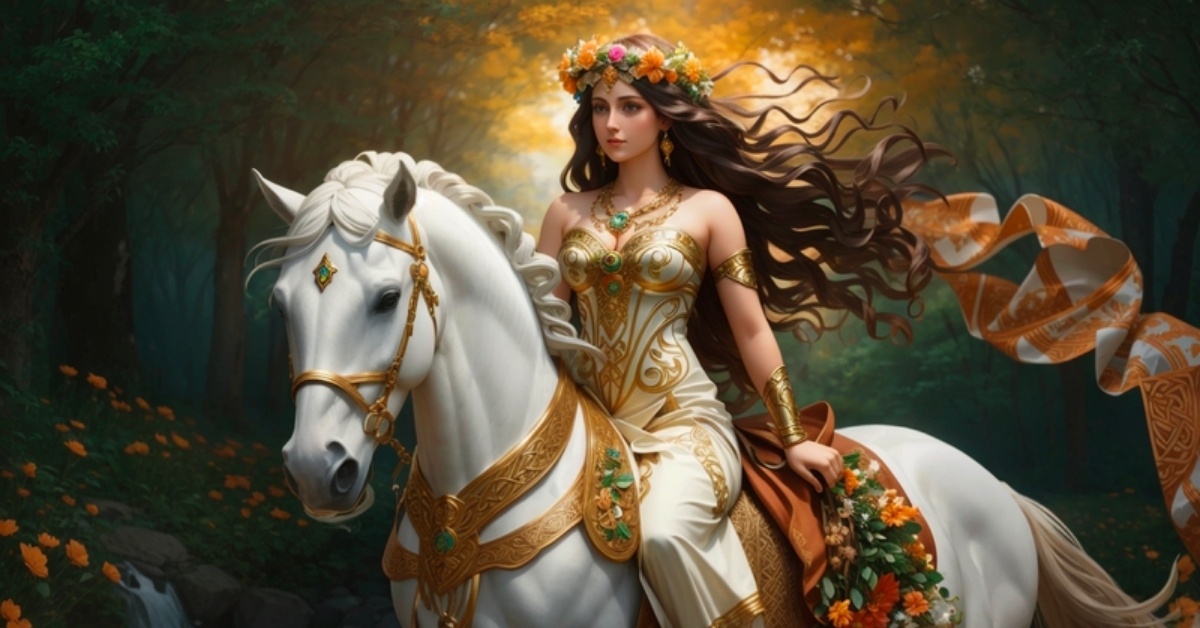
Epona: The Celtic Horse Goddess
On the wall of a Roman stable, above the straw and the reek of it, somebody painted a woman on a horse.
The satirist Juvenal sneered at the nobleman who swore his oaths by her. The novelist Apuleius found her little shrine in a stable, wreathed in fresh roses. And from a fort in Scotland to a garrison in Bulgaria, cavalrymen cut her name into stone: Epona.
Overview of Epona
Epona is the horse goddess of the Gauls, and she is the rare Celtic deity we know chiefly from objects. Hundreds of carvings, bronzes, and inscriptions survive. Of narrative myth, we have one strange paragraph. Her home ground was eastern and northeastern Gaul, the horse-breeding country of the Aedui and the Lingones in what is now Burgundy, and the Rhineland forts along the empire’s German frontier.
Her name says what she is. It comes from the Gaulish epos, “horse,” the same root as Latin equus, with the ending -ona that Gaulish used to mark a great or divine one. “Divine Mare” and “Great Horse” are the usual glosses. She watched over horses, mares and their foals, mules and donkeys, and the people whose lives ran on them: grooms, carters, breeders, and above all riders.
Then something happened that happened to no other Celtic god. The Roman army adopted her. Auxiliary cavalry recruited in Gaul and the Rhineland carried her across the whole empire, and a rustic calendar found at Guidizzolo, near Mantua in northern Italy, lists a feast of Epona on December 18. That single line makes her the only Celtic deity known to have been given a day in a Roman calendar.
Titles
- Epona Augusta (“the August,” the imperial title)
- Epona Regina (“the Queen”)
- Eponabus (the plural “Eponas,” on a few military altars, where she is honored as a group of goddesses)
Characteristics
How Epona tends to be shown in art:
- A calm, fully dressed woman in a long tunic and cloak, often with a diadem or a veil
- Seated side-saddle on a walking mare, facing the viewer, one hand resting on the horse’s neck
- Or standing or enthroned between two horses, sometimes feeding them from her lap
- Frequently with a foal beneath the mare, nosing toward her
- In one Burgundian type, reclining half-draped along the horse’s back
- Occasionally with a dog at her feet, or flanked by other gods
Abilities
- Guardian of horses — the health of mares, the safe birth of foals, the soundness of the animals a farm or a cavalry troop depended on
- Protector of riders — the goddess a horseman invoked before a patrol, a march, or a battle
- Giver of plenty — her cornucopia and her lapful of grain make her a goddess of the harvest as much as the herd
- Keeper of the way — carved on tombstones in the Rhineland, she accompanied the dead on their last ride
- Holder of the keys — a few images give her a key, read by some as the key to the stable, by others as the key to the otherworld
Symbols
- The mare and foal — her signature image, protection and increase in a single carving
- The patera — the shallow dish for pouring offerings, held out to her horses
- The cornucopia — the horn of plenty, overflowing with fruit
- Grain and bread — ears of wheat, loaves, and fruit, sometimes carved impossibly large
- The key — stable door or otherworld gate, depending on who is reading
- Roses — the garlands Apuleius saw on her stable shrine
Traits
- Serene and settled, the stillest figure in any carving she appears in
- Practical, a goddess of working animals and working people
- Generous, always shown with something to give
- Portable, at home in a stable niche, a barracks altar, or a roadside shrine
- Steady, honored for what she kept safe
Festivals and Rituals
The one dated festival we have is the December 18 feast on the Guidizzolo calendar. The stone gives the day as XV Kalendas Ianuarias Eponae, the fifteenth day before the Kalends of January, and it is the only calendar anywhere to name her. Whether the whole empire kept the day or only the farmers of one valley in Cisalpine Gaul remains an open question.
Everyday worship looked humbler and happened closer to the animals. Her images stood in niches in stables and barns, sometimes painted straight onto the wall, and were dressed with flowers. Small bronzes and clay figurines of her turn up in houses across Burgundy, at Alesia among other places. Only one built temple with dedications to her has been identified, at Entrains-sur-Nohain in the Nièvre. Soldiers gave her altars, and one bronze plaque from Alesia, once fixed to a mule cart, records a man named Satigenus paying his vow to “Dea Epona.” Roses, grain, and a fulfilled promise: that was her cult.
Legends associated with Epona
Epona’s stories are short, and most of them were told by outsiders, Romans who met her in a stable or a barracks and wrote down what they saw. Read together, they map how a Gaulish farm goddess became a goddess of the Roman army.
The mare’s daughter
The single origin story we have survives in the Parallela Minora, a collection of paired Greek and Roman tales that circulated under Plutarch’s name and was almost certainly written by someone else, which is why scholars call the author Pseudo-Plutarch. He credits it to an even more obscure historian, Agesilaus, and his lost Italian History.
A man named Fulvius Stellus hated women. He lived with a mare instead. In time the mare bore him a beautiful daughter, and they named her Epona, the goddess who looks after horses.
That is the whole tale. It reads like a Roman trying to explain a foreign goddess with a horse in her name, and it belongs to a genre of ancient jokes about who sleeps with what. Still, it carries one real memory. In her oldest, most Gaulish form, Epona may have been imagined as a mare, the way her worshipers so often carved her: half of the picture human, half of it horse.
Painted on the stable wall
Around the year 100, Juvenal wrote a satire on noblemen who disgrace their ancestors. His example was Lateranus, a consul who drove his own chariot like a hired mule-driver and hung around the stables with grooms. Standing at the altar of Jupiter, Juvenal says, this man swears by nobody except Epona and the pictures painted on the reeking stable walls.
Half a century later, the novelist Apuleius gave the same scene a warmer glance. In The Golden Ass, his hero Lucius, transformed into a donkey and shoved into a stable, spots a small shrine of Epona in a niche on the central pillar, decorated with freshly gathered roses. He wants those roses badly, because roses are the cure for his enchantment, and he gets a beating from a groom for reaching toward them.
Then the Christians got in on it. Pagans had accused Christians of secretly worshiping a donkey’s head. Minucius Felix, in his dialogue Octavius, threw the charge straight back: it is you, he says, who keep whole donkeys as sacred in your stables, along with your Epona. Tertullian made the same jab. Three different writers, one detail in common: her place was in the stable, among the animals she guarded.
The cavalry’s goddess
Epona’s real story is written in stone across two thousand miles of frontier.
Rome recruited its auxiliary cavalry from the peoples who rode best, and the Gauls and the Rhineland tribes rode as well as anyone alive. Those horsemen took their goddess with them. Her altars stand at forts along the Danube in Hungary and Bulgaria, on the Rhine at Mainz and Pförring, and at Auchendavy on the Antonine Wall in Scotland, where a centurion named Marcus Cocceius Firmus dedicated an altar to a whole roster of gods with Epona among them. A dedicator at Mainz describes himself as Syrian. In Rome itself, nearly every inscription to her comes from one address: the barracks of the equites singulares Augusti, the emperor’s mounted bodyguard, recruited largely from Gaul, Germany, and Pannonia. Their altars, found near the Lateran, honor her beside the Campestres, the goddesses of the parade ground.
The dedicators are troopers, decurions, standard-bearers, and the occasional centurion, men with Romanized names doing a job that depended on a horse staying sound. The historian Katherine Linduff, whose 1979 study is still the standard account, called her “a Celt among the Romans,” and argued that she traveled with the soldiers as a working devotion, the goddess of a trade that ran on horses. Her traces cluster in the countryside and along the frontier. She was a goddess of the barn, the barracks, and the road.
Epona Augusta, Epona Regina
Once inside the army, she picked up the army’s manners. Soldiers addressed her as Epona Augusta, the title that tied a deity to the emperor’s own cult, and as Epona Regina, the Queen. On a few altars, one of them at Sarmizegetusa in Dacia, she becomes plural, Eponabus, “to the Eponas,” as if the troopers had multiplied her the way they multiplied the Mothers and the Campestres, into a whole company of protectors. A country goddess had become part of the machinery that held the frontier together.
An older Epona?
In the late twelfth century a Welsh cleric named Gerald of Wales wrote down, with visible horror, how a certain northern Irish people made a king. A white mare was led into the assembly. The man about to rule embraced her as a husband would. Then the mare was killed, cut up, and boiled. The new king bathed in the broth and drank it while his people ate the meat.
Whether Gerald saw any of this or repeated a slander is debated. What interests scholars is the shape of the rite. The Vedic aśvamedha, India’s great royal horse sacrifice recorded in the Rig Veda and the Yajur Veda, ends with the chief queen lying down beside the slaughtered stallion in a mock marriage. Rome had its own October Horse, sacrificed each year to Mars. In the 1920s Franz Rolf Schröder set the Indian and Irish rites side by side, and Georges Dumézil and later Jaan Puhvel built the comparison into a wider argument: that the Indo-European peoples inherited an idea in which the king wed the land, and the horse stood in for the land.
That is the frame into which several scholars have set Epona. The Welsh Rhiannon of the Mabinogi rides a pale horse that no rider can catch however hard he gallops, and her name is generally derived from a British *Rīgantonā, “Great Queen.” The Irish Macha, another horse-queen wronged around a birth, curses the men of Ulster after they force her to race the king’s horses. Henri Hubert linked Epona to Rhiannon in the 1920s, and Miranda Aldhouse-Green has argued that all three belong to one Celtic tradition of a horse-goddess bound up with sovereignty, fertility, and the otherworld. On that reading, the queen on the mare in a Rhineland carving is the last public image of a goddess who once made kings.
Other scholars pull hard the other way. Ronald Hutton points out that there is no evidence of a horse goddess in Iron Age Britain and that Rhiannon, in the text we actually have, is a medieval literary character who confers no kingdom on anyone. The World History Encyclopedia entry on Epona notes the obvious differences, a single goddess of the frontier against a married queen of Welsh romance, and concludes it is wiser to keep them apart. The rite Gerald described and the goddess the cavalry worshiped are separated by a thousand years and a sea.
So the older Epona stays a question. The mare and foal on her carvings could mark a goddess of increase and nothing more, or the faded emblem of the horse that made a king.
Epona across cultures
The idea of a goddess who is also a mare turns up beyond the Celtic world, sometimes in strikingly similar shapes.
In Arcadia, Pausanias tells us, Demeter fled from Poseidon by turning herself into a mare; the god became a stallion, and the child of that union was the divine horse Arion. At Phigalia she was worshiped as Demeter the Black, with a horse’s head. It is the Stellus story turned inside out: here the goddess herself is the mare.
Rome’s handling of Epona also stands out beside the way it handled other foreign goddesses. Cybele, the Great Mother of Anatolia, arrived in 204 BCE by decree, fetched from Pessinus as a black stone after the Senate consulted the Sibylline Books, and installed on the Palatine with a state festival. Epona came in on horseback, one trooper’s altar at a time, and ended up with a day on a farmer’s calendar. Both were foreign, and both were absorbed, but the one that came from the bottom up left her name in barracks from Scotland to the Black Sea.
Her Celtic kin took different roads out of antiquity. Rhiannon rode into medieval Welsh literature and is still read today. Macha was folded into the Ulster cycle and into the great war goddess the Morrígan. Brigid crossed into Christianity as a saint and kept her feast day. Epona, whose cult lived and died with the Roman army, left the stones.
Final thoughts
Every carving of Epona is a small act of gratitude from someone whose livelihood had four legs.
Her whole record is a foal under a mare, a dish held out, and a name scratched into an altar by a man who wanted his horse to come home. Among goddesses with epics, rivalries, and tempers, that stands out. Two corrections are owed to her modern reputation. The “mare” in “nightmare” is an Old English word for a crushing night-spirit, unrelated to horses, so the habit of handing Epona the world of bad dreams rests on a pun. And the loyal horse in The Legend of Zelda is named for her, which may be the widest her name has ever traveled.
The soldiers who carried her cult across an empire were mostly ordinary men far from home. Out of every god on offer, what was it about a still woman on a walking mare that made them choose her to keep?
Bibliography
- Aldhouse-Green, Miranda. Celtic Goddesses: Warriors, Virgins and Mothers. British Museum Press, 1995.
- Apuleius. The Golden Ass, Book III. Trans. William Adlington, via Project Gutenberg.
- bisdent. “Epona”. World History Encyclopedia, 2012.
- Gerald of Wales. Topographia Hibernica (c. 1188), the Tyrconnell inauguration rite. Wikipedia overview.
- Hutton, Ronald. “Finding Lost Gods in Wales”. Gresham College lecture transcript, 2023.
- Juvenal. Satire VIII. Trans. A. S. Kline, Poetry in Translation.
- Linduff, Katherine M. “Epona: A Celt among the Romans.” Latomus 38, no. 4 (1979): 817–37.
- Minucius Felix. Octavius, ch. 28. Trans. via New Advent.
- Nantonos and Ceffyl. “Epona Inscriptions” and “Epona in Classical Literature”. EPONA.net.
- “Noínden Ulad: Background”. Irish Sagas Online, University College Cork.
- Pseudo-Plutarch. Parallela Minora, 29. Trans. F. C. Babbitt, via Theoi.
- Puhvel, Jaan. Comparative Mythology. Johns Hopkins University Press, 1987.
- “Epona”, “Equites singulares Augusti”, and “Horse sacrifice”. Wikipedia.