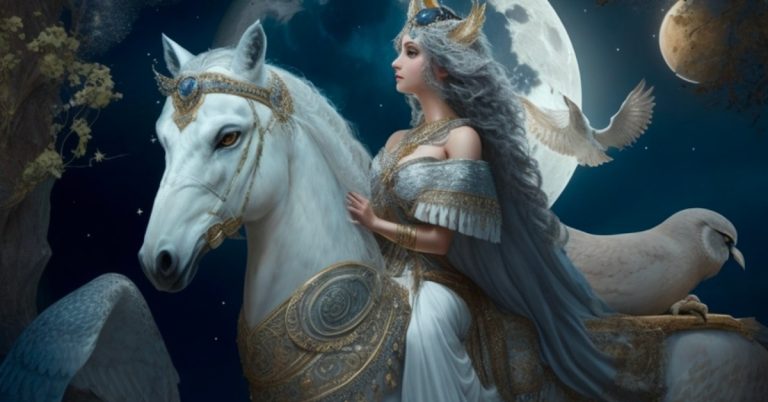
Persephone: Goddess of Spring and Queen of the Underworld
Every spring, the story goes, she comes back up.
Persephone is the girl who was carried down into the dark and came out a queen.
The Greeks knew her two ways at once: Kore, the maiden gathering flowers in a sunlit meadow, and the dread Queen of the Underworld who sits beside Hades and holds the dead in her keeping. Same goddess, two faces half a year apart.
How she gets from one to the other is one of the oldest and most argued-over stories in Greek myth: a girl snatched into the earth, a mother whose grief freezes the world, a bargain sealed with pomegranate seeds, and a daughter who walks back out of death changed.
And depending on who is telling it, and when, it is either the bleakest story in the whole canon or a story about a woman coming into her power.
Overview of Persephone

Source: Dante Gabriel Rossetti, Proserpine (1874), Tate — Wikimedia Commons
Persephone is the daughter of Zeus, king of the gods, and Demeter, goddess of the grain and the harvest. Born of the sky and the soil, she ends up ruling the dead, so all three layers of the Greek world run through her.
Above ground she is the goddess of spring and growing things, the green force that comes back to the earth each year. Below ground she is the Queen of the Underworld, enthroned beside Hades, with the souls of the departed under her hand. The Greeks often called her simply Kore, “the Maiden,” when they meant the bright daughter of the upper world, and Persephone when they meant the queen below.
Her name is older than any of the explanations for it. The Greeks themselves were not sure what it meant. Ancient writers reached for grim folk readings that tied “Persephone” to the bringing of death, but the word almost certainly predates Greek. It survives in so many wobbling forms (Persephassa, Persephatta, Phersephone) that scholars take the sheer variety as a sign the Greeks were wrestling with a name they had inherited rather than coined. Modern guesses run from “she who destroys” to a link with the sheaf of grain to “she who brings the light through.” Nobody really knows. It is a fitting kind of mystery for a goddess who lives on both sides of the dark.
Titles
- Kore (the Maiden)
- Queen of the Underworld
- Dread Persephone (Homer’s “the awful one”)
- Goddess of Spring and the growing earth
- Proserpina (her name in Rome)
Characteristics
How Persephone tends to appear in art and legend:
- Young and flower-crowned as Kore; tall and commanding as the Queen
- Often holding a torch, lighting the way through the underworld dark
- Crowned and enthroned at Hades’ side below
- Carrying sheaves of grain, the sign of her mother and the harvest
- Cradling a pomegranate, the fruit that bound her to the dead
- Wreathed in narcissus and spring blooms when she walks the upper world
Abilities
- Sovereignty over the dead — she rules the underworld and its souls in her own right, beside Hades
- The turning of the seasons — her return greens the earth; her descent lets it wither into winter
- Keeper of the mystery — she holds the secret of death-and-return taught at Eleusis
- Power over growth — vegetation, grain, and the whole cycle of bloom and decay answer to her
- Mercy and passage — she can soften toward the dead and grant what the underworld rarely gives back
Symbols
- The pomegranate — the fruit of the dead; seeds of ending and of life in the same red hand
- The narcissus — the flower that lured her, beautiful and treacherous at once
- The torch — Demeter’s search and Persephone’s own light in the dark
- Sheaves of grain — her bond with Demeter and the harvest
- Asphodel and the dark throne — the pale meadows and the seat of her underworld reign
Traits
- Begins innocent and ends formidable; a maiden who grows into a queen
- Merciful to the dead, and wise to power now
- Self-possessed, keeping her own counsel between two worlds
- Resilient enough to survive the dark and then learn to rule it
Festivals and Rituals

Source: Great Eleusinian Relief (c. 430–420 BC), National Archaeological Museum, Athens — Wikimedia Commons
Persephone’s greatest rite was the Eleusinian Mysteries, held each year at Eleusis, near Athens, for close to two thousand years. Initiates were sworn to secrecy on pain of death, and they kept the oath so well that we still do not know exactly what happened in the inner hall. What we do know is the broad story they told. The Mysteries reenacted Persephone’s descent, Demeter’s search, and the daughter’s return. Initiates went home unafraid of death, promised that what goes into the dark can come back.
There is good reason to think the rite was older than the abduction plot wrapped around it, and that in its earliest layers it belonged to women. Several scholars read Eleusis as a mother-and-daughter mystery of grain, birth, and rebirth that long predates the Olympian story of a kidnapping. More on that below, because it changes how the whole myth reads.
Her other festival was the Thesmophoria, a women-only autumn rite chiefly for Demeter as the law-giving harvest mother, with Persephone honored at her side. Married women withdrew for three days to fast, to handle sacred objects buried in the earth, and to call up fertility for the fields and for themselves. Men were kept firmly out. Whatever else these festivals were, they were spaces the women of Greece kept for themselves.
Legends associated with Persephone
Persephone has one central story, and it is enormous: the descent, the grief, the bargain, the return. But the Greeks never told it just one way, and the variants are half the fun.
Where she comes from
The standard genealogy is simple. She is the daughter of Zeus and Demeter, and that is the version most of Greece told.
The older Orphic tradition tells it far stranger, and the variant is worth knowing. In the Orphic “Rhapsodic Theogony,” Zeus pursues his own mother, Rhea, who turns into a serpent to escape him. He becomes a serpent too, and from that union Persephone is born; afterward Rhea becomes Demeter. In this telling the child comes into the world malformed, even monstrous, and is guarded by the Curetes. It is an esoteric, unsettling strand, a long way from the sunlit maiden of the popular myth. But the Greeks kept both, and so will we.
The abduction

Source: Gian Lorenzo Bernini, The Rape of Proserpina (1621–22), Galleria Borghese — Wikimedia Commons
Persephone was in a meadow on the plain of Nysa, gathering flowers with her companions, when she reached for a narcissus that stood taller and brighter than the rest. It was a trap. Gaia, the earth herself, had grown that one bloom at Zeus’s bidding to draw the girl away from her friends. The moment Persephone’s fingers closed on it, the ground tore open. Hades rose up in his black chariot, seized her, and drove down into his kingdom. Her father Zeus had quietly agreed to the match. Her mother Demeter had not been asked.
In the oldest surviving telling, the Homeric Hymn to Demeter, there is no softening of how Persephone felt about it. She is taken against her will. She screams for her father. Later, reunited with her mother, she says plainly that it was forced.
Here is where it gets interesting, because this is where the tellings split.
The versions that came down to us are the ones that survived, written down and copied and recopied across the centuries. That is not the same as the only story, or the oldest one. There is an older reading that says something else was there first: a women’s mystery of descent and return, sacred long before anyone added a kidnapping to explain it. In that telling, the snatching is a later layer painted over a story that once belonged to mothers and daughters, to grain going under the ground and coming back green.
Was it always an abduction, or did that come later? Nobody can prove it either way, and that is part of the fun. The sources are in the bibliography below; the truth you take from them is yours.
And there is a third way to hold it that does not erase the first. Persephone is taken. But she does not stay a victim. She eats the pomegranate. She takes the throne. She becomes the Queen of the Dead, feared by her own name, merciful when she chooses, ruling a kingdom of her own. Whatever was done to the girl in the meadow, the woman who walks back up is sovereign. The maiden goes down. A queen comes up.
Demeter’s search
When Demeter heard her daughter’s cry echo up out of the earth and then stop, she went looking. For nine days and nine nights she crossed the world with a torch in each hand, eating nothing, drinking nothing, asking everyone she passed. No one would say a word. It was Hecate, who had heard the scream from her cave, and bright Helios the sun, who sees everything, who finally told her the truth: Hades had taken Persephone, and Zeus had allowed it.
Wild with grief, Demeter left Olympus and walked the earth as a stooped old woman. She wandered until she came to Eleusis, where a kind family took her in, and she nursed their baby son, Demophon. She loved the child, and she meant to make him immortal by laying him in the hearth fire each night to burn away his mortal part. But his mother caught her at it and cried out in terror. Demeter rose to her full height, blazing as the goddess she was, and commanded the people of Eleusis to raise her a temple. That temple became the home of her Mysteries, the most sacred rite in the Greek world.
The pomegranate and the bargain
Demeter’s grief had teeth. With her daughter gone, the grain goddess let the whole earth go barren. Nothing sprouted, nothing ripened, and the human race began to starve, which meant the gods began to lose their offerings. Zeus, who had allowed the abduction in the first place, was finally forced to act. He sent Hermes down to bring Persephone home.
But the underworld has a rule: anyone who eats its food belongs to it. Before Persephone left, Hades gave her pomegranate seeds, and she ate them, whether tricked or tempted depends on the telling. That bound her. The underworld had its claim on her now.
So they struck a bargain. Persephone would spend part of each year below with Hades and the rest above with Demeter. How long depends on who is telling it. The Homeric Hymn gives her a third of the year in the dark and two-thirds in the light; later versions split it evenly into the familiar six and six. The number of seeds drifts too. The hymn never counts them; later writers settle on four, or six, one for each month she owes. Accounts differ. What everyone agrees on is the rhythm. When Persephone goes down, Demeter mourns and the world goes cold. When she returns, spring comes back up with her.

Source: Frederic Leighton, The Return of Persephone (1891), Leeds Art Gallery — Wikimedia Commons
The queen of the dead
Once she is crowned, Persephone stops being a girl things happen to and starts being a power other gods have to reckon with.
When Orpheus came down with his lyre to beg for his dead wife, it was Persephone who was moved by his music, and Persephone who persuaded Hades to let Eurydice go, on the one condition Orpheus then failed to keep. When the mortal Psyche was sent on an impossible errand to fetch a box of beauty from the underworld, it was Persephone she had to face. And in the story of Adonis, the strikingly beautiful youth that both she and Aphrodite wanted, Persephone refused to give him up, so that he too had to divide his year between the world above and the world below. Another descent, another return. The pattern is hers, and she enforces it.
And when the hero Pirithous got the reckless idea to come down and carry off Persephone herself as a bride, dragging his friend Theseus along, the queen was not amused. Hades welcomed the pair with a feast and offered them seats, and the moment they sat, the stone grew into them and held them fast. They were still trapped there years later when Heracles passed through. He tore Theseus loose. Pirithous he left where he sat. No one carries off the Queen of the Dead.
She is no soft figure in these tales. Homer calls her the “dread” Persephone, the awful one, and the dead do not argue with her. But she can be reached, on her own terms. The dread queen still chooses when to be kind.
The oldest pattern
Persephone is not the only one who made this journey. Long before Greece, in the cities of Sumer, the goddess Inanna descended through the seven gates of the underworld and returned. In Egypt, Isis gathered the scattered body of Osiris and brought him back to life. The dying-and-returning story turns up again and again across the ancient world, always circling the same hope: that death is a door you can walk back through.
To some readers, that repetition is no accident. They see in Persephone, Inanna, and Isis the scattered faces of one older Great Goddess whose central mystery was always the descent and the return, the seed buried and the green coming back. Whether you read that as history or just as a pattern worth noticing, it puts Persephone in deep company, and it is part of why her small Greek story has never stopped feeling like something much larger.
Modern appearances
Persephone has had a remarkable second life, especially among storytellers reclaiming her as something other than a victim:
- Hadestown — Anaïs Mitchell’s Tony-winning folk musical reimagines Hades and Persephone as a long-married, world-weary couple, her seasonal coming-and-going written into the weather of the whole show.
- Lore Olympus — Rachel Smythe’s enormously popular webcomic retells the myth as a modern slow-burn romance, and is a big part of why a new generation knows Persephone’s name at all.
- Double Persephone — Margaret Atwood’s very first book, a 1961 poetry collection, already reached for Persephone to write about the doubleness of innocence and experience, a thread she returned to for the rest of her career.
What ties the modern versions together is the move Persephone has always invited: the shift from looking at a girl who was taken to looking at a woman who took a throne.
Final thoughts
Persephone refuses to sit still as one thing. She is victim and queen, daughter and ruler, the green of spring and the silence under the ground. The story has been told and retold for three thousand years because no single telling can hold her, and because the people who retell it keep finding new questions inside the old one.
She went down into the dark as someone’s daughter and came back up as no one’s but her own.
Every spring, she does it again.
Bibliography
- Homeric Hymn to Demeter. Trans. Hugh G. Evelyn-White. Perseus Digital Library.
- Cartwright, Mark. “Persephone”. World History Encyclopedia.
- Gimbutas, Marija. The Living Goddesses. University of California Press.
- Stone, Merlin. When God Was a Woman. Harcourt Brace.
- Sjöö, Monica, and Barbara Mor. The Great Cosmic Mother. HarperOne.
- Monaghan, Patricia. Encyclopedia of Goddesses and Heroines. New World Library.
- “Inana’s Descent to the Nether World”. Electronic Text Corpus of Sumerian Literature, University of Oxford.
- “Descent of Inanna into the Underworld”. Wikipedia.
- “Persephone”. Theoi Project.
- “Persephone” and “Eleusinian Mysteries”. Wikipedia.
- “Persephone”. Encyclopaedia Britannica.